
For plant teams, that means recurring soil, odors, restricted flow, failed sanitation checks, and equipment problems. In food and pharmaceutical settings, it can also mean product-contamination risk. A USDA-ARS study found Listeria biofilms more resistant to sanitizers than free-floating cells.
This guide defines biofilm, shows where it forms, explains how to choose and apply a remover, and covers prevention and verification.
Key Takeaways
- Established biofilm usually needs more than routine sanitizing because its matrix limits chemical contact.
- The right cleaner depends on deposit type, surface material, equipment design, and cleaning method.
- Chemistry works best with contact time, temperature, flow, pressure, or agitation.
- Verification, records, and prevention keep it from becoming a repeat problem.
What Is Biofilm, and Why Is It Difficult to Remove?
What biofilm is
Biofilm is a community of microorganisms attached to a surface and enclosed in a self-produced matrix. The CDC describes biofilms this way, in contrast to free-floating (planktonic) cells.
The matrix is made of polysaccharides, proteins, extracellular DNA, and lipids. It can also trap minerals, corrosion particles, oils, and organic residues. The result is a layered deposit that sticks to equipment and infrastructure.
Why ordinary cleaning may not be enough
A rinse or surface sanitizer can miss established biofilm if the matrix isn't penetrated, dissolved, detached, or flushed away. Killing cells, detaching cells, and removing matrix are three different outcomes.
One commercial-cleaner study found that conventional cleaning often needs shear, elevated temperature, or longer holding time to remove biofilm. Its test model deliberately excluded significant mechanical cleaning.
Product terms matter too, per EPA definitions:
| Product type | What it does |
|---|---|
| Cleaner | Removes dirt and organic matter |
| Sanitizer | Reduces bacteria on surfaces |
| Disinfectant | Kills viruses and bacteria on surfaces |
| Descaler | Acid-based; removes mineral deposits |
No single product does all four jobs.
Operational impact
Evidence is setting-specific, not universal:
- Food processing: FSIS describes Listeria niches that resist superficial cleaning and spread bacteria to food-contact surfaces.
- Pharmaceutical water: FDA notes biofilms in pipes and tanks can slough organisms, and contamination is uneven, so one water sample may not represent the system.
- Paper mills: Studies link slime deposits to pink stains and odors in paper.
- Cooling and process water: Reviews tie biofilm to reduced heat transfer, clogging, energy losses, and possible shutdowns.
Where Industrial Biofilm Forms and How to Recognize It
Common industrial locations
Look first at places with moisture, residue, or limited access:
- Drains, floor channels, and sumps
- Hoses, process lines, and dead legs
- Tanks, vessels, mixers, and spray devices
- Valves, worn or cracked seals, and hollow conveyor rollers
FSIS lists drains, hollow rollers, worn seals, and standing water as harborage sites. A 2020 Austrian meat-plant study found 10 biofilm hotspots, three of them after cleaning and disinfection. That is one facility, not a prevalence estimate.
Industry examples include food and beverage process equipment, pharmaceutical utilities, paper-machine wet ends, chemical or coating vessels, and heavy-equipment wash bays.
Signs that may indicate biofilm
- Recurring slime or discoloration
- Odor or foaming
- Rapid re-soiling
- Unexplained microbial results
- Flow restrictions
These signs can also come from grease, scale, corrosion, mold, or other deposits. Scale is mineral, grease is organic fouling, and biofilm contains microorganisms and matrix. Don't assume.
Investigation and testing
Document the location and operating conditions, then inspect accessible surfaces. Use site-approved methods:
- ATP: Screens for organic residue. It can't tell bacteria from food debris.
- Swabbing or sponging: FDA favors sponging most surfaces and swabbing small or inaccessible sites.
- Visual inspection: Subjective, and not a microbial count.
Pick methods and acceptance criteria with your quality, sanitation, EHS, and regulatory requirements in mind.
How to Choose a Biofilm Cleaner or Remover
Match the chemistry to the deposit
Start with what the deposit is: organic, protein, fat, microbial, mineral, or a mix. Then check labels and technical sources for each class.
| Chemistry | Typical role |
|---|---|
| Enzymatic | Act on matrix proteins, lipids, and carbohydrates |
| Surfactant | Lower surface tension and disperse soil |
| Alkaline | Denature protein and saponify fats |
| Chlorinated alkaline | Alkaline cleaning plus hypochlorite |
| Acid | Remove mineral scale and rust |
| Oxidizers | Peracetic acid and hydrogen peroxide, used as disinfectants |
None is universally best. Surfactant action isn't proof of microbial kill, and acids won't dissolve organic matrix.
Account for the application and substrate
Open surfaces, drains, tanks, CIP loops, paper equipment, and wash bays differ in access, recirculation, foaming, flow, temperature, and rinsability.
Confirm compatibility with stainless steel, plastics, elastomers, coatings, gaskets, membranes, and flooring first. Alfa Laval warns that chlorine can reduce stainless-steel corrosion resistance and that prolonged cleaner exposure can damage gasket glue.
Evaluate safety, compliance, and wastewater
- Review the SDS, PPE needs, ventilation, storage, and worker training.
- Never mix incompatible chemicals. Bleach with ammonia or acid releases toxic gas.
- Check labels for approved uses, concentration, temperature, contact time, and rinsing.
- Antimicrobial claims fall under EPA FIFRA registration. EPA's biofilm guidance covers hard, nonporous surfaces and excludes food-contact surfaces.
- Industrial discharges to publicly owned treatment works face EPA pretreatment prohibitions, plus local limits.
Compare standalone chemistry with an integrated method
Mature biofilm often needs chemistry plus pressure, hot water, steam, brushing, or recirculation. The four interacting factors are time, temperature, mechanical action, and chemistry.

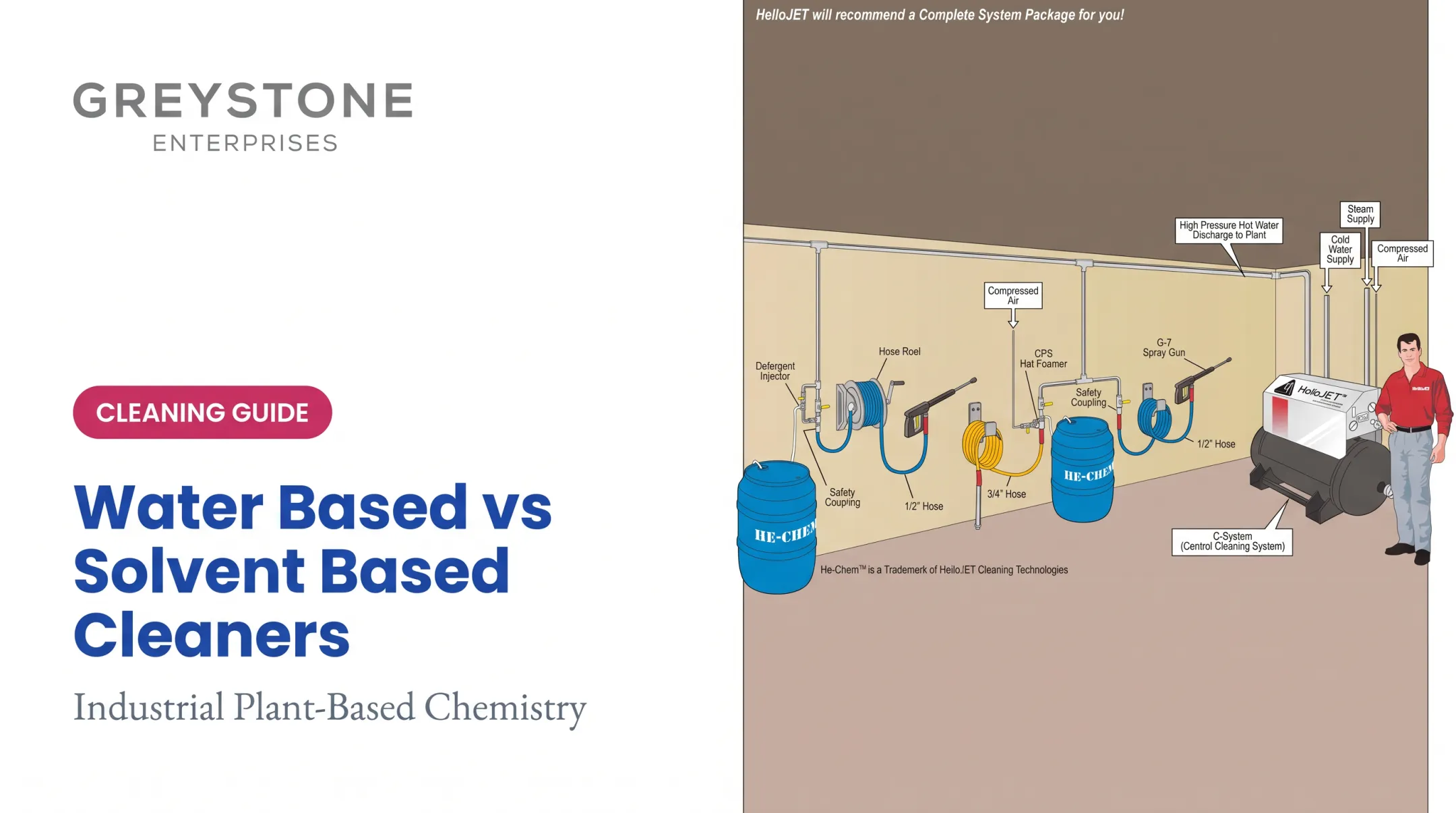
Greystone's approach pairs Tri-Solve plant-based chemistries with HelioJET high-pressure hot-water and steam systems. Tri-Solve EcoGel, for example, is a halogenated alkaline gel designed for complex organic soils and biofilms.
It suits spot cleaning and tank tidelines where longer contact helps, but it needs thorough rinsing. Not every Greystone product is formulated or approved for every biofilm application, so evaluate fit for your site.
Build a facility-specific checklist
- Suspected deposit and location
- Substrate and access method
- Temperature and pressure limits
- Required contact time and rinse needs
- Worker exposure and wastewater handling
- Verification method
- Expected downtime
How to Remove Biofilm Safely and Effectively
Confirm the problem and prepare the work area
Identify the equipment or zone and review earlier sanitation and test results. Isolate the area, protect adjacent operations, and decide whether production stops.
Follow label directions, SDS requirements, PPE rules, and ventilation needs. Where unexpected energization is possible, lockout/tagout applies (29 CFR 1910.147).
Remove gross soil first
Food residue, grease, scale, and fibers can shield biofilm. Use your approved pre-cleaning method: scraping, brushing, flushing, circulation, or controlled agitation.
FSIS cautions that high-pressure cleaning can splash contamination onto cleaned equipment or aerosolize it near exposed product.
Apply the cleaner under controlled conditions
Concentration, temperature, contact time, flow, pressure, and coverage all affect results. Follow the product and equipment instructions rather than a generic dose.
Common application methods include:
- Spray, foam, or gel
- Soak and recirculation
- CIP and tank washing
- High-pressure hot water
Target hard-to-reach areas
Biofilm often hides in places crews miss. Prioritize:
- Drains and floor channels
- Dead legs, valves, and gaskets
- Nozzles, tank interiors, and mixer parts
- Pipe interiors
For drains, remove trapped solids and flush thoroughly. Pouring chemical down the drain alone will not clear biofilm.
Rinse, recover, and manage wastewater
Flush detached biofilm, residue, and loosened soil using your approved rinse and recovery process. Gels in particular leave more residue than foams or liquids.
Handle collection, neutralization, and discharge according to the product, facility, and local rules.
Verify and document
- Inspect visually, then confirm with ATP, swab, microbiological, or residue testing.
- A clean look doesn't prove microbial control.
- Treat a failed result as a trigger for root-cause review and corrective cleaning.
A 2023 pilot study found standard CIP made planktonic cells undetectable but did not fully eliminate biofilm cells, which is why post-clean verification matters.

Adapt the process to complex facilities
Complex sites need an assessment that matches chemistry, hot water or steam, pressure, and access. Greystone works with facilities on plant-wide washdown, tanks and vessels, paper equipment, and heavy-equipment wash bays. Request product- and application-specific recommendations rather than assuming a blanket biofilm claim.
How to Prevent Biofilm From Returning
Control moisture, residue, and low-flow conditions
These conditions feed recurrence:
- Standing water and delayed drainage
- Dead legs and low turbulence
- Damaged surfaces and nutrient residue
Review equipment design, drainage, hose storage, spray coverage, piping, and cleaning access.
Dead-leg rules need care. ASME's 2013 branch leg study describes 6D as historical and cites work favoring L/D below 2. Do not treat 6D as a universal allowance.
Set a documented schedule
Document separate programs for:
- Routine cleaning and periodic deep cleaning
- Drain maintenance and CIP cycles
- Disassembly and targeted biofilm treatments
Base frequency on risk, residue, usage, environment, test results, and requirements. FDA, FSIS, and drug cGMP all point to hazard-dependent scheduling, not one fixed calendar.
Monitor and validate
Trend these signals over time:
- Verification results and recurring locations
- Failed events and downtime
- Chemical and water use, plus equipment condition
FDA's Listeria draft guidance suggests watching for repeated positives and increases at particular sites.
If biofilm keeps returning, bring in quality, maintenance, EHS, engineering, or an industrial cleaning specialist.
Include sustainability goals
Compare methods on:
- Water, chemical load, and energy use
- Wastewater and worker exposure
- Equipment life and downtime
Reported savings are system-specific. GEA, for example, reports up to 50,000 L saved per CIP cycle in large membrane plants.
Greystone's sustainability-focused approach pairs plant-based chemistry with hot-water systems. Measure your baseline first and validate any improvement.

Frequently Asked Questions
What is the most effective biofilm cleaner?
It depends on biofilm composition, surface, equipment, application method, and validation needs. Follow the label and facility procedures rather than looking for a universal best.
What is the best biofilm cleaner for drains?
Choose one that addresses organic buildup, reaches affected surfaces, and suits the drain system. Pair it with mechanical cleaning and flushing. Labels and wastewater rules control selection.
Is it possible to eliminate biofilm completely?
Established biofilm can often be removed or substantially reduced, but permanent elimination can't be assumed. A cooling-tower study documented recolonization from survivors. Rely on validated cleaning, design fixes, and prevention.
What is the difference between a biofilm cleaner and a disinfectant?
A cleaner physically removes soil and biofilm matrix. A disinfectant reduces or kills microbes. Many sanitation programs need both steps.
How often should industrial facilities use a biofilm remover?
Frequency depends on risk, process conditions, residue, equipment design, monitoring results, and industry requirements. Set the schedule through documented validation, not a generic interval.