
Introduction
Stainless steel resists corrosion and wipes clean more easily than most materials. It is not automatically sanitary, though. Residue hides on walls, welds, agitator shafts, fittings, gaskets, and connected piping.
Stainless steel tank cleaning is the controlled removal of product residue, mineral deposits, biofilm, and other contaminants. Sanitizing is a separate step that reduces microorganisms after the surface is clean.
This guide covers how to identify the residue, pick a method, follow a controlled sequence, protect your people and equipment, and confirm the tank is ready for production.
Key Takeaways
- The right program depends on residue, tank geometry, materials, and sanitation requirements.
- CIP, COP, manual, high-pressure hot-water, and steam cleaning each fit specific jobs.
- Validate chemical compatibility, coverage, and rinse quality, not just appearance.
- Written procedures and preventive inspection cut buildup and make changeovers more consistent.
What Makes Stainless Steel Tank Cleaning Effective?
Cleaning protects product quality, prevents cross-contamination, keeps equipment reliable, and limits unplanned downtime. That holds across food, beverage, chemical, coatings, adhesive, and pharmaceutical operations.
Under U.S. food rules, 21 CFR 117.40 requires equipment to be cleanable and maintained, and seams to be smooth enough to minimize soil buildup.
Identify the contaminants
Classify the soil before choosing chemistry:
- Organic: fats, proteins, sugars, product films
- Inorganic: mineral scale and salts
- Pigments, dyes, hardened coatings, or adhesives
- Microbial contamination and biofilm
UF/IFAS guidance notes that water-soluble soils include sugars and salts, acid-soluble soils include mineral deposits, and alkali-soluble soils include proteins and fats. Age matters too. Fresh soil comes off far more easily than dried or baked-on deposits, and heat can melt grease while still leaving a film behind.
Account for tank and system design
Coverage failures usually start with geometry. Look hard at:
- Tank bottoms, baffles, agitator shafts and blades
- Welds, ports, and manways
- Spray devices, valves, hoses, and filters
- Transfer lines and dead legs
Review the alloy, surface finish, weld quality, and gasket materials before settling on chemicals, pressure, or temperature. A cleaner that suits the shell may attack a seal.
Understand the cleaning variables
Chemistry, mechanical action, temperature, contact time, flow, and coverage work together. Raising one rarely rescues a poor spray pattern or the wrong chemical.
A rinse-water study on 304 stainless pipe found that higher flow velocity improved protein-residue removal, while a temperature increase from 45 to 67 °C (113 to 153 °F) added little at higher velocities. That is one study's conditions, not a tank recipe.
So test at your own facility and write down the procedure. No universal cycle exists.
Cleaning versus sanitizing
Cleaning removes soil. Sanitizing reduces microorganisms on a surface that is already clean, and leftover product film can undermine a sanitizer. Whether sanitizing is required depends on the product, process, and risk.
Human-food plants fall under 21 CFR Part 117, drug makers under 21 CFR 211.67, and meat and poultry under 9 CFR 416.4. Dairy has its own rules. These regimes are not interchangeable, and a chemical or coatings tank may follow none of them.
How to Clean a Stainless Steel Tank Step by Step
Prepare the tank and work area
- Empty and drain the tank, then depressurize it.
- Isolate equipment and apply lockout/tagout so agitators, pumps, and heaters cannot start. OSHA's 1910.147 standard requires an energy-control program for servicing.
- Inspect the interior, exterior, access points, spray devices, gaskets, valves, and lines.
- Note unusual buildup, pitting, corrosion, damage, or blocked nozzles before you start.
Pre-rinse
A pre-rinse softens and removes loose product. Pick water temperature and pressure to suit the residue and equipment limits. Keep residue from spreading into adjoining lines, drains, or clean areas, and collect wastewater according to site procedure.
Apply the cleaning chemistry
Alkaline cleaners generally suit organic soils such as proteins and fats. Acid cleaners address mineral scale. Whichever you choose must be compatible with the alloy, finish, seals, and gaskets.
Follow the label and Safety Data Sheet for dilution, temperature, contact time, and ventilation. Don't borrow concentrations from another plant. For tough organic soils and biofilm, an alkaline gel such as Tri-Solve EcoGel can help. Rinse it thoroughly afterward.
Provide mechanical action and coverage
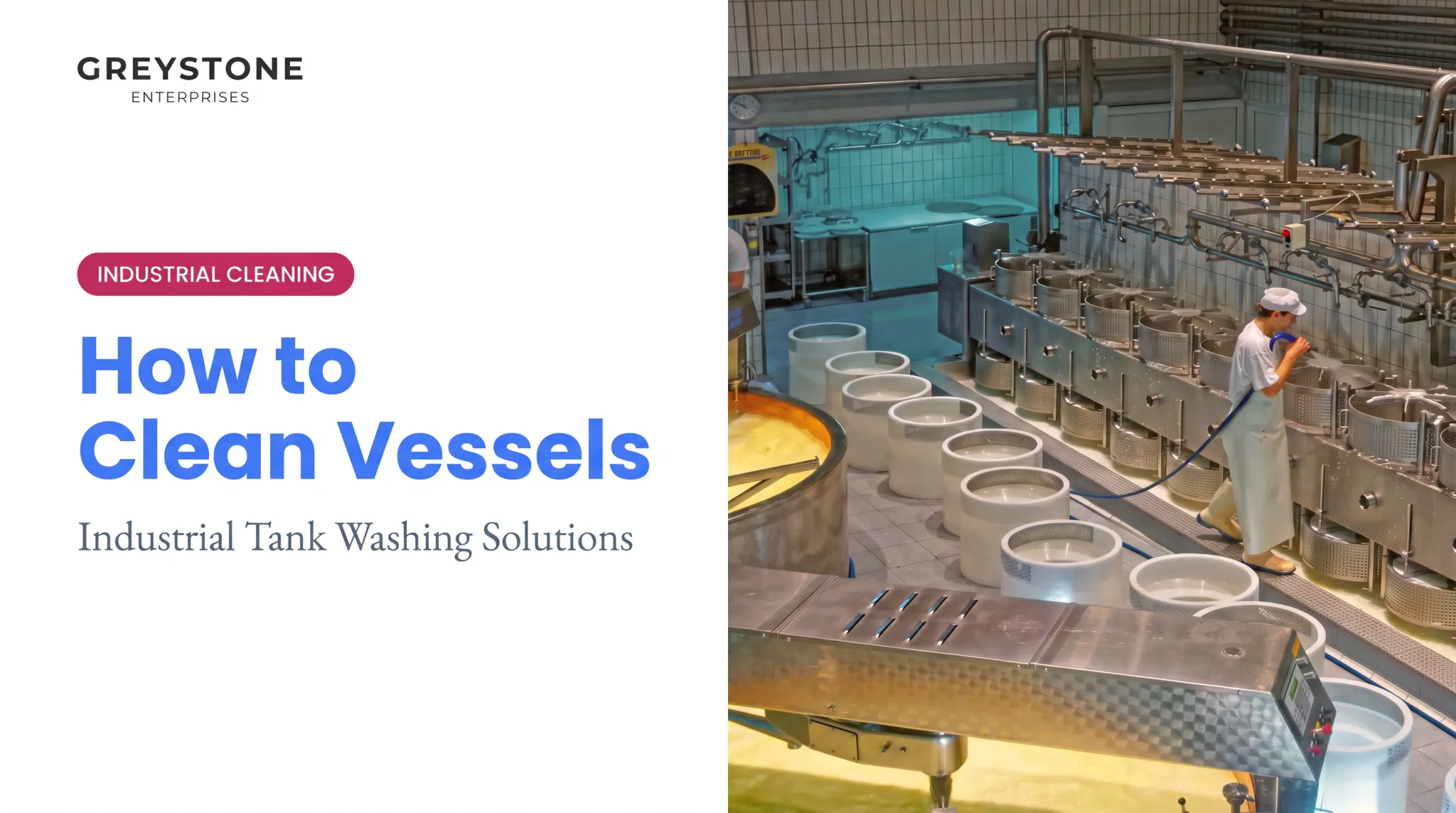
Spray balls, rotary heads, internal tank washers, hot water, steam, brushes, or pads all supply mechanical action. Match the tool to tank size, access, and soil.
Give extra attention to:
- Corners and weld seams
- Agitators, baffles, and bottoms
- Manways, outlet valves, and areas behind removable parts
A riboflavin and UV test can show coverage gaps: coat the vessel, rinse, and look for remaining fluorescence. It tests spray reach, not microbial absence.
Rinse and neutralize
Rinse thoroughly after each chemical stage. Some validated programs add an acid or neutralizing step to remove alkaline film or scale. Check rinse quality with your approved indicators, such as pH, conductivity, or visual inspection, before moving on.
Sanitize, dry, and release
Where sanitizing is needed, follow the registered product label for dilution, wetting, and contact time. EPA label guidance calls for at least one minute of contact. Sanitizing a visibly dirty tank never replaces cleaning.
Then drain and dry, reassemble, protect against recontamination, and complete required testing, documentation, and supervisor approval.

How to Choose Between CIP, COP, and High-Pressure Cleaning
Clean-in-place for fixed systems
CIP cleans tanks, piping, and pumps without routine disassembly. A typical sequence runs pre-rinse, caustic wash, rinse, acid rinse, sanitize, and post-rinse, but each cycle should be designed for the soil and equipment.
An automated cycle only works where the solution reaches. Verify spray-device placement, flow, return coverage, temperature, concentration, and cycle time.
Clean-out-of-place and manual cleaning
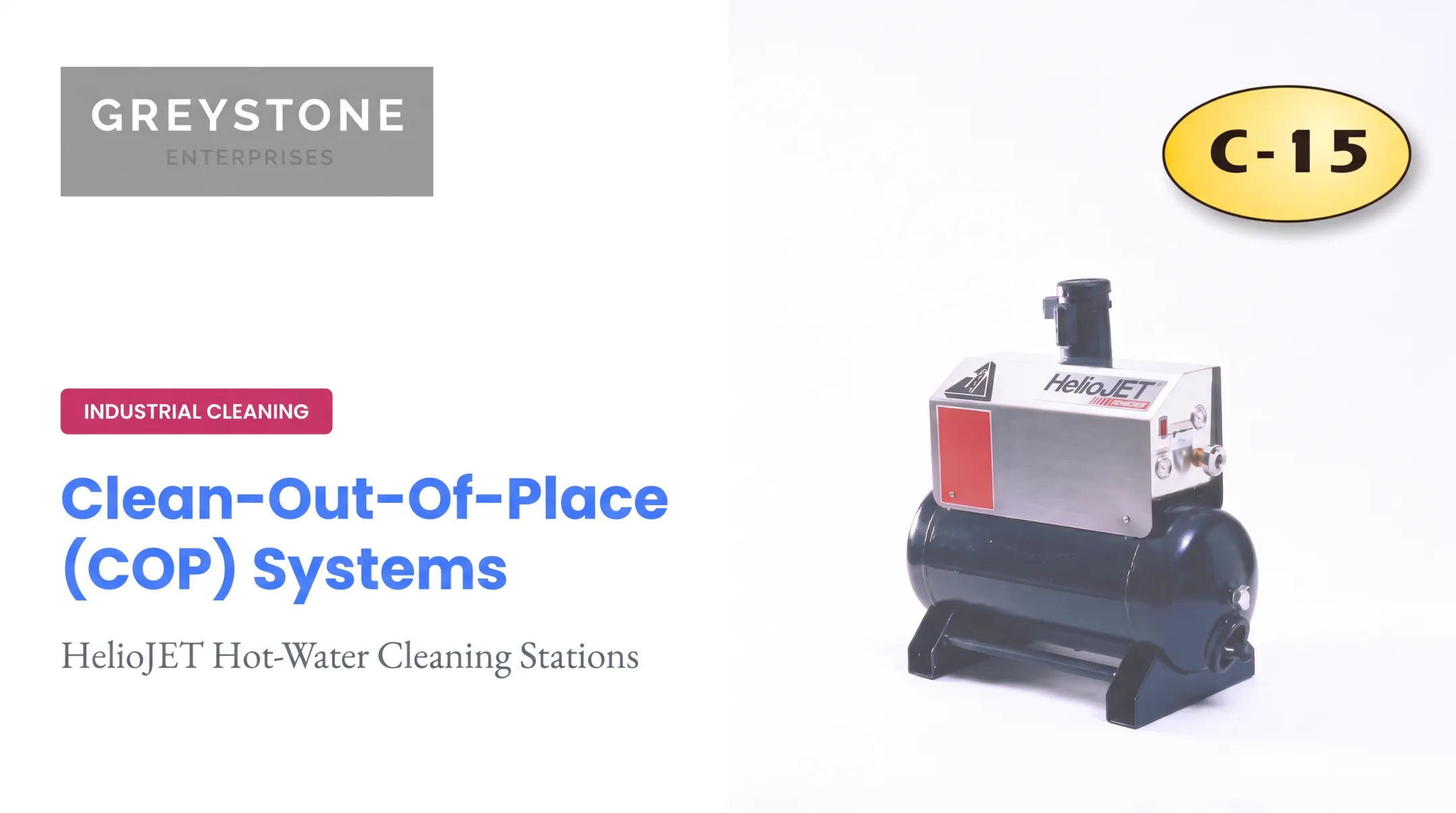
COP removes impellers, shafts, nozzles, gaskets, hoses, screens, and small fittings for cleaning and inspection in a wash area. Manual scrubbing helps with hardened, sticky, fragile, or hard-to-reach residue.
Tag removed parts, clean and inspect them, sanitize when required, and reassemble correctly.
High-pressure hot water and steam
| Method | Best for | Watch for |
|---|---|---|
| High-pressure water | Stuck-on deposits, large tanks | Splash, aerosols, surface limits |
| Heated water | Greasy or fatty films | Heat can leave residue behind |
| Steam | Thermal sanitizing, melting grease | Operator exposure, material limits |
FSIS guidance warns that splash and aerosols can carry bacteria onto cleaned equipment. Internal tank-washing heads improve coverage in large vessels, provided pressure and temperature stay within equipment limits.
Choose by actual need
Match the method to your operation. Key factors include:
- Tank volume and tank count
- Changeover frequency and allowable downtime
- Product viscosity and residue hardness
- Labor and wastewater capacity
- Required sanitation assurance
Many plants blend methods: CIP for fixed systems, COP or targeted high-pressure cleaning for removable parts and problem spots.
Where Greystone may fit
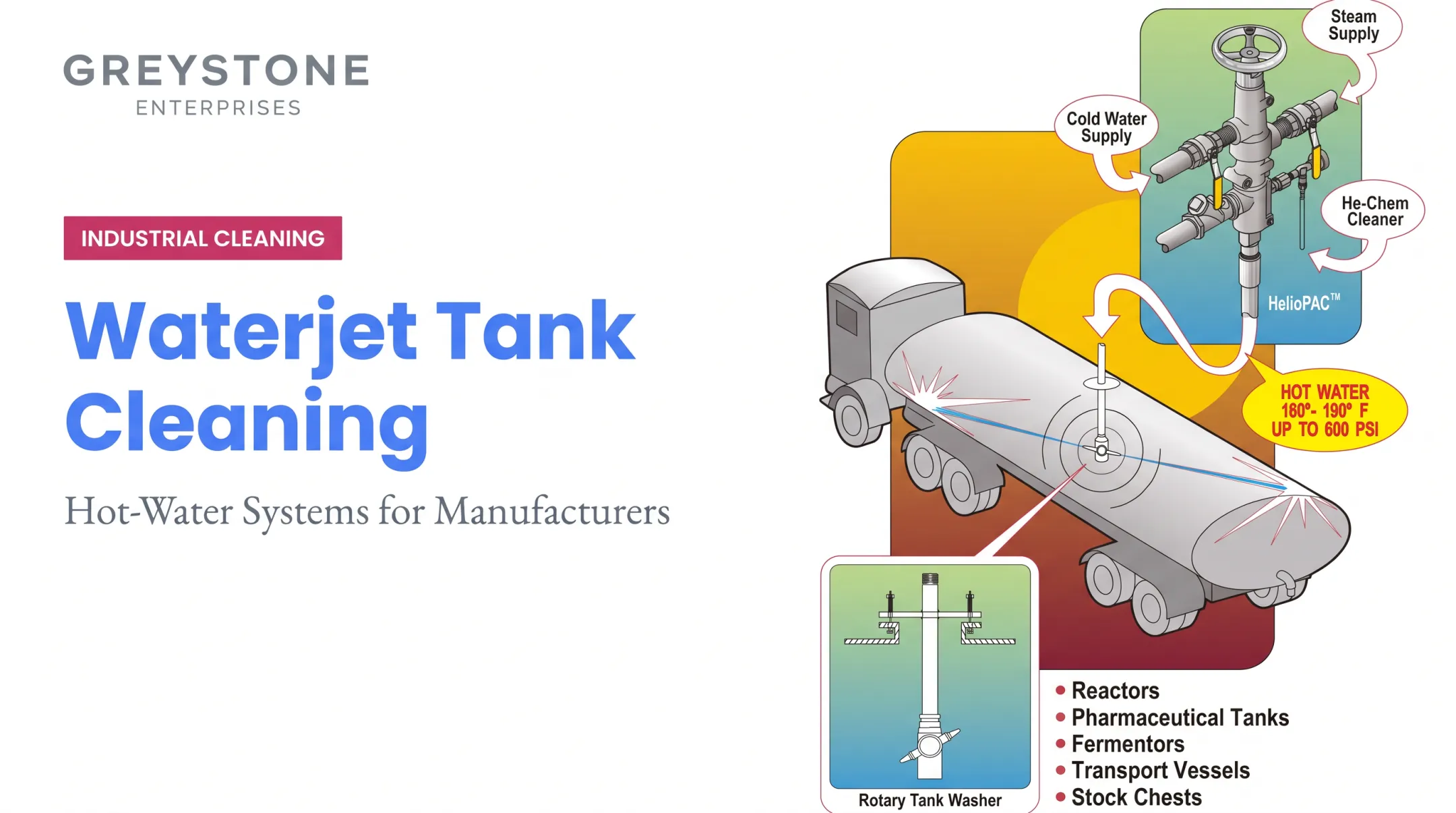
Greystone works with process plants that have tanks, vessels, and mixers. Its approach pairs HelioJET high-pressure hot-water and steam equipment, including interior tank washers with rotary heads, with Tri-Solve plant-based chemistries. Rotary tank washing cycles typically run about 15 minutes, and extreme cases may need more than one.
Selection should follow an application assessment, a compatibility review, testing, and a documented procedure. Greystone also offers a trial tank wash starter kit tailored to the application. Match the kit and procedure to the soil and equipment rather than treating any single approach as universal.

Safety, Chemical Compatibility, and Environmental Controls
Protect workers
- Apply lockout/tagout before any servicing
- Wear chemical-resistant PPE and eye/face protection selected from an OSHA PPE hazard assessment
- Ventilate the area and control slip and electrical hazards
- Follow procedures for hot water, steam, and chemical solutions
- Keep SDS accessible and train workers on hazard communication
Tank entry is never routine. If entry is even being considered, evaluate the space under OSHA's confined-space rules, test the atmosphere, issue a permit, and plan for rescue.
Prevent damage and incompatibility
These practices can damage stainless steel, welds, seals, and connected equipment:
- Abrasive tools and excessive pressure
- Unsuitable acids, alkalis, or chlorides
- Incompatible sanitizers and improper mixing
Chloride in particular can break down the passive film and cause localized pitting, depending on grade and conditions.
Before changing a product, concentration, temperature, or piece of equipment, consult the tank manufacturer, chemical supplier, SDS, and your engineering or EHS staff.
Manage water, chemicals, and wastewater
Optimized cycles, proper maintenance, and reuse where permitted can cut water, chemical, and energy use without weakening validated cleaning. In a 2024 dairy case study, adaptive cleaning devices on one 3,000-liter tank cut cleaning time by 32%. The authors caution that other applications need their own analysis.
Wastewater rules are local. Under federal pretreatment rules, discharges to a municipal treatment plant can't be corrosive, and pH can't fall below 5.0 unless the plant is designed for it.
Many plants set stricter limits. Confirm collection, neutralization, discharge, storage, and disposal requirements with your local pretreatment authority and site procedures.
How to Verify Cleanliness and Maintain the Tank
Verify before release
Inspect walls, bottoms, welds, ports, agitators, spray devices, gaskets, valves, hoses, and piping. Visual cleanliness alone may not be enough for higher-risk processes.
Add tools suited to your risk profile:
- ATP testing, which detects organic matter, not specific bacteria or allergens
- Microbial swabs, which take days but measure microbes directly
- Allergen-specific tests where cross-contact matters
- Rinse sampling, pH, or conductivity checks
In pharmaceutical work, FDA guidance states that rinse samples alone are not acceptable when direct surface measurement is feasible. A non-detect also means below the method's limit, not zero residue.
Document and improve
Record for every cleaning:
- Tank or line, date, and operator
- Previous product and cleaning method
- Chemical identity and cycle parameters
- Inspections, test results, and deviations
- Corrective actions and release approval
Trend review exposes recurring residue, blocked spray devices, poor drainage, high water use, or failed sanitation results. With rotary washers, a plugged discharge nozzle is a common cause of system faults, so check nozzles routinely.

Build in preventive maintenance
Inspect regularly for:
- Corrosion, pitting, and rough welds
- Damaged gaskets, worn seals, and blocked nozzles
- Weak points in agitators, valves, pumps, hoses, and filters
- Hard-to-drain areas that can hold residue
Set frequencies by product risk, changeover schedule, residue behavior, equipment condition, and validated procedures, not a single interval.
Frequently Asked Questions
What is the best way to clean a stainless steel tank?
It depends on the residue, tank design, materials, and sanitation needs. The best method is whichever of CIP, COP, manual, high-pressure, hot-water, or steam cleaning gives validated coverage.
Can you use high-pressure water to clean a stainless steel tank?
Yes, often with good results on stuck deposits. Limits include surface and equipment ratings, operator safety, aerosols, drainage, and reaching every internal area.
What chemicals are used to clean stainless steel tanks?
Alkaline, acidic, enzymatic, and specialty chemistries each target different soils. Selection must account for stainless steel, seals, gaskets, product requirements, and SDS directions.
How often should stainless steel tanks be cleaned?
Regulations generally say "as frequently as necessary." Frequency depends on product, changeovers, residue buildup, microbial risk, and inspection or test results.
What is the difference between cleaning and sanitizing a stainless steel tank?
Cleaning physically removes soil. Sanitizing reduces microorganisms and should follow effective cleaning when the process requires it.
When should a tank use CIP instead of manual or COP cleaning?
Fixed, frequently used systems benefit from repeatable CIP. Removable components, stubborn residues, and inaccessible areas may need COP or targeted manual cleaning.