
Introduction
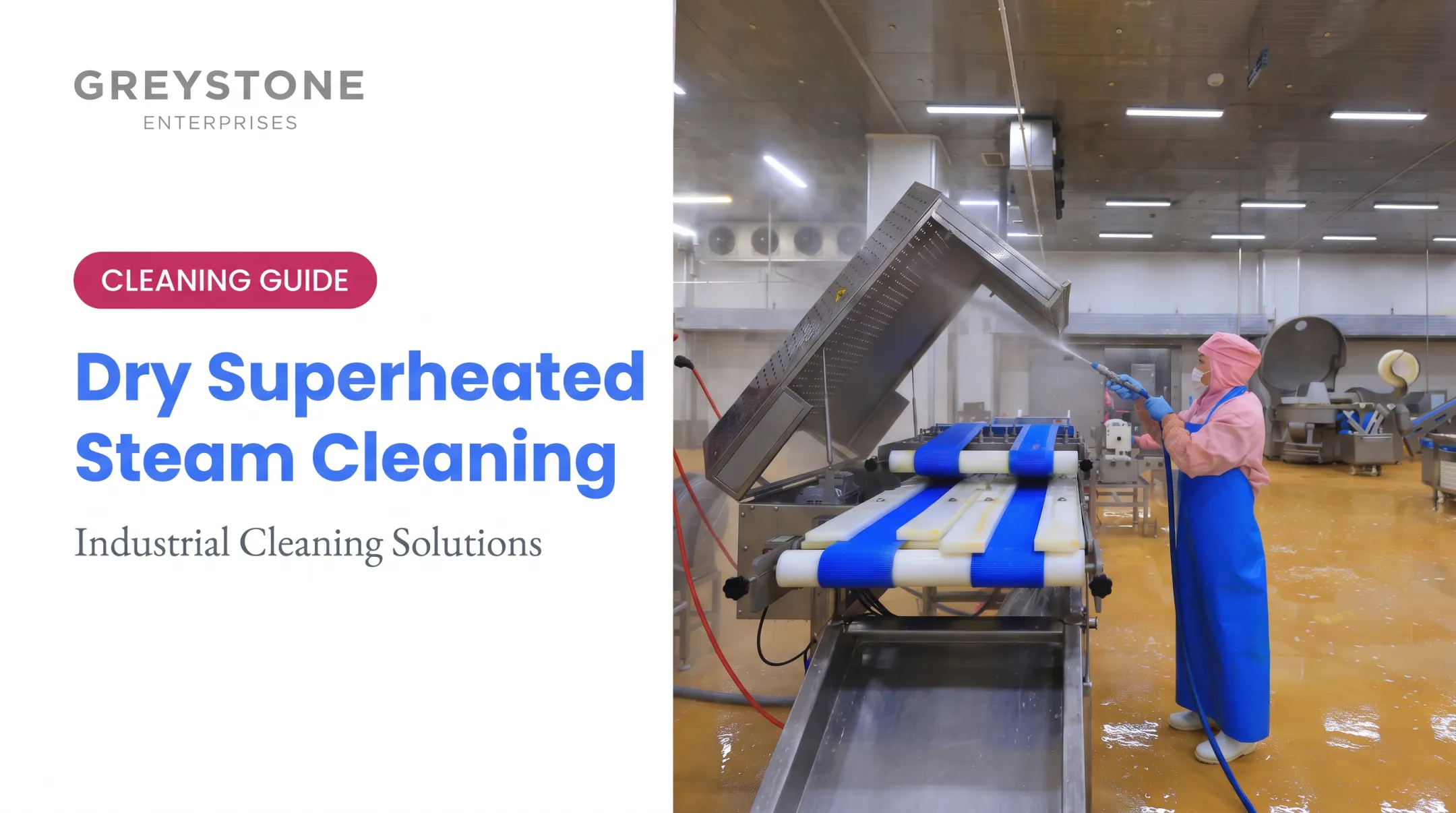
Steam looks like an easy answer for industrial sanitation. It delivers heat and moisture, adds mechanical force, and can cut back on conventional chemical applications.
But pointing a wand at a dirty surface isn't sanitizing. Results depend on pre-cleaning, surface temperature, exposure time, coverage, equipment settings, and the standard your facility must meet.
Coverage is the usual failure point. A 2025 study found that manual operation of commercial superheated-steam units limited surface efficacy, with a highest average reduction of 3.6 ± 1.3 log CFU/cm² across 24 trained operators.
This guide covers definitions, preparation, application steps, surface selection, worker safety, verification, documentation, and common mistakes.
Key Takeaways
- Steam sanitizes only when the actual surface reaches the required conditions.
- Remove soil, grease, protein, and biofilm first. Debris shields microorganisms.
- Follow manufacturer instructions, your SSOPs, and US regulatory guidance, not a universal temperature or time.
- Pair steam with worker protection, verification, drying, and records.
What Steam Sanitizing Means, and What It Does Not
Cleaning, sanitizing, disinfecting, and sterilizing are different outcomes
Don't use these terms interchangeably.
- Cleaning: removing soil and residues, usually with water and detergents.
- Sanitizing: under 21 CFR 117.3, treating cleaned surfaces to kill vegetative pathogen cells and substantially reduce other undesirable microorganisms. The FDA Food Code benchmark is a 5-log (99.999%) reduction.
- Disinfecting: eliminating many or all pathogenic microorganisms on inanimate objects, except bacterial spores.
- Sterilizing: destroying all forms of microbial life through a validated process.
Steam can serve more than one of these goals. Any formal claim should cite the applicable US standard, product label, or facility requirement.
How heat and steam affect contaminated surfaces
Saturated steam releases substantial latent heat when it condenses on a surface. That heat, plus moisture and mechanical action, loosens soils and stresses microorganisms. What matters is the condition at the target surface, not the temperature shown on the machine.
Variables that change the outcome:
- Surface temperature and dwell time
- Nozzle distance, steam flow, and pressure
- Surface geometry and soil load
- Material type
- Whether the operator achieves full coverage
The 2025 study above found surface temperature dropped with greater surface thickness and distance from the impingement point. Heat reaches a small area, and everything outside it gets less heat.
Published numbers belong to their own processes. The Food Code calls for 171°F immersion for at least 30 seconds in manual warewashing. The Grade A PMO specifies 170°F for at least 5 minutes for milk-contact equipment immersion. Neither is an open steam-wand exposure time.

Pre-cleaning is a required part of the process
Steam shouldn't be a shortcut on heavily soiled equipment. UF/IFAS notes that organic matter can dramatically reduce sanitizer activity, and biofilms in crevices block direct contact.
Different soils need different pre-cleaning:
- Grease and oils: alkaline detergents with emulsifying ingredients, or a compatible degreaser
- Proteins: highly alkaline, peptizing formulations
- Deposits and tank tidelines: an acid or alkaline gel matched to the deposit
- Biofilm: mechanical action plus detergent, then sanitizing
FDA's 2017 draft Listeria guidance lists a seven-step sequence:
- Dry clean
- Pre-rinse
- Soap and scour
- Post-rinse
- Prepare for inspection
- Pre-op inspection
- Sanitize and assemble
Some hot-water and steam systems can clean and sanitize at once, but cleaning generally comes first.
How to Steam Sanitize: A Step-by-Step Process
1. Plan the task and inspect the equipment
Define the sanitation objective, target surfaces, contamination risks, production restrictions, and drainage needs. Pull the equipment manual and your SSOP.
Then inspect:
- Hoses, fittings, and nozzles
- Pressure controls and temperature monitors
- Guards and electrical connections
Remove damaged equipment from service. Never run a unit with defective or leaky hoses or fittings.
2. Prepare the area and protect workers
- Isolate the work zone and keep unnecessary people out
- Ventilate and manage condensation and visibility
- Protect nearby electrical components
- Control slip hazards with drainage
- Assess PPE for scalding, hot condensate, pressure release, and chemical residues
Face shield, wet suit, boots, and gloves are typical for hot-water and steam wash stations. Confined spaces and elevated work need their own controls.
3. Pre-clean and set up tools
Remove loose debris, apply approved chemistry if needed, rinse, and confirm the surface is ready. Then match the tools to the job. Nozzle size, hose length, and extensions determine whether you can reach seams, joints, undersides, and shadowed areas.
Use the specified nozzle. On Greystone's LittleJET units, an oversized nozzle reduces pressure output, and an undersized one causes continuous overflow.
4. Apply steam systematically
- Hold the manufacturer-recommended nozzle distance
- Use deliberate, overlapping passes
- Treat seams, crevices, and corners individually
- Move slowly enough that the surface actually reaches the required condition
No single exposure time fits every object. Use validated parameters for your equipment, surface, organism of concern, and standard.
5. Finish and prevent recontamination
Remove pooled condensate, allow drying, restore guards and connections, and inspect the area. Keep people, tools, and dirty water from recontaminating clean surfaces. Low-moisture food areas under 21 CFR 117.35 must be thoroughly dried before reuse.
Record each run:
- Date, operator, settings, and target area
- Chemistry used
- Issues, verification results, and corrective actions
- Release decision

Choosing the Right Steam Approach for the Surface and Facility
Match steam treatment to material compatibility
Check each material before exposing it to heat and moisture.
| Material | Consideration |
|---|---|
| Stainless steel | Preferred food-equipment surface, but check assembled seals and components |
| EPDM seals | Long life in hot water and steam, per Trelleborg |
| Silicone gaskets | Can degrade in steam above 212°F, despite a higher dry rating |
| Plastics and coatings | Heat can damage them; confirm with the manufacturer |
| Electrical enclosures | NEMA 4X is not a steam rating; check product specs |
Get manufacturer approval and test a small area where appropriate. Thermal shock, trapped moisture, softened coatings, corrosion, and water intrusion are the usual damage risks.
Industrial applications where steam may support sanitation
The endpoint differs by setting:
- Dairy: PMO specifies hot-water sanitation, plus a steam method for assembled piping
- Pharmaceutical: SIP of equipment and piping requires validated cycles
- Tanks and mixers: documented cleaning between batches
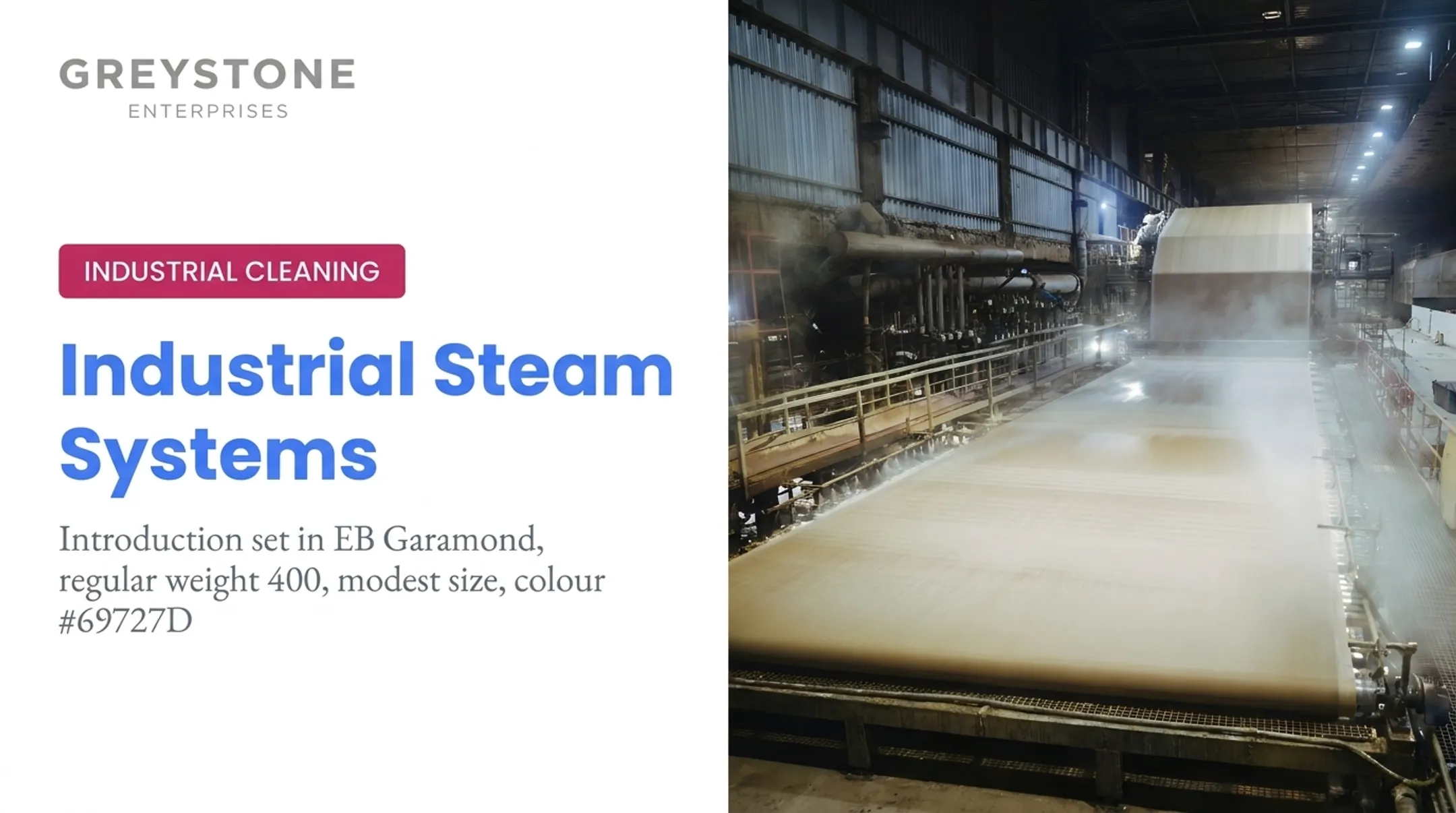
- Paper mills: deposit and fabric cleaning
- Fleet bays: soil removal plus washwater containment
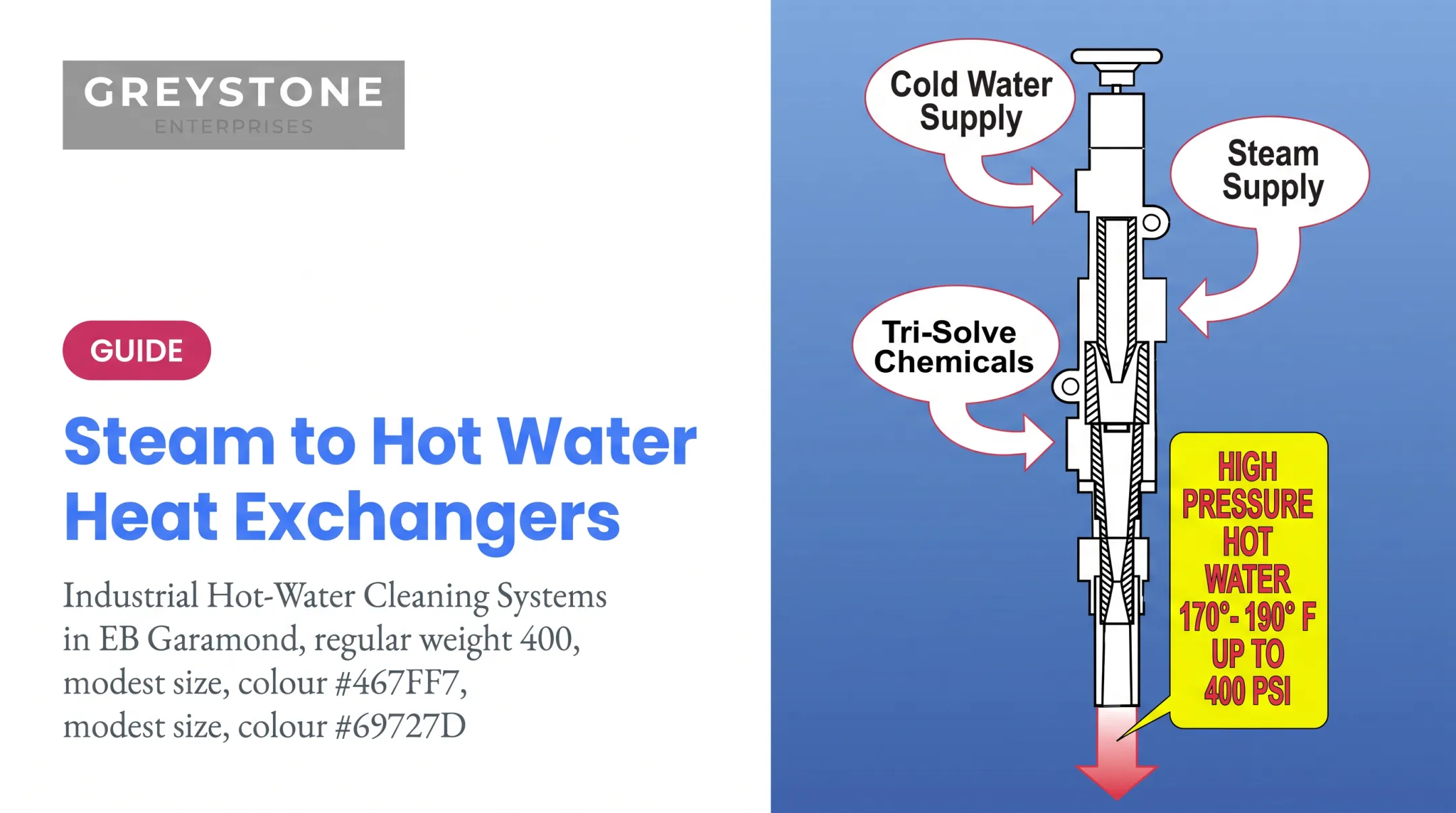
Greystone's HelioJET technology combines steam and cold water into high-pressure hot water, for example up to 350 PSI at 180°F. Evaluate it for centralized multi-drop systems or difficult applications. Tri-Solve plant-based chemistries can support soil removal when compatible with your materials, process, and sanitation requirements.
Know when steam alone is not the right method
Steam may fall short on:
- Porous materials
- Deeply embedded contamination
- Inaccessible internal surfaces
- Heat-sensitive equipment
- Heavy chemical residues
- Processes needing an approved disinfectant or sterilant
Document a decision process for combining steam with chemistry, mechanical action, rinsing, or another validated method. More pressure or longer steaming rarely fixes the underlying problem.
Safety, Compliance, and Verification
Control the main hazards
Steam cleaning poses risks of burns, scalds, high-pressure injection, hot condensate, whipping hoses, slippery floors, poor visibility, noise, and chemical exposure. Relevant OSHA standards include:
- 1910.132: hazard assessment and PPE
- 1910.147: lockout/tagout, including residual energy
- 1910.146: permit-required confined spaces
- 1910.22: drainage and walking surfaces in wet processes
- 1910.95: noise, with an 85 dBA action level
- 1910.1200: hazard communication for detergents and descalers
Lock out steam and water supplies before cleaning, changing, or removing nozzles. Follow manufacturer limits, such as HelioPAC's ban on inlet pressures above 250 psi.
Align with your compliance program
Fit steam sanitizing into your SSOPs, preventive maintenance, allergen controls, and quality systems. Requirements vary by facility:
- FDA 21 CFR 117: sanitation controls need records, corrective actions, and verification
- USDA FSIS 9 CFR 416: daily SSOP monitoring, with records kept at least 6 months
- 21 CFR 211.67: written cleaning procedures and records for pharmaceutical equipment
Confirm current FDA, USDA, EPA, and state requirements for your facility type, especially for antimicrobial claims.
Verify process conditions and results
Document what matters at the surface: temperature, exposure time, nozzle distance, settings, and coverage. Use calibrated instruments. A machine's discharge gauge shows output temperature, not surface temperature.
HelioJET systems, for example, typically read 150–170°F at discharge.
Verification options:
- Visual inspection: catches missed soil
- ATP testing: a fast read on organic residue, not a microorganism count, and detergents can interfere
- Swabs or sponges: microbiological sampling, with periodic testing alongside ATP
- Facility-approved methods: with defined acceptance criteria
Respond to failed verification
Document the failure, assign corrective action, and decide whether to reclean, resanitize, or escalate. Capture issues such as:
- Missed areas
- Low temperature or dwell time
- Damaged surfaces
- Recurring soil
- Positive results
- Equipment faults
Verification builds confidence but doesn't replace validation, training, maintenance, or periodic SOP review.

Common Mistakes and Equipment Maintenance
Even solid steam programs slip when technique or upkeep is off. Common mistakes include:
- Steaming visibly dirty surfaces
- Moving the nozzle too fast
- Skipping shadowed areas
- Using excessive pressure
- Assuming all microorganisms respond to heat the same way
- Improvising with unapproved chemicals, attachments, damaged hoses, or settings beyond manufacturer limits
Chemical compatibility matters too. LittleJET hoses suit alkaline cleaners but not solvent cleaners or hydrochloric acid.
Pair good technique with routine maintenance:
- Descale mineral buildup (LittleJET: every six months; a Goodway dry-steam manual says 6–12 months)
- Inspect hoses and seals
- Clean nozzles; plugged tips trigger caution lights, and worn ones lose pressure
- Check pressure and temperature controls
- Drain equipment as directed
- Keep service records
Retrain operators and review the SOP when equipment, materials, soil conditions, regulations, or verification results change.
Frequently Asked Questions
Can you sanitize with steam?
Yes, when the surface receives validated heat exposure and full coverage. Steam isn't automatically equivalent to disinfection or sterilization.
How long do you have to steam something to sanitize it?
There's no universal duration. It depends on surface temperature, equipment instructions, contamination risk, and the validated procedure.
What is the difference between steam cleaning and steam sanitizing?
Cleaning removes soil. Sanitizing reduces microorganisms on a cleaned surface. Pre-cleaning and verification connect the two.
Do you need to clean a surface before steam sanitizing it?
Generally yes. Grease, proteins, deposits, and biofilm shield contamination, so follow your approved cleaning sequence first.
What surfaces should not be steam sanitized?
Heat-sensitive, porous, moisture-sensitive, electrically vulnerable, or coated materials may be unsuitable. Check manufacturer instructions first.
How do you verify that steam sanitizing worked?
Record process conditions, then use visual inspection, ATP or swabs, and microbiological testing where appropriate. Judge results against facility acceptance criteria.