
Waterjet tank cleaning is the controlled use of high-pressure water, suitable nozzles, and recovery methods to clean industrial tanks, vessels, and mixers. This guide is for US industrial facilities, not household water tanks or sewer lines.
Key Takeaways
- Match the method to the tank and the residue, not to a default pressure.
- Higher pressure isn't automatically better; flow, temperature, coverage, and chemistry matter too.
- Plan wastewater and solids handling before the first jet fires.
- Cleaning frequency follows use and risk, not a universal calendar.
What Is Waterjet Tank Cleaning?
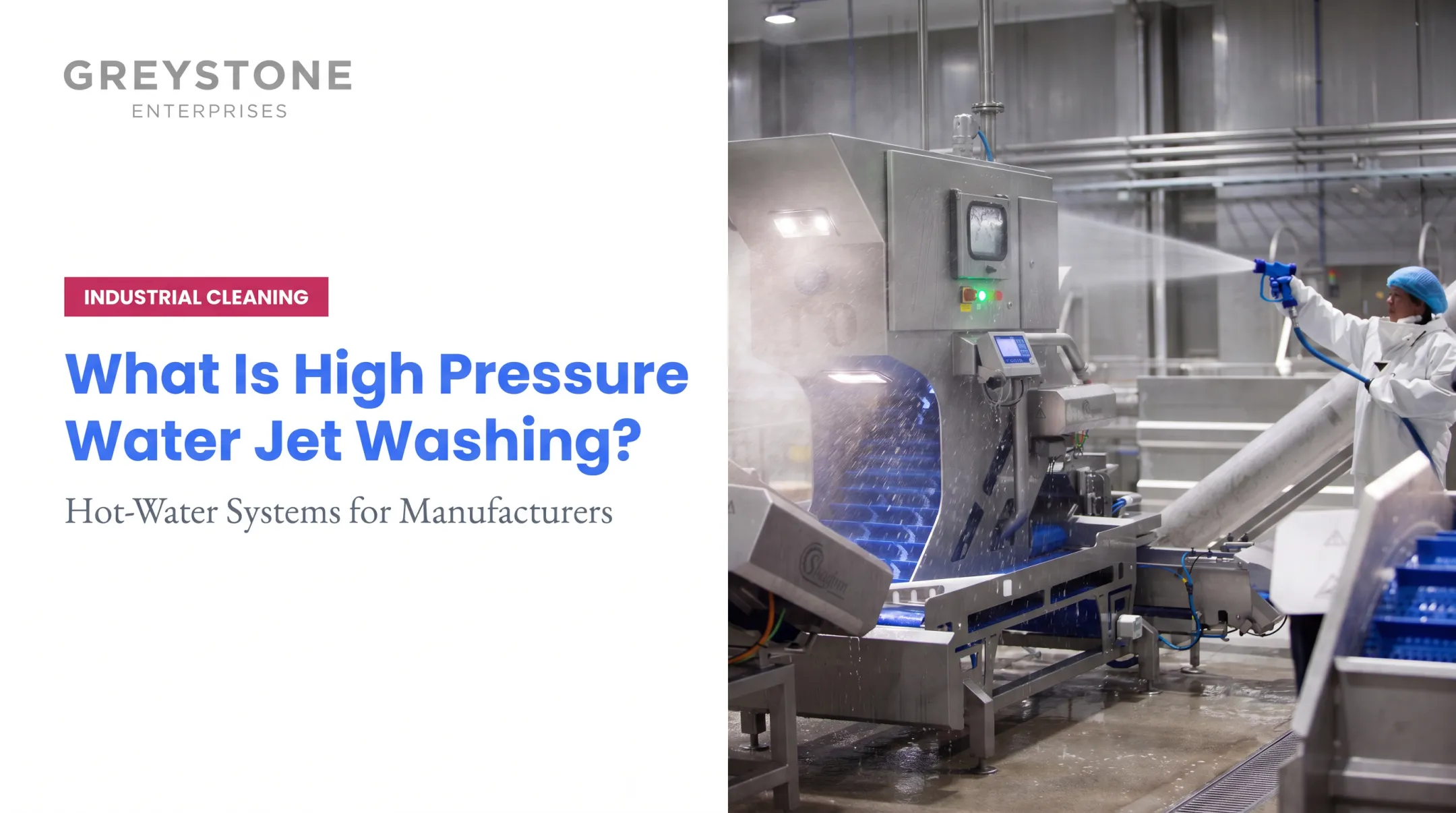
Waterjet cleaning uses hydraulic impact, spray coverage, flow, and controlled nozzle movement to loosen deposits from walls, welds, corners, agitators, and other hard-to-reach surfaces. Rotary jet heads, for example, use pressure and flow to create impinging jets in a rotating pattern, according to Alfa Laval's brochure.
Pressure terms vary. The WJTA's 2021 best practices define "high pressure" as 5,000 psi or greater, though it notes that high flow or job-site hazards can warrant the same precautions at lower pressures. Plenty of effective tank cleaning happens well below that line.
How it differs from other jetting work
Industrial tank cleaning is not sewer jetting, jet-vac tanker work, or residential tank washing. Industrial jobs may involve:
- Product isolation
- Residue identification
- Wastewater recovery
- Cleaning verification
What drives method selection
- Tank material and coatings
- Vessel size, access ports, and internal geometry
- Residue composition and product sensitivity
- Required cleanliness level
- Water availability
- Allowable downtime
How the Waterjet Tank Cleaning Process Works
No single sequence is required, but a sound job follows these stages.
- Assess and plan. Document tank construction, internal fittings, access points, previous contents, SDS information, drain and recovery arrangements, and the cleanliness standard. Ask whether entry can be avoided.
- Isolate and prepare. Shut down connected systems, apply lockout/tagout where the task calls for it, control product and utility lines, drain or recover contents, and set up containment.
- Select equipment and parameters. Evaluate pressure, flow, nozzle pattern, lance or automated head, coverage, temperature, and compatibility with tank materials.
- Clean, rinse, and recover. Work jets across walls, floors, roofs, fittings, and mixing components. Collect loosened residue and water so debris doesn't redistribute.
- Inspect and verify. Examine hard-to-reach areas, confirm residue and chemical remnants are gone, document before and after, and get approval before production resumes.

How you set pressure, heat, chemistry, and time determines how well those stages work.
Choosing parameters
GEA frames cleaning around Sinner's Circle: mechanical action, temperature, cleaning agent, and time. Change one and the others shift. That's why maximum pressure is rarely the answer.
Greystone's HelioJET system is one option for matching those parameters. A HelioPAC rotary tank washer supplies hot water at 160°–190°F and up to 600 psi. The rotary washer travels on two axes to cover the interior. Most tanks clean in 6–12 minutes, and the automated setup works without anyone entering the tank.
Where residue, sanitation requirements, and material compatibility support it, the system can be paired with Tri-Solve plant-based chemistries such as AlkaGel or EcoGel for tank tidelines and biofilms. These gels need thorough rinsing, since residue is more likely to remain than with foam or liquid cleaners. This is a facility-specific option, not a one-size-fits-all answer.
Why Facilities Use Waterjet Tank Cleaning
Common users include food and beverage, chemical, coatings, adhesives, pharmaceutical, and energy plants. Typical triggers:
- Batch changeovers
- Hardened product removal
- Sanitation work
- Maintenance shutdowns
- Unexpected buildup
Operational and sustainability benefits
Controlled jetting reaches complex geometries and gives repeatable coverage. Published results come mostly from food and beverage equipment makers, so treat them as case-specific, not guaranteed:
- An Alfa Laval case study at an ice-cream plant replaced 23 static spray balls with rotary jet heads and reported about 2.6 million gallons less CIP water and payback in under six months.
- GEA reported savings of more than 13,700 gallons of water at a brewery after changing tank cleaners.
Water temperature, flow control, chemistry choice, and wastewater handling all affect the footprint. These are manufacturer-published figures, not independent trials. Chemical, coatings, and pharmaceutical tanks rarely publish comparable water-savings data, so base expectations on a site-specific trial rather than food-and-beverage case studies.

Alternatives and limits
- Manual lance work: flexible, but puts operators close to the jet.
- Automated heads: repeatable coverage with less exposure.
- Mechanical tools: suit aggressive or thick soils that won't dissolve in liquid alone.
- Chemical-only cleaning: works for dissolvable soils with long contact time.
- Manual entry: sometimes unavoidable, but it adds confined-space burden.
Waterjetting can fall short with fragile materials, hazardous residues, restricted water handling, or insufficient access.
Safety, Environmental Handling, and Compliance
High-pressure hazards
Injection injuries are the headline risk. A clinical review notes the puncture can be small and easy to underestimate. Other hazards include hose whip, uncontrolled spray, flying debris, slips, noise, and aerosols.
WJTA practice calls for:
- Guns with a dump system or dry shutoff, trigger guard, and interlock (never wedge the trigger)
- Barriers or adequate operator separation
- Lockout of nearby agitators unless movement is required
- Hose inspection and pressure-rated hardware
- Trained operators and an emergency plan
Noise matters too. OSHA's action level is 85 dBA over an 8-hour average.
Confined spaces and isolation
Evaluate whether the tank is a permit-required confined space. If entry is required, follow OSHA 1910.146:
- Test oxygen, then combustibles, then toxics
- Provide an attendant and confirm rescue availability
- Coordinate host and contractor duties
Automated cleaning often avoids entry entirely.
Verify product and utility isolation, keep SDSs accessible, and prevent incompatible reactions. Confirm that coatings, seals, and welds tolerate the selected temperature, pressure, and chemistry.
HelioJET guidance also caps HelioPAC inlet pressure at 150 to 160 psig and requires rated hoses with a 9-inch minimum bend radius.

Wastewater and solids
- Discharge to waters of the US requires NPDES authorization
- Discharge to a sanitary sewer needs POTW approval; 40 CFR 403.5 prohibits corrosive, flammable, or heat-inhibiting discharges
- Generators must make a hazardous-waste determination under 40 CFR 262.11; don't assume sludge is nonhazardous
- Check federal, state, and local transport and disposal rules before work starts
Documentation and verification
Keep work permits, equipment and chemistry records, inspection results, corrective actions, and sign-off. Drug manufacturers must follow 21 CFR 211.67, and food facilities 21 CFR 117.35.
Routine cleaning differs from validated cleaning. FDA says rinse samples alone don't support validation, and direct surface sampling is preferred where feasible.
Choosing the Right Waterjet Tank Cleaning Approach
Decision factors
- Tank capacity and geometry
- Access points and internal components
- Residue hardness and tank material
- Required cleanliness level
- Water, steam, and power availability
- Wastewater infrastructure
- Production window
- Recurring or one-time recovery
Method trade-offs
| Approach | Strength | Trade-off |
|---|---|---|
| Manual lance | Flexible, direct control | Operator exposure, possible entry |
| Rotary spray or jet head | Repeatable coverage, no entry | Fixed pattern, setup needed |
| Hot-water system | Temperature adds cleaning power | Needs steam or heat source and drainage rated for hot water |
| Mechanical tools | Handles thick soils | Labor, surface damage risk |
| Robotic inspection/sludge removal | No-entry sediment work | Not proof of waterjet performance |
Contractor and equipment checklist
Ask for:
- A written method statement and pressure and flow plan
- Residue-handling and waste plans
- Confined-space controls
- Insurance and training records (WJTA hydroblasting training is one benchmark)
- A verification process
- Estimated downtime
- A quote separating mobilization, cleaning, recovery, validation, and disposal
Cost, Cleaning Frequency, and Project Planning
What drives cost
Industrial tank cleaning has no single reliable price. Quotes depend on:
- Tank size and access
- Residue type and cleaning intensity
- Equipment and crew
- Shutdown duration
- Wastewater containment, treatment, and disposal
- Verification and mobilization
- Specialized safety controls
Setting frequency
FDA's drug rule requires written schedules at "appropriate intervals," and the food rule requires cleaning "as frequently as necessary." Base your schedule on:
- Residue type
- Changeover patterns
- Inspection findings
- Contamination risk
- Customer or regulatory requirements
Document the schedule, then revise it when inspection data changes.
Before requesting a proposal
Gather:
- Tank drawings and dimensions
- Construction materials
- Previous contents and residue details
- Access restrictions
- Photos or inspection records
- Required cleanliness standard
- Preferred production window
- Available utilities and wastewater arrangements
- Applicable EHS or quality procedures
If your plant has difficult tank, vessel, or mixer cleaning, Greystone can help assess a facility-specific approach, including whether HelioJET technology and Tri-Solve chemistries fit your application. Greystone also offers a 30-day risk-free trial of its HelioJET Interior Tank Wash Starter Kit.
Frequently Asked Questions
How much does it cost to clean out a water tank?
Industrial cleaning costs depend on tank size, residue, access, equipment, downtime, waste handling, and verification. A site-specific quote is more reliable than any generic price.
What is the procedure for waterjet cleaning?
Establish safety controls first, then assess and isolate the tank. Drain or recover contents, select equipment, and jet under controlled conditions. Remove wastewater, then inspect and document the results.
How often should your water tank be cleaned?
There's no universal interval. Frequency depends on tank use, product residue, sanitation risk, inspection results, changeover needs, and your facility procedures.