
Introduction
Industrial cleaning technology innovations are the equipment, chemistry, automation, data systems, and process changes used to clean production environments, machinery, and difficult surfaces.
US plants face tough sanitation rules, hard soils, worker safety risks, and tight labor. The Bureau of Labor Statistics reported 530,000 manufacturing job openings in its latest preliminary data, a 4.0% openings rate.
Downtime, water costs, and audit pressure make manual scrubbing harder to sustain. This article covers robotics, connected sensors, hot-water and steam systems, sustainable chemistry, and digital verification. It also explains what drives adoption and how to evaluate each option.
Key Takeaways
- Robotics, machine vision, and connected equipment make cleaning more measurable and consistent.
- Hot-water and steam systems paired with matched chemistry handle hard soils with less manual scrubbing.
- Sensors and digital records move facilities from fixed schedules toward data-informed cleaning.
- Adoption works best with baselines, training, cybersecurity, and a good fit to the facility.
Key Trends in Industrial Cleaning Technology
AI, Robotics, and Automated Cleaning Systems
Autonomous floor scrubbers, robotic vacuums, and automated cleaning units are moving into industrial settings. They suit repetitive floor and surface work. Complex equipment cleaning still needs human judgment.
Good fits include:
- Warehouses and open production areas
- Loading zones and plant walkways
- Scheduled downtime windows
- Repetitive, predictable cleaning routines
Poor fits include:
- Narrow aisles and ramps
- Moving machinery and crowded floors
- Changing layouts
- Irregular surfaces
One example: a Tennant case study describes a robotic scrubber at CNH Industrial's 250,000-square-foot Indiana packaging facility. The vendor reports it cleans about 1 million square feet weekly and that the former manual operator was redeployed. Success depended on pre-planned routes. This is a single vendor-reported case, not a sector benchmark.
Connected Sensors, IoT, and Predictive Maintenance
Sensors can track pressure, temperature, flow, chemical concentration, and turbidity. That data helps teams decide when and where to clean, and it documents what was done.
A Rockwell Automation case on a modular CIP system describes recipe-based cycles with flow, temperature, and concentration setpoints. Optional turbidity sensing can end a pre-wash once soil removal is acceptable. It also describes trend charts and automated records.
Predictive maintenance has some US evidence. A NIST survey of manufacturers found heavier users had 18.5% less unplanned downtime. NIST calls the result anecdotal and notes much higher direct maintenance costs for that group. Treat it as a signal, not proof.
In practice, dashboards could link cleaning records with maintenance, energy, and EHS workflows. Any such link needs secure OT asset management, and NIST SP 800-82 offers guidance.
High-Pressure Hot-Water, Steam, and Automated Washdown Technology
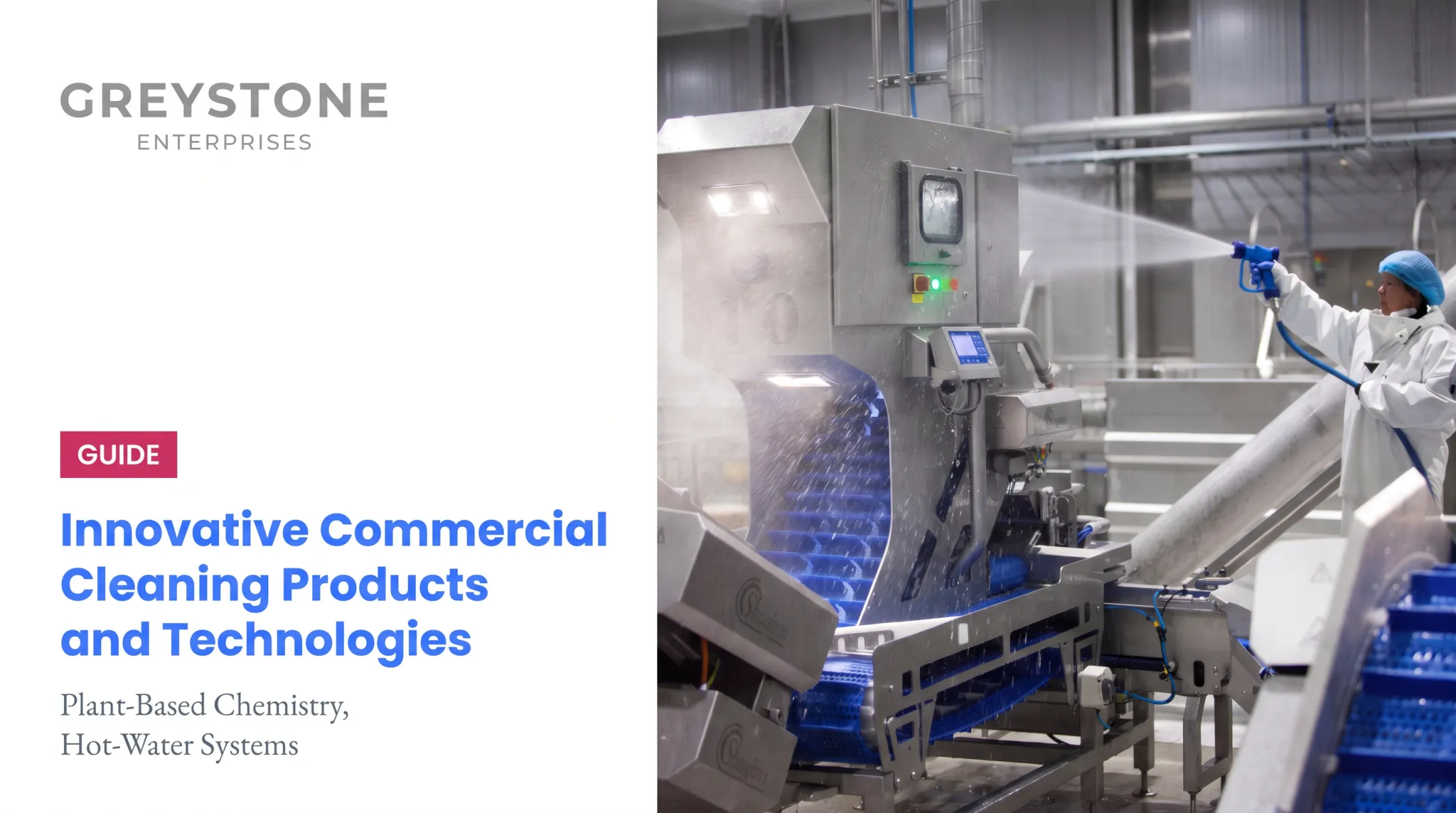
Heat, pressure, and flow control loosen grease, residues, and deposits, cutting reliance on hand scrubbing. Typical uses include:
- Plant-wide washdown and production-line sanitation
- Tank, vessel, and mixer interiors
- Food and beverage equipment
- Fleet maintenance bays
The right pressure, temperature, flow, and method depend on the soil, surface, equipment, and sanitation standard. SQF guidance says methods vary with operation and allergen or microbiological risk, and calls for documented, verified cleaning programs.
Greystone shows how equipment and chemistry can be planned together. Its HelioJET Central Cleaning System combines in-plant steam and cold water to supply high-pressure hot water to multiple stations, such as spray guns, foamers, conveyor showers, and tank-wash equipment.
Its Tri-Solve plant-based chemistries are matched to the facility's soils. HelioJET output reaches up to 350 PSI and 180°F, and its interior tank systems run at 160-190°F and up to 600 PSI. This is one approach, not a replacement for every method.

Sustainable Chemistry, Water Management, and Resource Optimization
Innovations include plant-based chemistries, precision dosing, low-water methods, filtration and reuse, and concentrated formulas. EPA's Safer Choice standard evaluates ingredients by functional class, including tailored criteria for specialized industrial products.
Documented, vendor-reported cases show the range:
- An industrial bakery using rinse-free cleaning cut clean time from 8 to 6.5 hours daily and saved 213,000 gallons yearly (Ecolab).
- A snack producer replaced 10,000 nozzles and reported 500 million fewer gallons yearly, with no cleaning-effectiveness difference (Spraying Systems Co.).
Both vendors' results are not guaranteed elsewhere. Evaluate sustainability alongside cleaning effectiveness, worker exposure, wastewater requirements, surface compatibility, validation, and total operating cost. EPA's National Pretreatment Program governs industrial discharges to municipal treatment works.
Machine Vision, Digital Verification, and Worker-Support Technology
Vision, imaging, digital checklists, and automated reporting can verify steps and document compliance. A 2025 poultry study tested color and fluorescence spectrometry to detect residues, but it is a research tool, not a proven plant deployment. ATP testing gives numeric readings of residual organic matter, though it does not identify specific pathogens.
These tools work best when they support people:
- Step-by-step instructions and highlighted problem areas
- Faster training for new staff
- Less exposure to hazardous tasks
Data quality matters. FDA's data-integrity guidance says records should be reliable and accurate. Add human review, validation, and cybersecurity before relying on automated decisions in regulated areas.
What's Driving These Industrial Cleaning Technology Trends
Technology Advances
Better sensors, pumps, steam generation, batteries, controls, and data platforms make cleaning more precise and connected. The IFR reports professional cleaning robot sales in its supplier sample grew 34% to over 25,000 units in 2024. Those figures are global and do not measure US plant adoption.

Market Demand and Customer Expectations
Food, beverage, pharmaceutical, and chemical customers expect consistent sanitation, traceability, and credible sustainability progress. Audit schemes such as SQF and FSSC 22000 call for validated, documented cleaning.
Cost Pressures
The Manufacturing Institute and Deloitte estimate up to 3.8 million additional manufacturing employees may be needed over 2024-2033. Even as a forecast, that gap helps explain the push to automate hard manual tasks and protect uptime.
Regulatory and Compliance Influences
Relevant rules include:
- OSHA standards for lockout/tagout (1910.147), confined spaces (1910.146), and hazard communication (1910.1200)
- FDA 21 CFR 117 and 211.67 for sanitation and equipment cleaning records
- USDA FSIS sanitation performance standards
- EPA pretreatment and hazardous waste rules
OSHA has no robotics-specific standard. None of these requirements makes a technology automatically compliant, so verify current obligations for your site.
Competitive Dynamics
Facilities adopt cleaning innovations to raise throughput, protect equipment, strengthen audit readiness, and show sustainability progress. The CNH and bakery cases above show organizations doing exactly that.
How These Trends Are Impacting US Industrial Cleaning
These technology shifts show up in day-to-day plant performance. Track results against a baseline across:
- Cleaning quality and cycle time
- Labor allocation and resource use
- Downtime and maintenance events
- Safety exposure and documentation
Operational Impact
Facilities are shifting from fixed schedules and visual inspection toward risk-based or condition-based cleaning. Turbidity-ended pre-washes, automated tank cleaning, and centrally piped washdown stations are examples.
Controlled pressure, temperature, dosing, and digital records reduce variation and catch cleaning failures earlier. Greystone reports HelioJET conveyor applications have shown up to 41% water savings; confirm that figure against your own site baseline.

Business Impact
Leaders increasingly treat cleaning as an operational investment, weighing total cost of ownership, integration, maintenance, training, and avoided downtime. No general ROI benchmark exists, so build the case from your own baseline.
Better control of water, energy, chemicals, and documentation also supports ESG goals and lowers compliance risk.
Workforce Impact
Automation can move employees from repetitive or hazardous scrubbing toward equipment operation, inspection, troubleshooting, and data interpretation.
Plan for:
- Documented procedures and technology training
- Lockout/tagout, chemical, and pressure safety
- Cybersecurity awareness
- Clear escalation when an automated system fails or flags a problem
Future Signals for Industrial Cleaning Technology
Cleaning, production, maintenance, EHS, and sustainability data will keep converging, but adoption will be selective and tied to measurable value.
Early indicators include:
- More pilot programs and connected washdown
- Automated sanitation records and predictive maintenance alerts
- Customer demand for traceable cleaning data
Worth watching:
- Adaptive robotics and better machine vision
- Digital twins for process simulation
- More efficient steam and hot-water generation
- Advanced dosing, water recovery, and safer human-robot collaboration
IDC's 2025 report anticipates greater autonomy and adaptability in cleaning robots.
Scenarios for the next 1-3 years:
- Conservative: Facilities automate predictable tasks first, such as open-floor scrubbing.
- Connected: Cleaning data links to maintenance and production systems.
- Higher automation: Vision and adaptive equipment adjust cleaning to real-time conditions.
Outcomes depend on validation, workforce readiness, cybersecurity, and facility suitability.
Conclusion
Industrial cleaning is advancing through automation, connected data, hot-water and steam systems, sustainable chemistry, and digital verification. Matched to the right application, these tools can improve safety, consistency, productivity, equipment reliability, and resource management.
Early evaluation, facility-specific planning, workforce involvement, and measurable baselines beat adopting technology just because it's new. Greystone's approach starts the same way: identify priorities, soils, and constraints, then match equipment and chemistry.
Frequently Asked Questions
What are the latest trends and technologies in industrial cleaning?
Key trends include AI and robotics, IoT sensors, machine vision, predictive maintenance, hot-water and steam systems, sustainable chemistry, precision dosing, and digital cleaning verification.
How is AI used in industrial cleaning?
AI can support route planning, visual inspection, task prioritization, predictive maintenance, and performance analysis. Human oversight remains necessary, especially in regulated settings.
Can robots work in industrial cleaning environments?
Yes, for predictable, repetitive tasks in accessible areas. Dynamic production spaces, tight areas, hazardous conditions, and irregular equipment often need human-led or hybrid methods.
How do smart cleaning technologies improve sustainability?
They can enable precise water and chemical use, lower energy consumption, less rework, and better environmental tracking. Actual results depend on system design and facility conditions.
What should facilities consider before adopting industrial cleaning technology?
Consider soil type, surfaces, layout, compliance needs, downtime windows, worker safety, integration, maintenance, training, cybersecurity, total cost of ownership, and measurable success criteria.
Can high-pressure hot-water or steam systems replace cleaning chemicals?
Heat and pressure can reduce or change chemical needs for some soils. The right method depends on the residue, equipment, sanitation standard, material compatibility, wastewater controls, and a validated process.