
The problem for facility managers is fit. Adopting technology without matching it to soil type, surfaces, production schedules, safety requirements, or measurable goals adds cost and complexity. In CMM's 2026 survey, only 23% of building service contractors had adopted autonomous equipment, according to CMM's benchmarking survey. Most are still deciding.
This guide offers a practical framework for choosing products and technologies for US commercial and industrial facilities.
Key Takeaways
- Judge innovations on performance, safety, compliance, resource use, downtime, and ease of rollout, not novelty.
- Plant-based chemistry, concentrates, hot-water and steam systems can cut resource use when matched to the job.
- Robots, sensors, digital training, and ATP testing add visibility but never replace trained people.
- Start with a baseline, run a focused pilot, document results, train staff, then roll out in phases.
What Makes a Commercial Cleaning Product or Technology Innovative?
Defining innovation
Innovation means a product, process, equipment system, or digital capability that measurably improves cleaning results, safety, efficiency, sustainability, traceability, or equipment reliability. ISSA points to connected hygiene systems, real-time data, and robotic floor care as current examples. Cost, security, compatibility, and ROI remain common barriers.
Novelty alone doesn't qualify. A robot that suits a big open warehouse floor may be useless in a cramped plant. A chemistry that works on food residue may fail on paper-machine pitch.
Matching innovation to the cleaning challenge
Soil type, surface material, water availability, temperature, pressure, cleaning frequency, and turnaround time all shape selection. Requirements differ by sector:
- Food and beverage: 21 CFR 117.35 requires cleaning that protects against contamination and allergen cross-contact.
- Pharmaceutical: 21 CFR 211.67 requires written procedures, defined intervals, and records.
- Paper mills: felts and dryer fabrics need cleaning that preserves permeability and runnability.
- Tanks and process plants: interiors need batch-to-batch cleaning, often clean-in-place.
- Fleet wash bays: grease and road film come with washwater containment rules.
A tank, a production line, a paper-machine fabric, and a wash bay each need a different strategy.
Measuring outcomes beyond visible cleanliness
Track what actually matters:
- Re-cleaning frequency and labor time
- Water, chemical, and energy use
- Downtime and equipment reliability
- Audit performance
- Worker exposure risk
ISSA's CIMS standard requires documented measurement against scope and performance outcomes. It is a management framework, not a microbial pass/fail threshold.
When you track those outcomes, keep the terms straight:
- Cleaning: removes dirt and organic matter
- Sanitizing: reduces germs to safe levels
- Disinfecting: kills or inactivates remaining germs within a product's approved claims
For sanitizing and disinfecting, follow the EPA-approved label, the safety data sheet (SDS), and your training program rather than broad efficacy claims.
Innovative Commercial Cleaning Products for Safer, More Sustainable Results
Plant-based and lower-impact chemistries
Plant-based or renewable-source chemistry can support sustainability goals. Buyers still need to verify soil removal, surface compatibility, concentration, storage, and SDS documentation.
Third-party programs verify different things:
| Program | What it verifies |
|---|---|
| EPA Safer Choice | Every ingredient against criteria, plus performance |
| Green Seal GS-37 | Industrial and institutional cleaners; excludes disinfectants and sanitizers |
| UL ECOLOGO | Multiattribute, life-cycle-based criteria |
| USDA Certified Biobased | Biobased content percentage only |
"Plant-based," biobased content, and a multiattribute certification are not equivalent. The FTC's Green Guides also require substantiation for unqualified "degradable" or "non-toxic" claims. Green marketing never replaces label, SDS, and performance review.
Concentrates and controlled dispensing
Concentrated detergents with dilution control and metered dispensing reduce overuse, packaging, and storage volume. Green Seal's GS-42 requires clear directions that prevent overuse and waste.
Implementation requires:
- Calibrated dispensers verified for task-appropriate dilution
- Compliant labeling under OSHA HazCom, with SDS access every shift
- Employee training and chemical compatibility review
- Spill controls
No universal savings percentage applies, so measure your own.
High-pressure hot-water and steam systems
Heat, pressure, mechanical action, and the right chemistry work together on grease, residues, and deposits. University of Florida extension guidance notes that heat helps remove fats above their melting point, while heat-denatured proteins can become harder to remove. Hotter isn't always better.
Safeguards matter. OSHA's cleaning guidance flags noise, slips, burns, pressurized-stream injuries, and wet-condition electrical hazards. Also plan for:
- Surface damage and aerosolization
- Ventilation
- Wastewater: a sewer connection is not permission to discharge, so check pretreatment rules
- Equipment and chemical manufacturer instructions
ASME certification addresses pressure-vessel quality control, not cleaning efficacy.
Surface- and process-specific formulations
Food residues, oils, coatings, adhesives, mineral deposits, paper-machine deposits, and vehicle grease all call for different chemistry. Before choosing, check:
- Dwell time and rinsing needs
- Residue left behind
- Corrosion potential
- Food-contact or pharmaceutical requirements
- Compatibility with seals, finishes, and machinery
An integrated product-and-equipment example
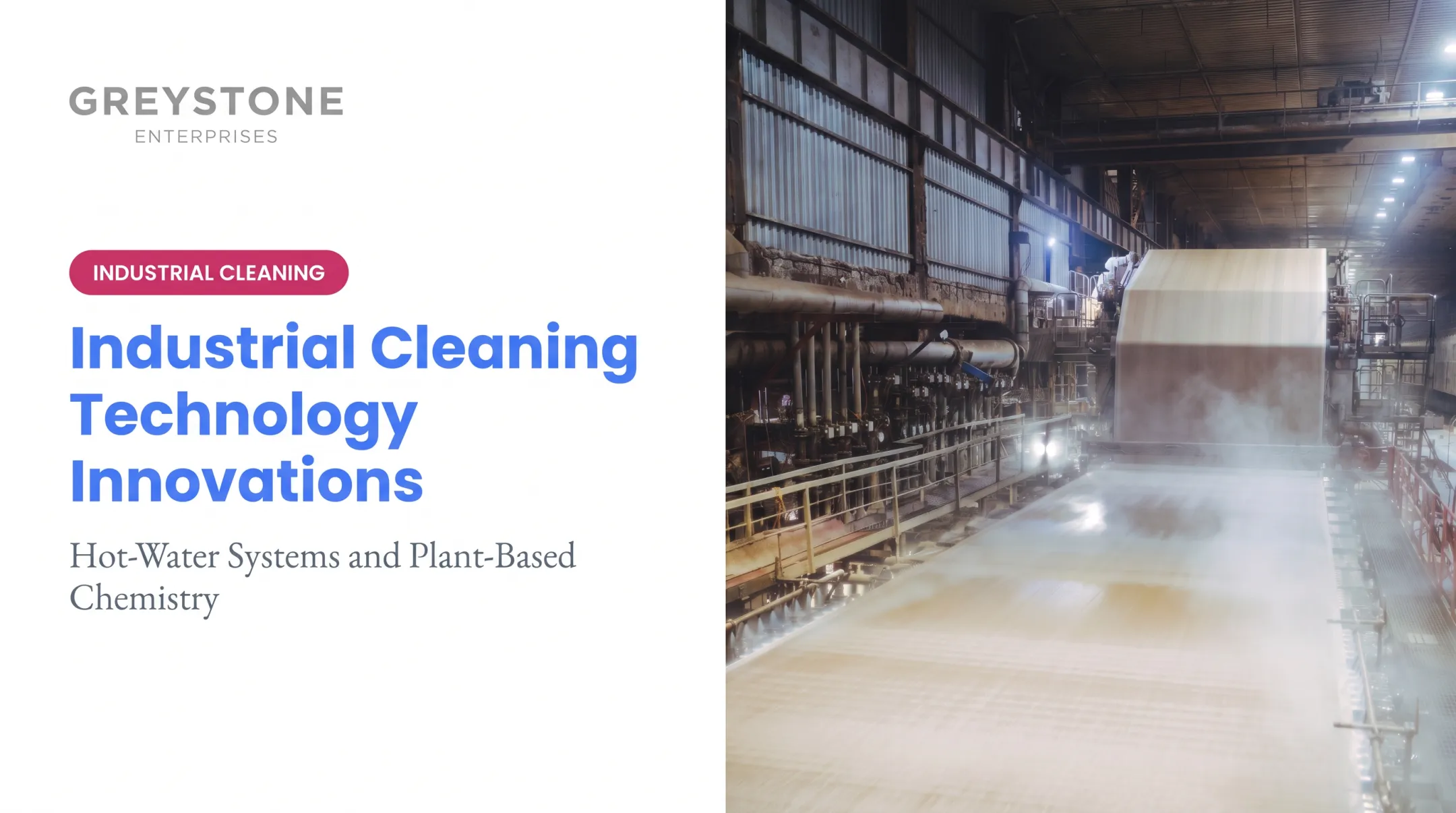
Greystone pairs HelioJET high-pressure hot-water and steam equipment with Tri-Solve plant-based chemistries. HelioJET's patented systems combine steam and cold water to deliver pressurized hot water. A HelioPAC, for example, can deliver 300 psi water at 185°F from 125 psi steam and 60 psi cold water, and output depends on a plant's supply conditions.
In one paper-mill dryer-fabric case study, Greystone reports a 37% shorter cleaning cycle (22 minutes) and 75% less chemical use versus the prior method. That is one site's result. Assess any integrated solution on documented performance, safety, resource use, and reliability in your own facility.

Commercial Cleaning Technologies That Improve Efficiency and Verification
IoT-connected dispensers and facility sensors
Connected dispensers, supply sensors, restroom monitors, and service-request devices report consumable levels, usage patterns, and completed tasks. Value depends on:
- Reliable connectivity
- Clear data ownership
- Integration with work-order systems
- Cybersecurity review (NIST SP 800-213 offers a framework)
- Alert prioritization and a plan to act on the data
Robotics and cobotics
Autonomous vacuums and scrubbers suit repetitive, predictable work in large open areas. The IFR reports more than 25,000 professional cleaning robots sold globally in 2024, up 34%, per IFR's World Robotics report. That's global sales, not US adoption.
Robots supplement trained staff. Plan for route mapping, obstacle management, charging, maintenance, supervision, and safety controls. Check that safety standards fit your environment: UL 3300 excludes industrial environments.
Verification and cleanliness measurement
| Method | Shows | Limit |
|---|---|---|
| ATP testing | Organic residue | Doesn't measure bacteria directly |
| Fluorescent markers | Whether an area was wiped | Not microbial inactivation |
| Visual inspection | Visible debris | No microbial data |
Use them to confirm procedures are followed. None replaces microbiological, regulatory, or process-specific validation where required.
Electrostatic application and UV-C systems
Electrostatic spraying can improve coverage, but EPA label conditions on wet contact time and spray distance still apply. It treats surfaces; it doesn't remove soil.
UV-C depends on line of sight and delivered dose. Shadows and organic matter limit performance, and exposure can harm eyes and skin. Whole-room systems are adjuncts, and units that claim to kill microorganisms may be regulated under FIFRA. Follow current manufacturer and safety guidance.
Digital training, AR, and workflow systems
Digital work instructions, AR training, electronic SDS access, and mobile inspections can narrow the gap between procedure and practice. They help with onboarding and multilingual instruction. OSHA still requires training in language workers understand.
Evidence is limited. One 2023 AR maintenance study with 28 students showed task-time gains of 0.45% to 14.94%, and higher mental workload. It wasn't a cleaning-workforce trial. Pair digital tools with hands-on competency checks.

How to Evaluate and Implement Cleaning Innovations in a US Facility
Establish a baseline before buying
Map current tasks, products, equipment, labor, water and energy use, downtime, recurring failures, safety incidents, and audit findings. APPA's framework supports baselining area, staffing, cost, and quality. Then rank opportunities by operational impact and feasibility, starting with difficult or repetitive jobs that have a documented problem.
Pilot, measure, and validate
Run a controlled pilot in a representative area. Agree on measures up front:
- Cleaning quality and re-cleaning
- Labor time
- Chemical, water, and energy use
- Downtime and surface condition
- Employee acceptance
Compare against the existing method, record operating conditions, and involve operations, EHS, quality, maintenance, and procurement. No universal pilot length exists, so set one that captures normal variation.
Review total cost, compliance, and workforce readiness
Look past purchase price. NIST's life-cycle costing handbook counts acquisition, operation, maintenance, and disposal. Include consumables, training, integration, parts, wastewater handling, and service life.
Before full deployment, confirm:
- Labels and SDS access
- OSHA HazCom procedures
- Applicable EPA or industry requirements
- Machine guarding (1910.212) and electrical safety (1910.303)
- Lockout/tagout where cleaning counts as servicing (1910.147)
- Documented training

Conclusion: Building a Smarter Cleaning Program
The most effective innovation is a fit-for-purpose system: the right chemistry, equipment, workflow, verification method, and trained people working together.
If your facility has a difficult industrial cleaning challenge, Greystone can discuss a tailored strategy built around safety, efficiency, sustainability, compliance support, and equipment reliability.
Frequently Asked Questions
What are innovative commercial cleaning products?
They include advanced chemistries, concentrated formulations, controlled-dispensing products, and specialized cleaning agents. They qualify as innovative when they improve measurable facility outcomes and are matched to the application.
What are the latest technologies used in commercial cleaning?
Robotics, IoT-connected systems, digital workflow tools, and cleanliness verification lead the list. High-pressure and steam equipment and carefully controlled disinfection technologies complete it.
Are plant-based cleaning products effective for commercial facilities?
It depends on formulation, soil, surface, concentration, dwell time, and required outcome. Verify documentation and test performance rather than relying on "plant-based" labeling.
How do robotic cleaning technologies improve commercial cleaning?
Robots automate repetitive, predictable tasks and improve consistency. They need suitable layouts, human oversight, maintenance, safety controls, and trained staff.
What is the role of IoT in commercial cleaning?
Connected sensors and dispensers report usage, supply levels, service requests, and task completion. That data supports more responsive, efficient cleaning management.
How should a facility choose the right commercial cleaning technology?
Start with a baseline and clear performance goals. Review compatibility and compliance, run a controlled pilot, analyze total cost, and train staff before rollout.