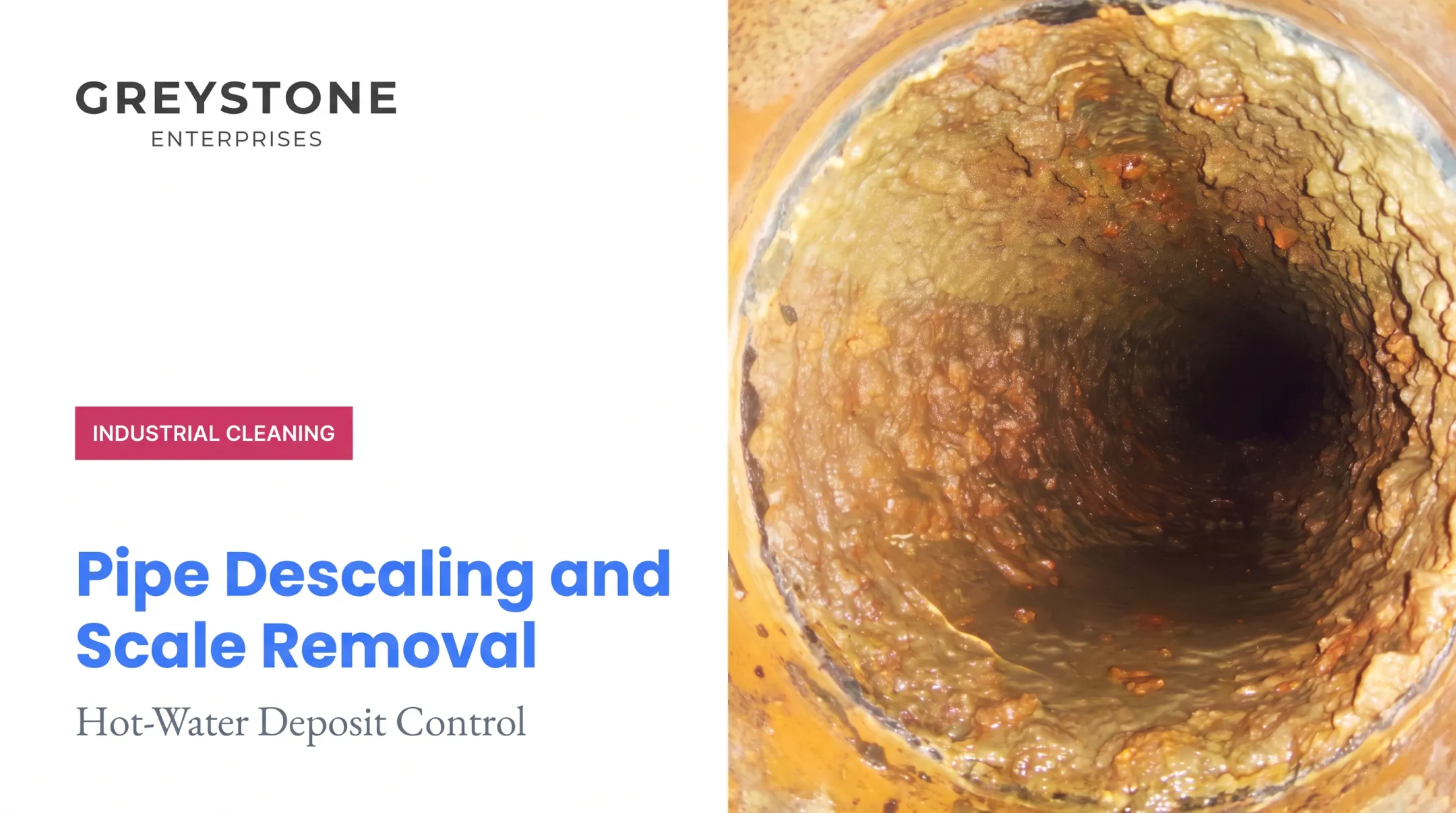

Most real jobs need a combination: mechanical tools, high-pressure water, hot water or steam, circulating chemistry, inspection gear, and recovery or drying accessories. Elevated approach temperature on a chiller, for example, signals fouling, but Trane's service guidance says to inspect first and choose the cleaning method second.
This guide covers equipment categories, a selection framework, a seven-step process, and safety and sustainability checks.
Key Takeaways
- Match the tool to the contaminant, pipe material, diameter, layout, and required cleanliness, not to pressure alone.
- Mechanical, hydraulic, chemical, thermal, and pigging methods each solve different access and deposit problems.
- A complete plan covers isolation, pre-cleaning, cleaning, rinsing, verification, drying, and records.
- Resource savings only count if safety, sanitation, and validation hold.
Industrial Pipe Cleaning Equipment and Tools
"Equipment" means more than the machine that makes pressure. A full setup includes:
- A power source (pump, steam and water supply, or drive unit)
- Cleaning heads, nozzles, lances, brushes, or pigs
- Hoses, fittings, and safety couplings
- Chemical dosing or recirculation hardware
- Recovery and filtration equipment
- Inspection tools and controls
Mechanical pipe cleaning tools
Mechanical tools make direct contact with deposits. Wilson's applications guide describes the main families:
- Spiral and nylon or brass brushes for light-to-medium deposits
- Expanding scrapers for wet or gummy deposits
- Cutters and drill heads for hard scale or plugged tubes
- Push-rod tools for manual tube cleaning
- Electric flexible-shaft systems for straight and curved tubes, with controlled rotation, feed, and flushing
Strengths: direct deposit removal on accessible interiors. Limits: scratching of sensitive surfaces, debris left behind, and poor reach in complex runs.
Trane specifies a different, bidirectional approach for enhanced tubes, so don't assume a brush that works in smooth-bore tubes is safe everywhere.
Before using any brush, scraper, or pig, confirm:
- Diameter and bend radius
- Lining, valves, and welds
- Internal obstructions
High-pressure water, hot-water, and steam equipment
Pumps, jetting nozzles, hoses, lances, and recovery systems remove loose soils, grease, and product residue from pipes and connected equipment.
Temperature matters for fats and oils. UF/IFAS notes that emulsified fat is generally rinsed with hot water above its melting point, and heavy oily deposits may need alkaline emulsifying cleaners.
Steam has drawbacks: difficult time and temperature control, condensation, and cost.
Temperatures are application-specific. Tetra Pak's coconut-processing guidance uses a 40-60°C pre-rinse and warns that going above 60°C makes protein soils harder to remove. It is not a universal pipe setting.
For pressure and standoff, follow the manufacturer's manual. WJTA best practices call for barricades at least 15 ft away, or shrouds where that is impractical.
Seek immediate medical attention for any suspected waterjet injury, however small the wound looks. StoneAge adds that accessories must never be connected, disconnected, or tightened while the pump runs.
Pigging and flow-assisted tools
Pigs (foam, cup, disc, or brush-equipped) are pushed through a line by product, water, or filtered air. They displace product, remove residue, and recover liquid.
Pigging is practical only when the whole route qualifies:
- Consistent internal diameter, with suitable welds and no intrusive fittings (per GEA's 2023 guidance)
- Compatible valves and fittings
- Launch and receive points
- Bend radius suited to the specific pig
- A product recovery arrangement
Bend ratings are product-specific. HPS states its pigs handle 1.5D, 90-degree bends; don't apply that to other pigs. Pigging also doesn't replace cleaning. Recovering bulk product makes the later CIP step easier, but chemical circulation, rinsing, and inspection usually still follow.
Chemical circulation and specialty equipment
A controlled chemical setup includes a recirculation tank, dosing system, pump, filters, spray devices, and compatible hoses. Tetra Pak identifies four variables that work together:
- Concentration
- Temperature
- Mechanical action or flow velocity
- Time
Chemistry choices include:
- Alkaline for organic deposits
- Acid for mineral scale
- Enzymatic (proteases, amylases, lipases) for specific soil components
- Solvent-based for materials that dissolve or suspend
- Plant-derived cleaners (judge hazard and performance apart from renewable origin)
Compatibility checklist before any circulation:
- Concentration and temperature limits for the pipe, seals, and coatings
- Contact time
- Ventilation
- Neutralization and rinse requirements
- Wastewater acceptance
- The supplier's safety data sheet
Seal compatibility is compound-specific. Parker identifies certain EPDM compounds for hot water, steam, acid, and alkaline CIP, while FKM suitability depends on formulation. Verify the actual seal.
Inspection, recovery, and drying accessories
These tools confirm cleanliness and prevent recontamination:
- Borescopes and cameras
- Test coupons and swabs
- Conductivity and pH rinse checks
- Filtration and vacuum recovery
- Air blowdown, drying pigs, and foam swabs
Evaluate the whole system: how removed soil is collected, how wastewater is managed, how adjacent equipment is protected, and how final condition is documented.

How to Choose the Right Pipe Cleaning Equipment
Work through these decisions in order: cleaning objective, pipe geometry, performance and utilities, safety and compliance, then system type and total cost.
Assess the contaminant and cleaning objective
Separate what you're removing. Each soil type needs a different mix of mechanical action, chemistry, temperature, and flow:
- Loose debris, oils, and grease
- Mineral scale and biological films
- Hardened product, corrosion byproducts, and cross-batch residue
Then name the purpose: changeover, sanitation, maintenance, heat-transfer recovery, blockage removal, corrosion control, or inspection readiness. DOE notes that mineral deposits and sludge insulate heat-transfer surfaces and raise the water-to-refrigerant temperature difference, so a chiller job has different goals than a changeover rinse.
Write the target in measurable terms: visual cleanliness, residue limits, rinse quality, microbial criteria, flow restoration, or validated acceptance.
Evaluate pipe construction and geometry
Check material, diameter, wall thickness, lining, welds, bends, dead legs, branches, valves, strainers, heat exchangers, and connected vessels. A method that suits a straight, accessible line may fail in a long, narrow, coiled, lined, or heavily branched system.
For complex systems, get a site survey or engineering review before buying, especially where access, pressure containment, or confined-space entry is involved.
Compare performance, utilities, and downtime
Compare options on effectiveness, flow, pressure, temperature, chemical demand, water and energy use, setup time, labor, portability, and fit with existing plant utilities.
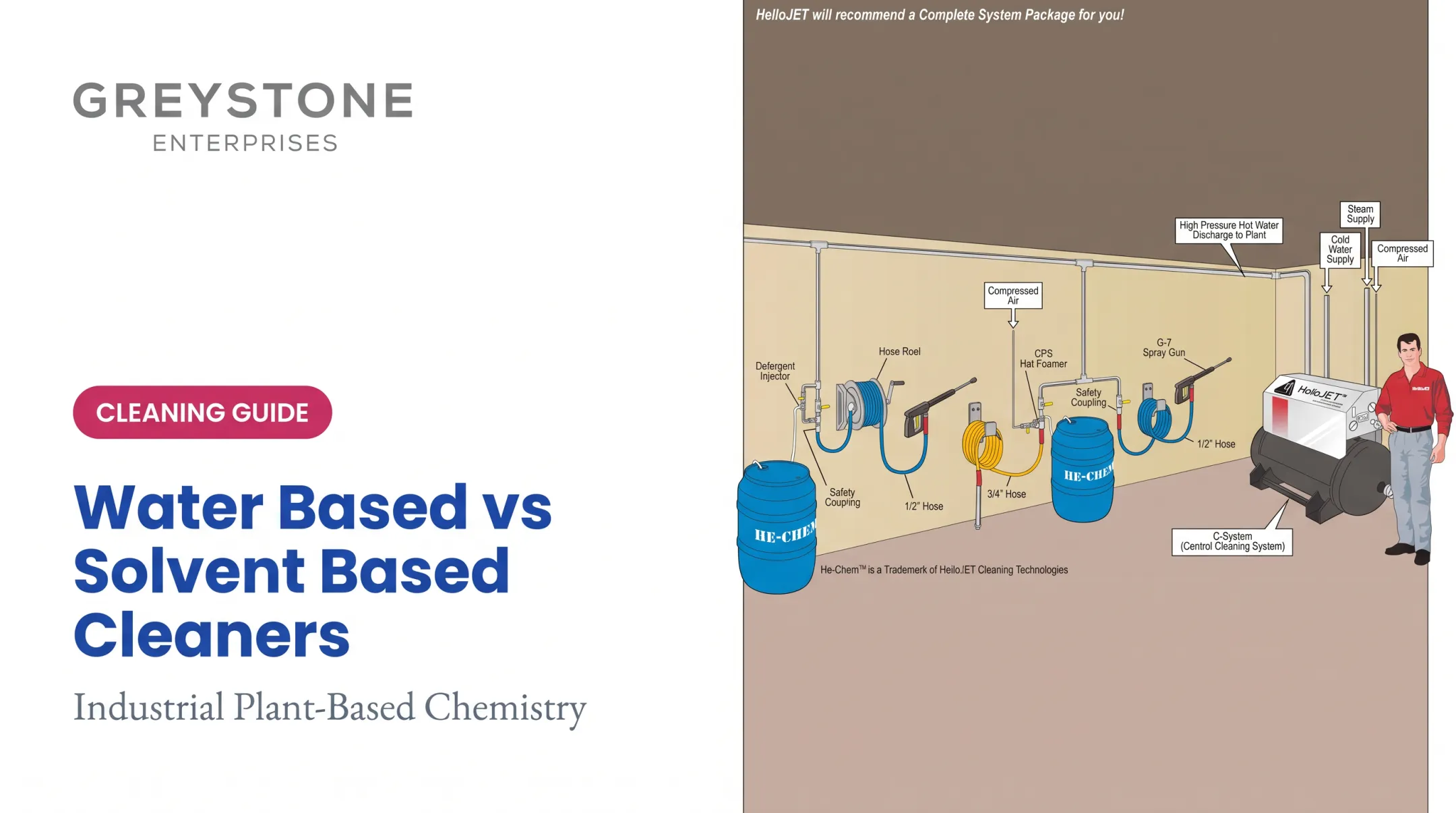
For example, Greystone's HelioJET C-100 central system runs on 125 psi steam and 60 psi cold water, delivering 100 GPM at 180°F and 250 psi, so steam availability becomes a selection factor.
Spray drop piping guidance calls for 3/4-inch pipe up to 8 GPM and 1-inch for 8-16 GPM, with water velocity under 6 feet per second.
The fastest cycle is a poor choice if it creates more waste, damages surfaces, raises exposure, or fails verification.
Consider safety, waste, and compliance
Review these hazards and controls before you buy:
- Pressure, hot surfaces, chemical exposure, and electrical needs
- Noise, aerosols, wastewater discharge, and ventilation
- PPE, emergency controls, and operator training
Read specifications alongside your lockout/tagout, confined-space, hazard communication, sanitation, and environmental procedures. Cite current OSHA, EPA, and manufacturer sources rather than assuming universal rules.
Portable tools or integrated systems
Portable units suit localized or intermittent cleaning. Centralized piped systems suit multi-line plants where several operators need cleaning points at once.
Alfa Laval offers mobile CIP for in-place heat-exchanger cleaning, while Tetra Pak notes central CIP suits shorter circuits and decentralized units suit long returns that dilute detergent.
Total cost of ownership should include:
- Installation, hoses, and fittings
- Chemistry, utilities, and maintenance
- Training, downtime, wastewater handling, and spare parts
When soil type, geometry, or validation needs make performance uncertain, run a pilot trial first.

The Industrial Pipe Cleaning Process: Seven Practical Steps
This framework adapts to production piping, process vessels, heat-transfer equipment, washdown systems, and maintenance work.
1. Define the scope and prepare the system
Start by identifying:
- Line, contaminant, and target outcome
- Access points, connected systems, and utilities
- Recovery needs and acceptance criteria
Review drawings, operating history, past cleaning records, chemical compatibility, and known blockages.
2. Isolate the equipment and control hazards
- Shut down, depressurize, drain, and apply lockout/tagout
- Isolate valves, check temperatures, and set chemical controls
- Assign PPE, ventilate, and evaluate confined-space entry where applicable
OSHA's lockout/tagout standard requires verifying isolation before servicing covered equipment. Only trained personnel should run high-pressure, hot-water, steam, chemical, or confined-space operations.
3. Pre-rinse or remove loose material
Drain, vacuum, flush, scrape, or rinse lightly to clear loose soil. This avoids wasting chemistry and energy. Capture removed material and handle it under facility waste procedures, not through downstream equipment or drains without review.
4. Apply the selected method
The tool must supply the right combination of contact, agitation, flow, temperature, chemical action, and time. Operators should monitor:
- Flow and pressure
- Temperature
- Chemical concentration
- Return quality
- Equipment condition
On HelioJET systems, for example, a lit caution light that doesn't clear after startup most often points to plugged spray nozzles.
5. Rinse and remove residues
Final rinse, neutralize where required, filter, vacuum, and drain, while protecting connected process systems. Tie rinse quality to the objective and verify it with a method, not just clear-looking water.
6. Verify the result
Options include:
- Visual and borescope inspection
- Rinse testing, conductivity, and pH
- ATP or microbial testing
- Flow or pressure comparisons
- Residue testing
The right choice depends on product, process, material, sanitation standard, and risk. In pharmaceutical settings, FDA says rinse sampling alone isn't acceptable for cleaning validation, and favors direct surface sampling where feasible.
7. Dry, document, and prevent recurrence
Drain or dry where moisture could cause corrosion, microbial growth, dilution, or recontamination. Food operations covered by 21 CFR 117.40 must treat air or gases used on food-contact surfaces to avoid contamination.
Record the job thoroughly:
- Equipment, chemistry, and cycle conditions
- Inspection results and deviations
- Waste handling and operator observations
- Next scheduled action

Safety, Compliance, and Sustainability Considerations
Industrial pipe cleaning combines high pressure, heat, chemicals, and sometimes confined work, so hazard controls have to match the job.
Main hazards include:
- High-pressure injection and hose failure
- Hot water and steam burns
- Chemical exposure
- Unexpected line movement or thrust
- Electrical energy
- Aerosols
- Confined spaces
Verify controls against current OSHA, EPA, and facility requirements. Relevant OSHA standards include:
- 1910.147 (hazardous energy)
- 1910.146 (permit-required confined spaces, which only applies if an actual entry meets its scope)
- 1910.1200 (hazard communication)
- 1910.132 (PPE)
- 1910.95 (noise)
On discharge, EPA's 40 CFR 403 pretreatment rules prohibit pass-through and interference at POTWs, and local limits can be stricter. pH adjustment alone doesn't establish compliance.
Equipment instructions reinforce this. HelioJET documentation prohibits defective hoses, calls for rigid, anchored overflow piping routed away from personnel, and requires nozzle changes only after steam and water are locked out.
Sustainability without shortcuts
Savings come from:
- Soil-specific chemistry
- Controlled dosing
- Efficient hot water
- Recovery and filtration
- Optimized cycles
- Preventive cleaning
They never justify weakening worker safety, product safety, or validation.
Evidence needs to be case-specific. An HPS beverage guide reports an Australian winery cut effluent by 1,500 liters per bottling run, around 500,000 liters a year, using pigging. That's a manufacturer-reported example, not an industry average.
In another case, a brewery trial found a safer electrochemical cleaner inadequate alone until the existing cleaner was added back.

Track your own indicators:
- Water use and chemical consumption
- Energy demand and wastewater volume
- Labor, downtime, and rework
- Equipment reliability
When an Integrated Industrial Cleaning System Makes Sense
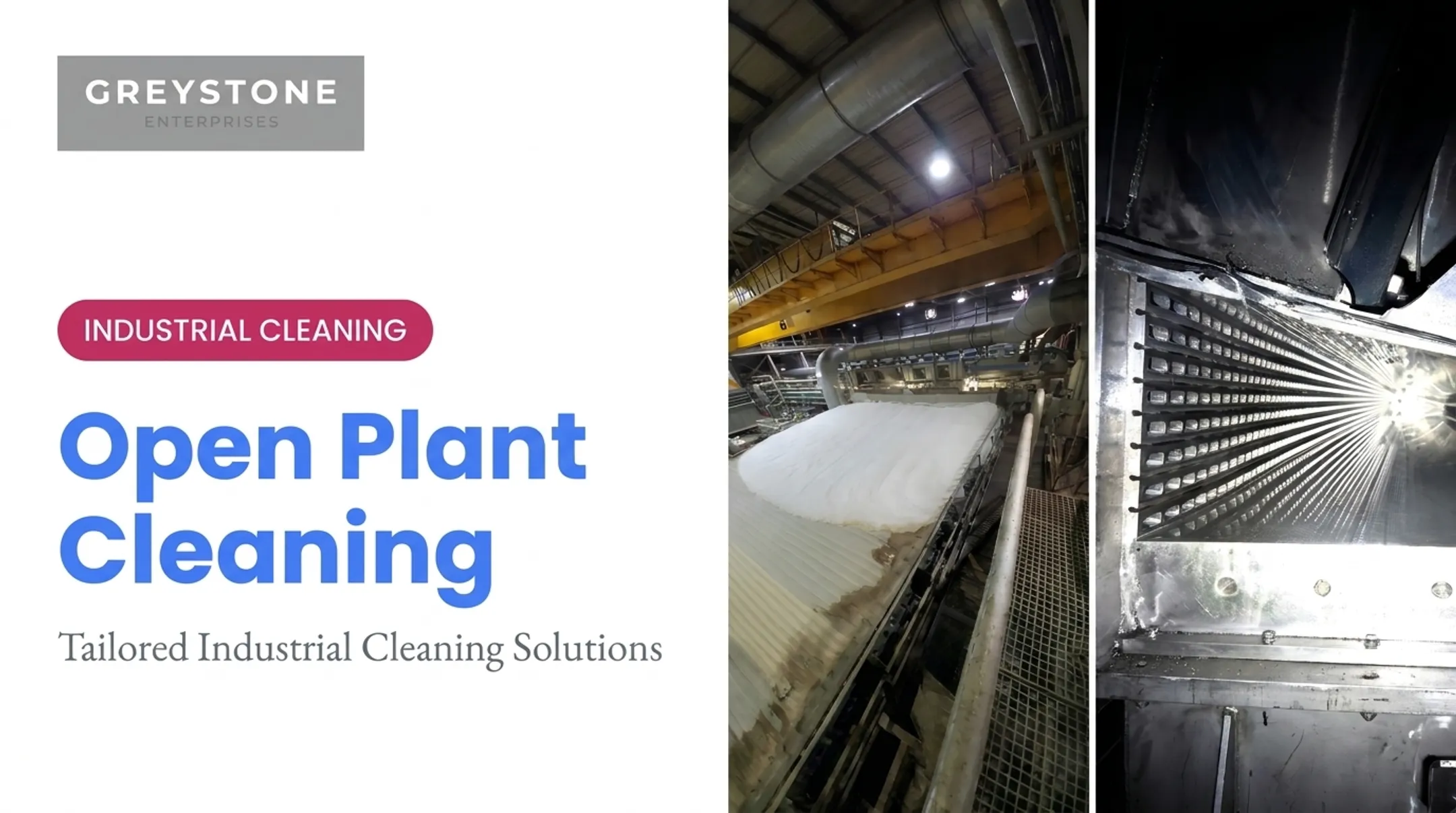
An integrated approach makes sense when portable units can't cover multi-drop washdown, vessel interiors, mill deposit control, or fleet wash demand.
Greystone combines HelioJET high-pressure hot-water and steam technology with Tri-Solve plant-based chemistries to build facility-specific programs. No single system fits every pipe, so application fit comes first.
Relevant applications include:
- Central plant-wide washdown systems piped to multiple drops, replacing several portable units
- Interior cleaning of tanks, totes, and mixing vessels between batches
- Paper-mill deposit-control programs with Bubble-Up foam cleaning for approach piping and headboxes when a full boilout isn't practical
- Hot high-pressure wash stations for fleet and heavy-equipment maintenance
If you're weighing options, bring your pipe configuration, soil type, cleaning objective, downtime limits, and sustainability goals to Greystone. The team can help determine whether a HelioJET, Tri-Solve, or combined solution fits your facility.
Frequently Asked Questions
What does mechanical cleaning mean?
Mechanical cleaning uses physical contact, such as brushes, scrapers, pigs, rods, or rotary tools, to loosen and remove deposits. Flushing water or chemistry often carries the loosened material out.
What are the 7 steps in the cleaning process?
- Scope and prepare
- Isolate and control hazards
- Pre-rinse or remove loose soil
- Apply the primary method
- Rinse
- Verify
- Dry and document
How often should chiller tubes be cleaned?
There's no universal interval. Frequency depends on water quality, fouling rate, performance, inspection results, and manufacturer guidance. Trane ties cleaning to inspection findings and elevated approach temperature.
What equipment is used to clean industrial pipes?
Common options include:
- Brushes, cable machines, and pigs
- High-pressure water, hot-water, or steam systems
- Chemical circulation equipment
- Inspection, recovery, and drying equipment
How do you choose the right industrial pipe cleaning method?
Match the method to the deposit type, pipe material and geometry, cleaning standard, safety risks, utilities, waste controls, downtime, and verification needs. For complex systems, survey first and pilot test.