
When that control slips, the results show up fast. In 2024, an environmental Listeria sample at Rizo Lopez Foods matched the outbreak strain, and the firm recalled all sell-by dates of its dairy products.
This guide defines cleaning and sanitation, walks through the correct sequence, explains how to build a documented program, and shows how to verify results and use resources more efficiently.
Key Takeaways
- Cleaning removes soils and residue; sanitizing follows to reduce microorganisms.
- Match methods to the soil, equipment, surface, and product risk.
- SSOPs, schedules, training, and records make cleaning repeatable.
- Verification and trend review show whether controls work, not just how clean surfaces look.
What Cleaning and Sanitation Mean in the Food Industry
Cleaning, sanitation, and disinfection explained
Food industry sanitation is the coordinated set of practices that keep production, processing, storage, and packaging environments hygienic and control contamination. FSIS training describes it as a broader program that prevents adulteration, spoilage, and objectionable contamination, not merely equipment cleaning.
The three terms are not interchangeable:
Cleaning removes food residue, dirt, and potential allergenic material.
Sanitizing is treatment of a cleaned surface that destroys vegetative pathogen cells and substantially reduces other undesirable microorganisms (21 CFR 117.3).
Disinfecting carries a broader EPA claim covering bacteria and viruses, while basic sanitizer claims concern bacteria. The registered label, surfaces, and contact time govern use.
Sanitation controls for hazards
Sanitation programs address biological, chemical, physical, and allergen hazards. Under 21 CFR 117.80, facilities must take precautions against microbial, chemical, and extraneous-material contamination.
Allergen cross-contact is a distinct hazard: the unintentional incorporation of an allergen into food. Removing allergen residue requires different evidence than controlling pathogens.
Coverage extends beyond food-contact surfaces:
- Non-food-contact surfaces, drains, and floors
- Personnel routes and tools
- Water systems and waste areas
- Overhead structures and facility fabric
Why it matters to manufacturers
CDC estimates roughly 9.9 million illnesses a year from seven major pathogens. These are modeled figures, not counts attributable to sanitation, but they show the scale of the burden.
For a manufacturer, solid sanitation supports:
- Consumer protection and product quality
- Regulatory compliance
- Equipment reliability and less downtime
- Lower recall exposure
Essential Cleaning and Sanitation Procedures
Prepare the area and remove gross soils
Start before any water or chemical touches a surface.
- Stop or protect production and remove exposed product and packaging.
- Follow lockout/tagout procedures where servicing or cleaning requires hazardous-energy control (OSHA 1910.147).
- Disassemble accessible parts.
- Dry-pick loose debris first.
Clean before sanitizing
The general wet-cleaning sequence, drawn from FSIS ready-to-eat sanitation training, runs like this:
- Dry pickup and disassembly
- Equipment pre-rinse
- Detergent application, foam, and scrubbing
- Rinse
- Visual inspection
- Sanitizer applied per label directions
- Drying
Sanitizing a dirty surface is unreliable. University of Florida extension notes that organic matter can sharply reduce sanitizer activity or inactivate it entirely, and detergent residues can interfere too.
Concentration, temperature, contact time, water quality, and coverage all need control and documentation where required.
This sequence is a wet-cleaning model. Low-moisture plants face a different problem, because water, splashing, and aerosols can spread contamination, so wet methods are not interchangeable with dry cleaning.

Choose the right method
| Method | Best fit | Watch for |
|---|---|---|
| Manual | Disassembled parts, inspection access | Needs access and disassembly |
| CIP | Equipment and piping designed for it | Design must support circulation |
| COP | Removed parts cleaned in wash tanks | Separate cleaning system needed |
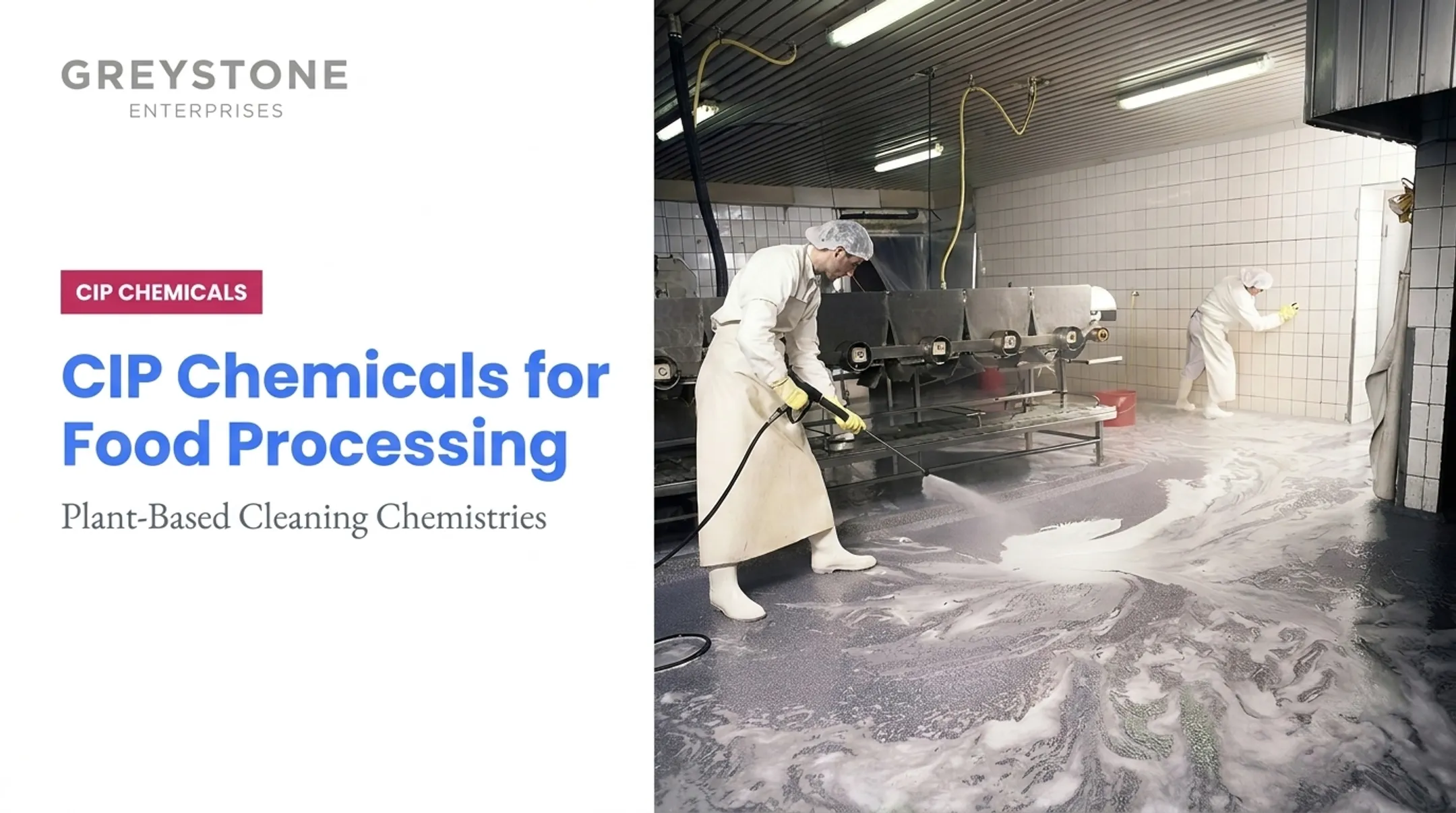
| Hot water / high pressure | Heavy soils, fats, large surfaces | Can embed debris and spread contamination |
| Steam | Thermal sanitizing option | Condensation, hard-to-control exposure |
| Chemical sanitizing | After soil removal | Label conditions, organic load |
In September 2025, FDA's warning letter to Gracie's Kitchens cited high-pressure cleaning that splashed from walls, mats, floors, and drains onto food-contact surfaces. Pressure helps only if water and debris movement is controlled.
Clean zones systematically
Work from the cleanest areas outward and from top to bottom so runoff doesn't recontaminate finished surfaces.
Surfaces to cover include:
- Mixers, tanks, conveyors, and utensils
- Floors, walls, drains, and floor-wall junctions
- Overhead structures
Pay special attention to harborage points, splash zones, and hard-to-reach areas.
Greystone pairs HelioJET high-pressure hot-water and steam technology with Tri-Solve plant-based chemistries to build facility-specific approaches, such as plant-wide washdown or interior tank and vessel cleaning.
Fit depends on equipment, soil, and the facility's own validation. Neither technology carries universal suitability or regulatory approval.
Control chemicals, water, and worker safety
Common chemistry categories and their roles:
- Alkaline cleaners lift food waste and acid soils.
- Acid cleaners remove mineral deposits.
- Surfactant detergents help lift otherwise insoluble soils.
- Food-contact sanitizers include chlorine, peracetic acid, and quaternary ammonium formulations.
Sanitizers are registered antimicrobial pesticides, so EPA labels govern use, including contact time. 21 CFR 178.1010 sets formulation-specific conditions, not one universal concentration.
For worker safety, OSHA's hazard communication rule requires labeling, accessible safety data sheets, and training.
- Provide appropriate PPE
- Store chemicals properly
- Never mix incompatible products; OSHA specifically warns against combining bleach and ammonia
Water matters too. Under 21 CFR 117.37, water contacting food or food-contact surfaces must be safe and of adequate sanitary quality. Hardness affects detergent and sanitizer performance, and heat helps with fats. Validate pressure, temperature, and flow at your facility rather than copying generic settings.
Building and Managing a Food Industry Sanitation Program
Conduct a risk-based assessment
Map the plant first. Document production areas, equipment, food-contact surfaces, allergens, soil types, changeovers, water routes, drains, waste areas, and employee traffic. That map drives cleaning methods, frequencies, responsibilities, and high-risk controls.
Write effective SSOPs and schedules
An SSOP should state:
- Area or equipment covered
- Preparation steps
- Cleaning and sanitizing sequence
- Chemicals and tools
- Safety precautions
- Responsible employees and frequency
- Acceptance criteria and release steps
- Required records
The FSIS SSOP model stresses that each plan must be modified for the specific facility. A master sanitation schedule then coordinates routine, periodic, pre-operational, post-operational, changeover, and maintenance tasks. No single frequency fits every plant; 21 CFR 117.35 requires cleaning as often as necessary.
Train employees and control execution
Training should be hands-on. Cover hygiene, tool segregation, chemical handling, disassembly, allergen changeovers, spill response, and reporting illness or deviations. 21 CFR 117.4 requires staff, including temporary workers, to be qualified and trained, with records.
Training doesn't guarantee behavior. A 2024 study of a UK sandwich factory observed that 32% of hand-hygiene opportunities were skipped. It's a UK comparator, not a U.S. benchmark, but the lesson transfers: add competency checks, refreshers, visual instructions, and clear ownership across shifts.

Integrate with U.S. compliance requirements
Sanitation sits inside several frameworks. Verify current text before relying on any of them.
- FDA Part 117: CGMPs and preventive controls, including written sanitation controls (117.135), corrective actions (117.150), verification (117.165), and records (117.305).
- USDA FSIS: 9 CFR Part 416 requires written SSOPs for official meat and poultry establishments, with daily records retained at least six months.
- Certification schemes: SQF, BRCGS, and FSSC 22000 each set documented cleaning and verification expectations, and editions are changing.
Requirements vary by product category and facility. Records should show implementation, monitoring, verification, deviations, corrective actions, and review.
Manage deviations, maintenance, and changeovers
When an inspection, test, or equipment problem reveals a failure:
- Hold or assess affected product where necessary.
- Document the deviation.
- Identify the root cause.
- Re-clean and verify.
- Prevent recurrence.
Tie sanitation to preventive maintenance, hygienic equipment design, allergen changeovers, pest control, drainage, waste handling, and changes in suppliers or chemicals.
Verifying Effectiveness and Improving the Program
Use multiple verification methods
No single test answers every question.
| Method | Shows | Doesn't show |
|---|---|---|
| Visual inspection | Visible residue | Allergen or microbial status |
| ATP | General cleanliness | Allergen-specific results; ATP can come from food |
| Environmental monitoring | Pathogen or indicator presence at defined sites | Allergen removal |
| Microbiological testing | Organism-specific evidence | Allergen removal |
For allergens, FDA's draft guidance treats changeover records and allergen-specific testing as verification examples. Sampling plans, methods, and acceptance criteria should come from your lab, regulators, and customers, not invented thresholds.
FDA's 2017 Listeria draft uses four zones, from food-contact surfaces (Zone 1) to areas outside processing (Zone 4), as a useful sampling framework.
Review records and investigate trends
Don't treat each failure as isolated. Review these records together:
- Checklists and chemical usage
- Missed tasks and recurring failed areas
- Environmental results and equipment issues
- Corrective actions
FDA's draft guidance says repeated findings in one area warrant root-cause analysis.
Where data allows, trend by line, area, shift, soil type, equipment, and method.
Improve hygienic design
Some problems are design problems, and no cleaning crew can fix them. Typical culprits:
- Inaccessible parts and hollow rollers
- Cracked floors and damaged surfaces
- Poor drainage and standing water
- Dead legs and condensate pans
- Floor-wall junctions that trap residue
The 2011 Jensen Farms investigation documented cooler condensate draining near packing equipment, an unsealed trench drain, and residue left after cleaning. FDA described a possible contamination pathway, not a proven single cause.

No single design feature eliminates risk, but 3-A and EHEDG guidance both stress deciding the cleaning method during design.
Reduce resource use without weakening food safety
EPA and Oklahoma State Extension both identify optimized CIP and washdown as ways to cut chemical, water, energy, and labor use.
Ways to look for savings:
- Improve soil removal so cycles don't repeat
- Match chemistry to the soil
- Tune pressure and heat
- Stop over-cleaning
- Maintain equipment
Treat sustainability as a controlled improvement. Any cut in water, chemicals, or energy needs validation against sanitation performance, product risk, worker safety, and applicable requirements.
Conclusion
Food industry sanitation functions as an operating system across the full production cycle. It spans risk assessment, preparation, cleaning, sanitizing, personnel practices, equipment condition, documentation, verification, and corrective action.
Food and beverage facilities with difficult soils, complex equipment, or inconsistent results can review their process with Greystone and evaluate a customized combination of Tri-Solve cleaning chemistry and HelioJET hot-water or steam technology.
Frequently Asked Questions
What are the standard cleaning and sanitation procedures in the food industry?
Typical steps are preparation, dry soil removal, detergent cleaning, rinsing, inspection, sanitizing, drying, documentation, and verification. Exact procedures depend on the facility, equipment, product, and applicable requirements.
What are the principles of food safety?
Food safety means preventing and controlling hazards through hygiene, sanitation, temperature and process controls, and allergen management. It also requires monitoring, verification, corrective action, documentation, and continuous improvement.
What are the 5 C's of food hygiene?
No single FDA, FSIS, or Codex manufacturing framework defines the "5 C's." A recognized alternative is WHO's Five Keys to Safer Food. Such mnemonics aid training but don't replace documented facility requirements.
What chemicals are commonly used in the food industry for cleaning?
Common categories are alkaline detergents, acid cleaners, surfactant cleaners, and approved food-contact sanitizers. Follow label directions for concentration, contact time, and compatibility. Use PPE, store chemicals safely, and never mix them.
What is the definition of food sanitation?
Food sanitation is the set of practices that maintain hygienic conditions and reduce contamination risk in food production. It's one part of the broader food safety management system, not the whole of it.