
Introduction
Paper recycling takes more than water and mechanical separation. Chemistry releases ink, adjusts pH, brightens fiber, and conditions pulp for its next life as a new product.
The catch is that no single formula fits every mill. Recovered paper grade, contaminants, equipment, and water quality all change what works.
This article separates the chemicals that recycle recovered paper from virgin wood pulping chemistry, papermaking additives, equipment cleaning, and wastewater treatment. It covers chemical categories, where each enters the process, environmental and safety issues, and how mills can evaluate a program.
Key Takeaways
- No universal recipe exists; furnish, contaminants, equipment, and finished product drive the program.
- Surfactants, alkali, bleaches, and process aids do different jobs and aren't interchangeable.
- Chemistry works alongside screening, cleaning, wastewater treatment, and safety compliance.
- Cleaner collection and sorting reduce the load on downstream chemistry.
Chemicals Used in Paper Recycling: Categories and Functions
Practices vary by mill, so this section covers representative chemical families rather than a ranking. Verify current practice for your own furnish.
De-inking and ink-release chemistry
Flotation involves three steps:
- Ink detaches from fibers
- Ink particles attach to air bubbles
- The ink-laden froth is removed
USDA Forest Service research shows surfactants can help or impair those steps. A 2011 Chalmers study describes nonionic surfactants as less sensitive to water hardness. The right blend depends on ink, paper grade, water chemistry, and equipment.
Alkaline agents play a supporting role. Sodium hydroxide appears among reported recovered-paper de-inking chemicals and sets pH for peroxide bleaching. Sodium silicate adds alkalinity and stabilizes hydrogen peroxide.
This is far milder than kraft pulping, where sodium hydroxide and sodium sulfide in white liquor digest wood chips and dissolve lignin. That is virgin-fiber chemistry.
Brightening and bleaching agents
Hydrogen peroxide is the documented oxidative brightener for deinked pulp and old newsprint. One 2021 old-newsprint study advised against exceeding 2% peroxide for economic reasons. That is a finding from one study, not a mill limit.
Chlorine dioxide and hypochlorite are a different story. How widely they are used on recycled-fiber pulp remains unclear. EPA regulates AOX and chloroform in some pulp and paper subcategories, but a pollutant listing doesn't show that a given mill uses chlorine bleach. Treat chlorine-containing options as process-dependent at most.
Process conditioning and contaminant-control aids
Sodium hydrosulfite is a reducing agent, not an oxidizing bleach. NCASI describes a minimal bleaching sequence with peroxide during pulping and hydrosulfite at the end of de-inking. Keep the two categories separate.
Other aids include:
- Chelants such as DTPA, used in a peer-reviewed de-inking example
- Stickies-control products combining enzymes, surfactants, dispersants, and passivators (a supplier claim, not independent validation)
Calcium carbonate is a papermaking filler. Alum and polyacrylamide show up in papermaking or wastewater work. None of these should be labeled core de-inking chemicals.

Where Chemicals Enter the Paper Recycling Process
Mechanical separation does most of the contaminant removal. Chemistry is applied selectively to improve fiber recovery, ink separation, brightness, water quality, or equipment performance.
Pulping and fiber liberation
Recovered paper is slurried with water in a pulper. Controlled alkalinity and surfactants help free fibers from ink, coatings, adhesives, and fillers.
Demand depends on the furnish. EPA's Secondary Fiber Deink category covers fine papers, newsprint, and tissue, while its non-deink category covers paperboard from wastepaper, including corrugating medium. No universal chemical-demand figure exists for any of them, and mixed paper's variable makeup rules one out.
De-inking and flotation
Chemistry conditions ink particles so air bubbles carry them to the surface. Screens and cleaners handle larger contaminants.
Dosage matters. Surfactant chemistry can affect flotation positively or negatively, and coating dispersants and fines influence froth stability. Flotation also removes valuable fiber and mineral material, which cuts yield. TAPPI research covers these component-removal effects, though no universal overdosing limits exist.
Screening, cleaning, and stock preparation
Pressure screens, centrifugal cleaners, and washers pull out plastics, adhesives, stickies, and heavy particles. Chemistry conditions the slurry; it doesn't replace the equipment.
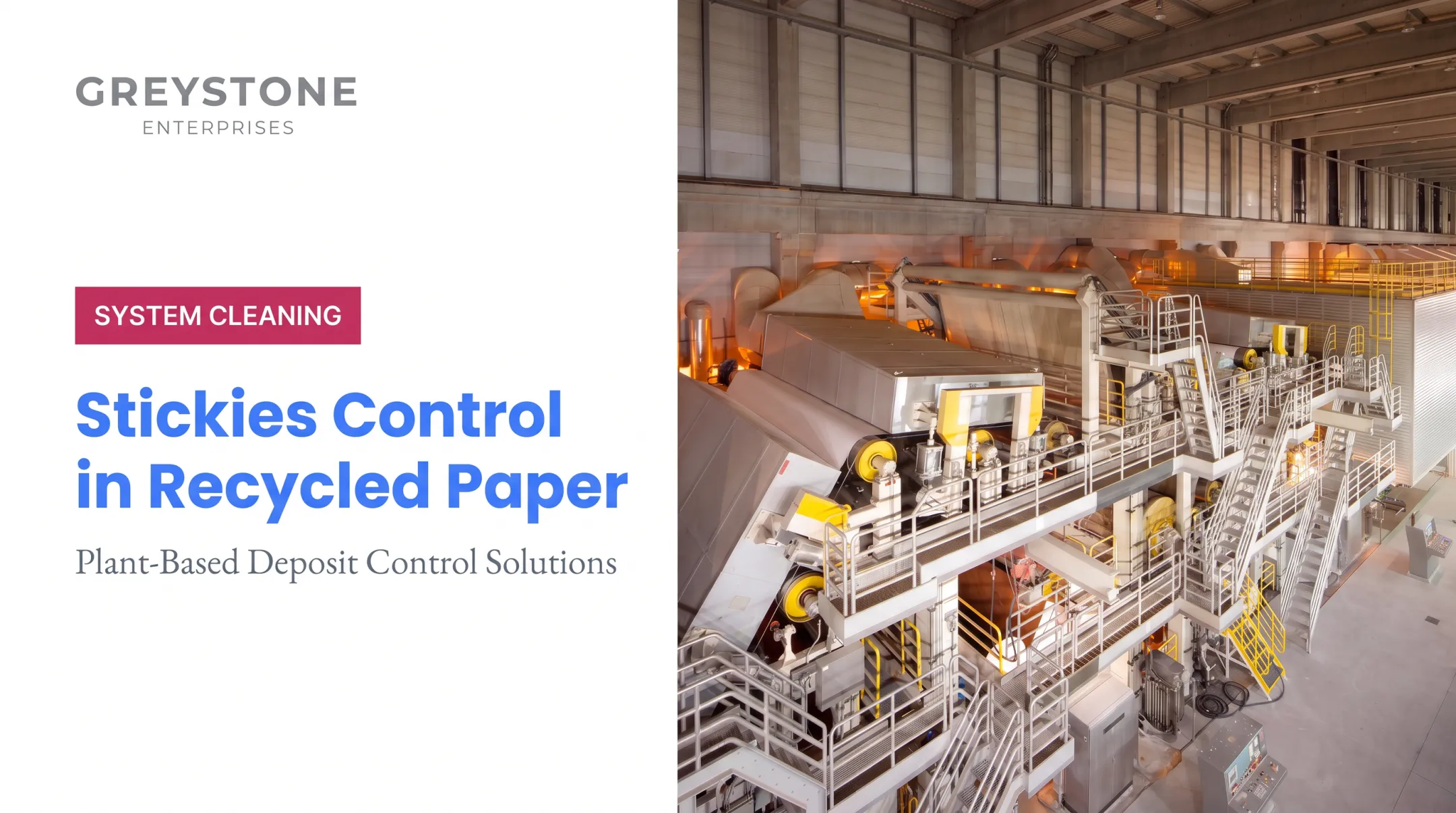
Stickies deserve attention. They deposit on wires, felts, rolls, and dryers, causing plugged fabrics, poor runnability, specks, holes, and cleaning downtime. Dedicated equipment cleaning is a separate category from process chemistry.
Brightening, sheet formation, and final product
Cleaned pulp may get further brightening before it is formed, pressed, and dried. Not every grade needs the same whiteness. Brightness targets differ by grade for tissue, newsprint, office paper, packaging board, and molded fiber, so confirm specifications with your customers.
Water loop and wastewater
Dissolved ink, fines, fillers, surfactants, salts, and bleaching residues enter process water. Treatment chemicals added after water leaves the process line are separate from process chemicals.
One study of a 100% recovered-paper mill found water-circuit closure was limited by contamination and runnability concerns. That mill used anaerobic and aerobic treatment followed by ultrafiltration and reverse osmosis. It's a case study, not a template.

Environmental, Wastewater, and Safety Considerations
Recycling can reduce demand for virgin fiber. A 2013 tissue life-cycle study found lower greenhouse gas emissions for the recycled route. Mills still manage wastewater, sludge, rejects, energy use, and chemical handling.
Wastewater quality and treatment
EPA's effluent guidelines list BOD, TSS, and pH as conventional pollutants, and COD, AOX, and chloroform among nonconventional ones. Regulated pollutants vary by subcategory under 40 CFR Part 430.
Typical objectives include:
- Solids separation and clarification
- pH adjustment
- Biological reduction of organic load
- Filtration and sludge management
Most mills use primary clarification, sometimes followed by secondary biological treatment. No single train fits every mill.
Chemical handling and worker protection
OSHA's Hazard Communication standard (29 CFR 1910.1200) requires SDS access, container labels, and employee training. Beyond that, plan for storage compatibility, ventilation, dosing controls, PPE, and emergency response.
Oxidizers, caustics, acids, reducing agents, and chlorine-containing products each need separate handling controls. One hydrosulfite SDS lists acids and oxidizing agents as materials to avoid. Follow product-specific SDS guidance.
Trade-offs and alternatives
No chemical is automatically green or harmless. Compare oxygen-based brightening, reducing agents, surfactant systems, and chlorine options on effectiveness, fiber impact, by-products, wastewater burden, and product specs. Mill-level evidence beats marketing claims.
Contamination prevention and compliance
EPA guidance says recovered paper should be clean, dry, and free of contaminants such as plastic, glass, and metal. Better sorting and removal of food, liquids, tapes, and coatings reduces chemical demand. Track brightness, yield, reject rates, sludge, and chemical use against your own baselines.
Review federal, state, and local rules for discharge, air emissions, hazard communication, storage, and disposal. Mills pulping secondary fiber may fall under certain MACT III provisions. Before introducing any chemical, request SDSs, technical data sheets, certificates of analysis, compatibility information, and traceability records.
How Mills Can Evaluate Paper Recycling Chemistry
No public universal protocol sets pass/fail thresholds for recovered-paper chemistry trials, so build your own.
- Match the program to your system: furnish, contaminant profile, equipment, water loop, final product, and treatment capacity.
- Run controlled trials: set acceptance criteria for brightness, ink removal, yield, stickies, foam, drainage, deposits, wastewater quality, and sheet performance. Track yield, brightness, and ERIC against defined limits. USDA research notes brightness and ERIC are less reliable for very clean paper.
- Compare total operating impact: dosage, storage, handling, equipment cleaning, treatment, downtime, rejected fiber, regulatory duties, and supplier support, not just purchase price.

Industrial Cleaning Support for Paper Mill Operations
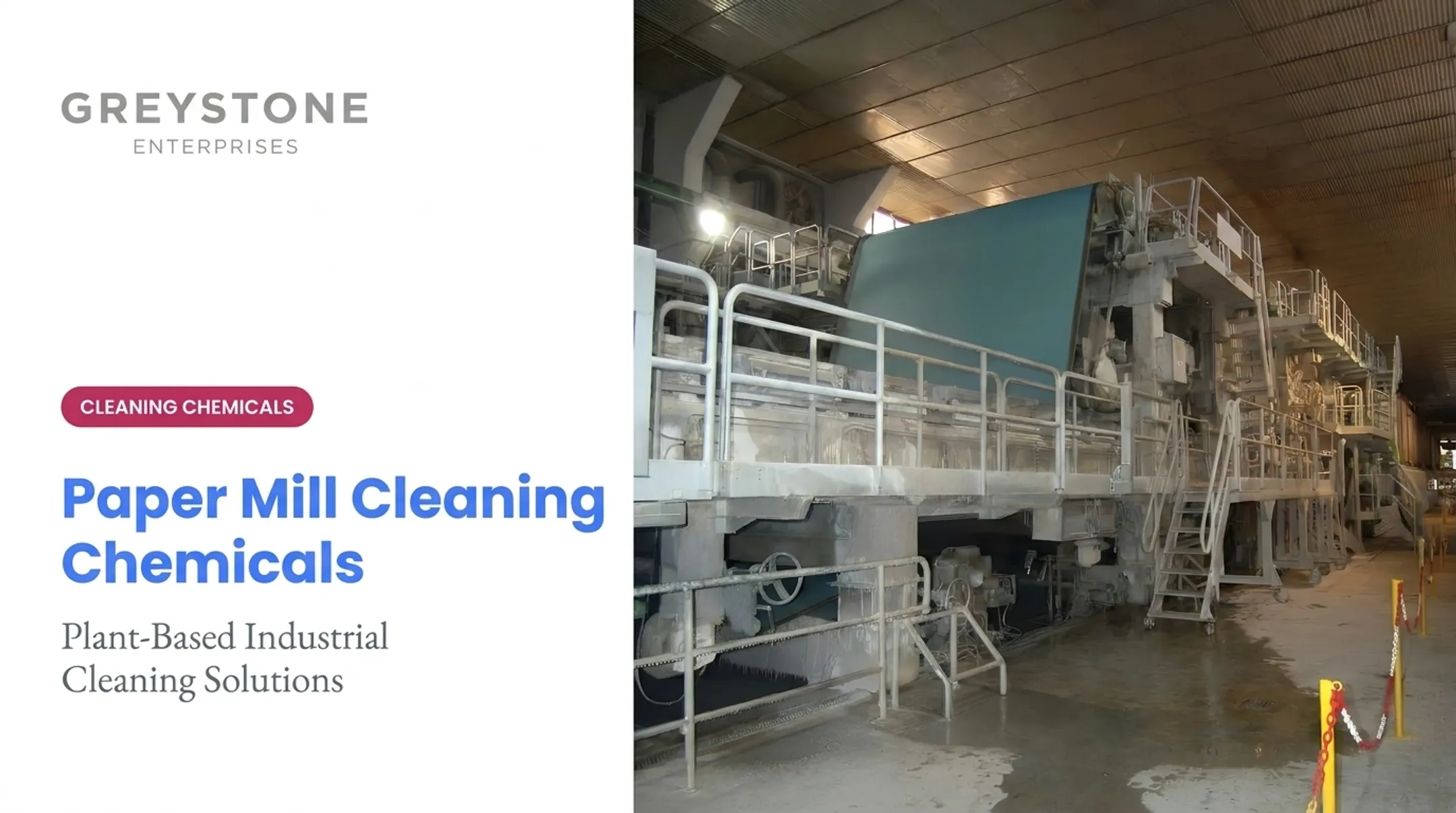
Process chemicals recycle fibers. Cleaning chemistry maintains the equipment that keeps those lines running: tanks, piping, wires, press felts, dryer fabrics, floors, and other surfaces.
Greystone serves paper mills on that equipment side with cleaning and conditioning chemistries, system and deposit-control programs, and facility-specific strategies. The focus is wires, press felts, and dryer fabrics, targeting permeability, drainage, and runnability. Greystone's cleaning solutions don't replace a mill's de-inking or pulping formulation.
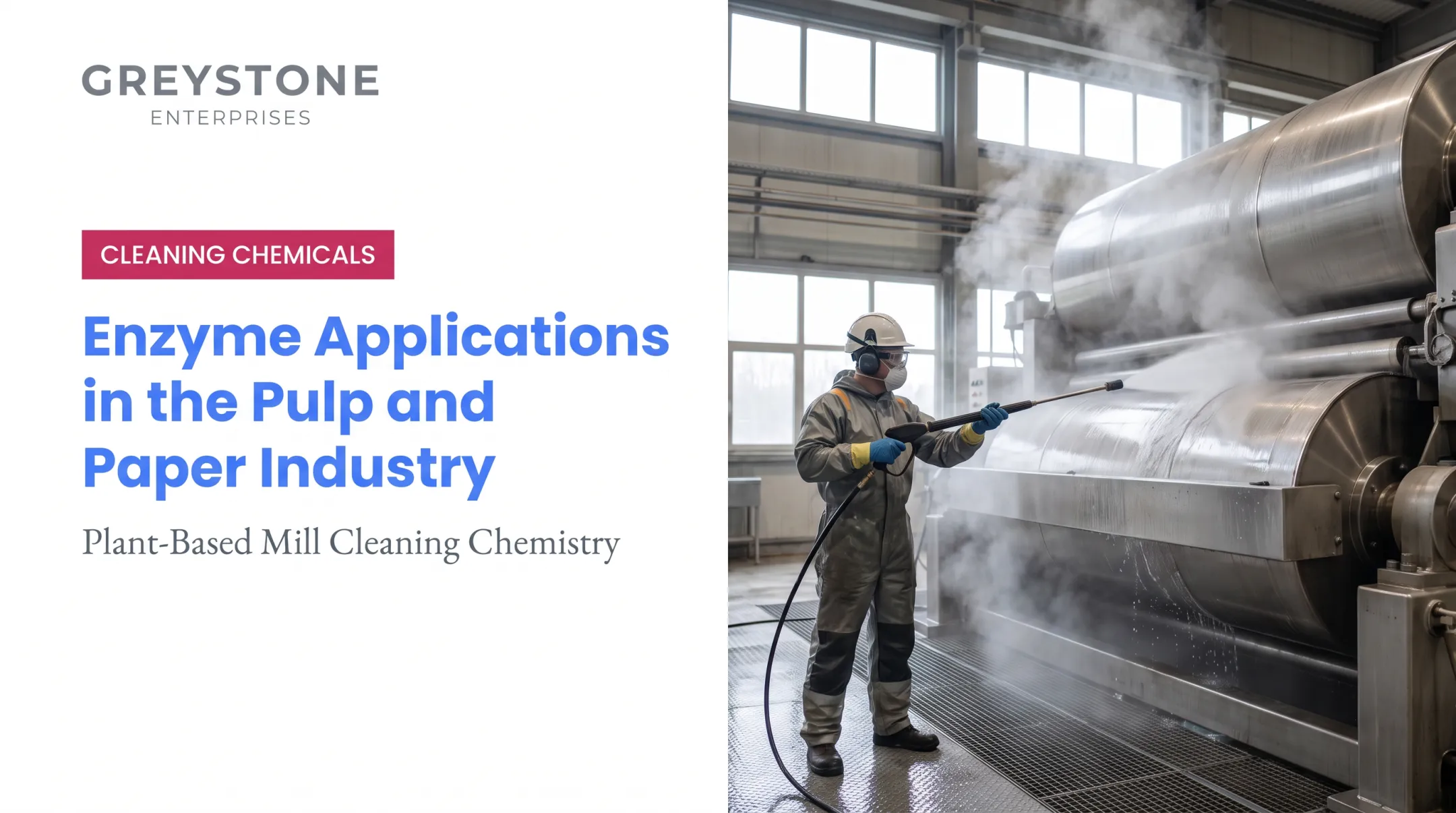
The company pairs HelioJET high-pressure hot-water and steam technology with Tri-Solve plant-based chemistries. Programs target contaminants that cut felt permeability, especially on machines running high percentages of secondary fiber:
- Pitch and tar
- Stickies and hot melts
- Latex and ink
Greystone reports dryer-fabric cleaning cycles as short as 20 minutes with HelioJET and chemistry.
Evaluate any cleaning solution through:
- Site assessment and compatibility review
- Safety documentation
- Measurable goals such as felt life, downtime, and rinse time
Frequently Asked Questions
What chemicals are used in paper recycling?
Main categories are de-inking surfactants, pH-control agents like sodium hydroxide, brightening agents like hydrogen peroxide, reducing agents like sodium hydrosulfite, and process aids. Formulations vary by mill and paper grade.
How is pulp and paper mill wastewater treated?
Treatment may include screening, clarification, pH adjustment, biological treatment, filtration, and solids handling. The mix depends on the wastewater profile and discharge requirements.
What are the three types of paper that cannot be recycled?
There is no universal US list of exactly three types. Common problem materials include food-soiled paper, waxed or plastic-coated paper, and thermal receipts. Check local acceptance rules.
Does recycled paper have microplastics?
Paper fibers aren't plastic, but coatings, synthetic additives, and contamination can introduce plastic. A 2024 Finnish study found microplastics in a pulp and paper mill's wastewater sludge, though it didn't tie them to recycled furnish.
Is kraft paper chemical free?
No. Kraft pulping uses sodium hydroxide and sodium sulfide to digest wood chips, and the paper may carry sizing, coatings, or dyes. Treat "chemical-free" claims skeptically and ask for verified composition.
How long will paper pulp last?
Fibers shorten with each cycle. EPA's archived FAQ cites a rule of thumb of five to seven cycles before fibers are too short to bond. Actual limits vary by fiber, mill, and product.