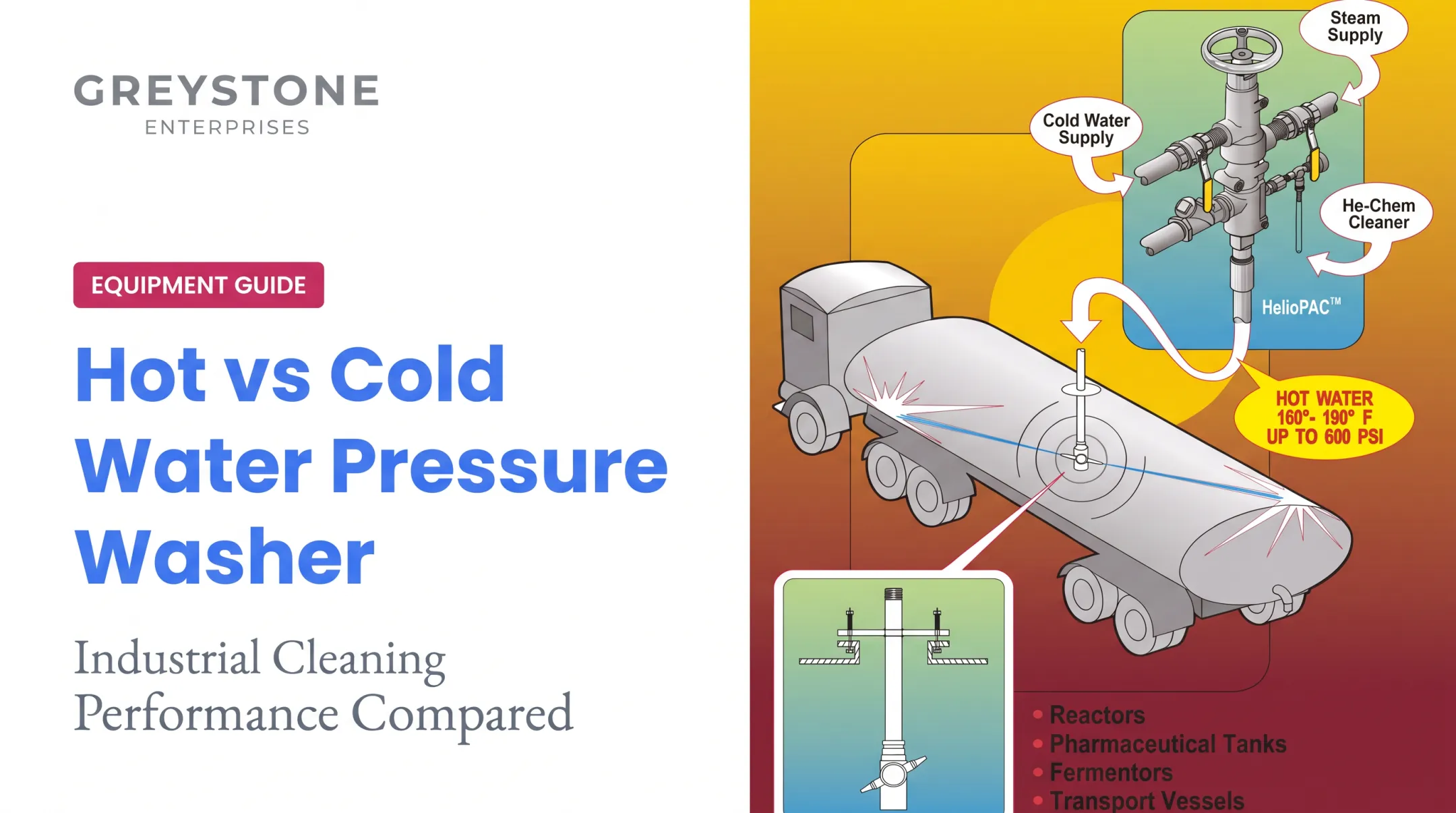

This guide is for industrial maintenance teams, fleet wash bays, manufacturing plants, and food and beverage facilities. The right result depends on more than PSI. We cover hot versus cold water, PSI and GPM, detergent and nozzle choice, safe technique, wastewater, and when a customized industrial system makes sense.
Key Takeaways
- Hot water usually outperforms cold on oil, grease, and fatty soils.
- Judge PSI, GPM, temperature, detergent, nozzle, dwell time, and technique together.
- Remove bulk grease first, protect people, and control runoff.
- Recurring plant-wide grease work may justify a centralized hot-water system.
Why Hot Water Pressure Washers Are Effective for Grease Removal
How grease behaves during cleaning
Grease isn't ordinary dirt. Cold water can soften, smear, or relocate oily soil instead of separating it from the surface. Heat lowers grease's resistance to removal, detergent breaks the bond between the soil and the surface, and water flow carries the loosened material away.
Karcher states that hot water softens congealed oil and grease, improves emulsification, and can reduce detergent requirements.
Heat, agitation, and chemistry work together
Cleaning combines temperature, mechanical action from pressure and flow, and a compatible detergent, plus time. Drop one element and you make up for it with another: more chemical, more dwell time, or more passes.
Hot water versus cold water
- Hot water: grease, oil, fats, and oily road film
- Cold water: mud, dust, and many non-greasy soils
Hot water isn't safe for every surface. Check coatings, seals, plastics, and process areas for compatibility before you start.
Hot water versus steam
A hot-water pressure washer pairs heated water with high-pressure flow and agitation. Steam equipment serves more specialized jobs, often at reduced water volume. Karcher's US guidance describes hot-water operation up to 185°F and a steam stage up to 311°F on its equipment. Neither method is universally better. Match it to the soil and surface.
How to Choose a Pressure Washer for Grease Removal
Start with the soil and the surface. Is it cooking fat, lubricant, hydraulic oil, fuel residue, road film, or a mix? Write down what you're cleaning.
Then work through these factors:
- Temperature and PSI: Hot water softens grease so it releases with less force. No universal setting exists; published industrial models range from roughly 1,300 to 3,500 PSI. Pressure alone doesn't measure cleaning performance, and excess pressure can damage coatings, seals, flooring, labels, and sensors.
- GPM: Flow, typically 2.2 to 8 GPM on industrial units, determines how fast loosened grease and detergent rinse away.
- Nozzle: Start with the widest spray angle (a 40-degree white tip) and narrow only as needed. Keep working distance in check and test an inconspicuous spot first.
- Detergent: Follow label directions for dilution and dwell time, confirm material compatibility, and keep the safety data sheet accessible. Where food contact is possible, verify the product's registration and rinse requirements.
Portable, mobile, or centralized
| System type | Fits best when |
|---|---|
| Portable | One or two users, occasional jobs, changing locations |
| Mobile or skid-mounted | Remote sites, onboard water or power needed |
| Centralized in-plant | Frequent use, many users, piped drops, available steam and utilities |
Consider hose runs, plant layout, ventilation, and wastewater controls. For reference, HelioJET single-user stations run 3 to 14 GPM, typically at 200 to 400 PSI and 170 to 190°F. Its central models scale from 15 to 100 GPM.

A Safe, Effective Grease-Removal Workflow
Site preparation and operator protection
- Isolate equipment and secure moving parts.
- Protect electrical components and set up a slip-resistant work zone.
- Wear PPE suited to a documented hazard assessment. HelioJET guidance calls for a face shield, wet suit, boots, and gloves.
- Follow washer and chemical manufacturer instructions.
OSHA's PPE standard requires employers to assess hazards, select PPE, and train workers. High-pressure spray can also cause injection injuries that look minor at first, so seek medical care immediately.
Before washing, inspect coatings, seals, bearings, sensors, labels, drains, and floor condition. Lockout/tagout applies when cleaning exposes workers to unexpected startup or energy release.
Remove bulk contamination first
Scrape, wipe, vacuum, or absorb heavy deposits. This keeps grease from spreading and cuts the contaminant load in your wastewater.
Apply detergent strategically
Use the approved degreaser at the correct dilution. Work in manageable sections and let it dwell without drying. Don't coat the whole area at once.
Wash with controlled heat, pressure, and flow
- Use the lowest effective pressure.
- Keep a safe distance and make overlapping passes.
- Adjust temperature and nozzle to the surface and soil.
- Work from cleaner areas toward dirtier ones.
- Avoid forcing grease into seams, drains, bearings, or insulation.
Rinse, inspect, and repeat only where needed
Rinse thoroughly, then look for leftover film. Re-treat those spots instead of raising pressure across the whole surface.

Wastewater, cleanup, and equipment care
Contain, collect, filter, or treat greasy wastewater under federal, state, and local rules. Never let oil, detergent, or wash water reach an unauthorized drain or waterway.
EPA's fleet-washing guidance calls for containment and treatment, avoiding storm-drain discharge, and sewer-authority permission before sanitary-sewer discharge.
Detergents can emulsify oil so it won't float, which defeats many oil/water separators. Cleaning performance doesn't prove the water is acceptable to discharge.
After the job:
- Flush detergent from the system.
- Inspect hoses and nozzles. Worn nozzle orifices lower pressure.
- Store equipment safely.
- Log recurring soil or equipment problems.
Best Industrial Applications for Grease-Removal Pressure Washing
Heavy-equipment and fleet maintenance wash bays
Hot-water washing removes grease, hydraulic residue, road film, and caked-on soil from trucks, trailers, engines, chassis, and shop equipment. Plan for runoff containment, and protect seals, sensors, and electrical connections during washdown.
Manufacturing, food, and beverage facilities
Production floors, conveyors, equipment exteriors, and changeover cleaning all involve fatty soils. Use approved chemistries, follow sanitation procedures, and control residue. Food plants must also verify results, since grease removal alone doesn't establish compliance with FDA or USDA sanitation rules.
Plant-wide and process-equipment cleaning
Tanks, vessels, mixers, and multi-line plants often use a centralized washdown system with matched hose drops and tank-cleaning accessories.
Across these applications, match the setup to the job:
- Contaminant: fat, oil, or mixed soil
- Surface: coating, stainless, concrete, or sensitive components
- Frequency: occasional or daily
- Utilities: steam, water, drains, ventilation
- Wastewater plan: containment, treatment, approved discharge
When to Move Beyond a Portable Pressure Washer
Watch for these signs:
- Several crews share one unit
- Setup takes too long
- Results vary from shift to shift
- Grease-heavy work repeats daily
- Hoses get dragged across the plant
- Water and chemical use are hard to control
When several of these show up at once, a portable unit is no longer enough. Greystone pairs HelioJET high-pressure hot-water and steam technology with Tri-Solve plant-based chemistries to build facility-specific cleaning strategies. HelioJET central systems pipe hot water to multiple drops, so crews wash on demand without a fleet of portable units.

Greystone works with manufacturing, food and beverage, energy, transportation, agriculture, pharmaceutical, and fleet operations. Before you choose a system, review soil types, surfaces, cleaning frequency, safety requirements, and sustainability goals against how your crews actually clean today.
Frequently Asked Questions
What's the difference between a power washer and a pressure washer?
The terms are often used interchangeably. Some sources reserve "power washer" for heated-water equipment. Check the specifications rather than the label.
What can a 3000 PSI pressure washer clean?
It can handle many heavy-duty surfaces and soils. Grease removal also depends on GPM, water temperature, detergent, nozzle, surface material, and technique.
Is hot water or cold water better for removing grease?
Hot water is generally preferred for grease and oil. Cold water can suit non-greasy dirt and surfaces that heat could damage.
What PSI and GPM do I need to remove grease?
No universal specification exists. Match PSI and GPM to the soil, surface, temperature, detergent, cleaning frequency, and manufacturer guidance.
What detergent should I use with a pressure washer for grease removal?
Use an industrial degreaser approved for your surface and application. Follow the label and safety data sheet, and verify food-contact and wastewater requirements.
How should I dispose of greasy wastewater after pressure washing?
Contain it and manage it under federal, state, and local requirements. Confirm drain authorization and treatment needs before any discharge.