
Introduction
A degreaser that strips everything in sight can still be the wrong degreaser. It may etch aluminum, foam out a recirculating tank, leave a film that ruins paint adhesion, or send a spent bath to your local wastewater plant with a pH that violates its limits.
This guide is a practical framework for US industrial settings. It covers ingredient functions, laboratory screening, pilot production, scale-up and compliance. It is not a ready-to-use recipe. Every formula has to be validated against your soil, substrate, equipment and cleanliness standard.
Key Takeaways
- The strongest degreaser is rarely the best one. Soil removal, substrate protection, and compliance decide it.
- Aqueous systems balance alkalinity, surfactants, chelants, and inhibitors; solvent systems rely on solvency and evaporation.
- Start with a written cleaning specification, then screen, test compatibility, pilot, and document.
- Validate the whole process: concentration, temperature, time, agitation, rinse, and drying.
What Industrial Degreaser Formulation Must Accomplish
Which soils must the formula remove?
Classify the soil before choosing chemistry. ASM's surface cleaning handbook lists pigmented drawing compounds, unpigmented oils and greases, and chips and cutting fluids. Process choice depends on both soil and substrate.
Common targets include:
- Mineral oils and greases
- Fatty, saponifiable soils
- Waxes, adhesives and carbon deposits
- Metalworking fluids and particulate
- Process residues such as stickies, pitch and tank tidelines
Soil age, oxidation and heat history all make removal harder. Treat them as test variables, since no single benchmark quantifies how much each factor slows cleaning. Heat-set organic soils on paper-machine dryer fabrics, for example, call for a different formula than fresh light oil on a shop floor.
Which variables decide whether it works?
Cleaning performance depends on more than the chemical:
- Substrate material and required surface cleanliness
- Water hardness and temperature
- Contact time and mechanical energy
- Dilution method and foam tolerance
- Rinse requirements and bath or wastewater conditions
Alfa Laval's cleaning principles describe this as temperature, mechanical action, time and chemistry. More of one factor can offset less of another.
Which architecture fits?
| Approach | Strength | Watch for |
|---|---|---|
| Alkaline aqueous | Saponifies fatty soils, low flammability | Aluminum, zinc and coating attack; skin hazard |
| Neutral aqueous | Gentler on sensitive substrates | Slower on heavy or baked soils |
| Solvent-based | Direct solvency, fast evaporation | VOCs, flammability, exposure, disposal |
| Emulsion/semi-aqueous | Blends solvency with water rinsing | Phase stability, rinse quality |
| Plant-based | Lower environmental impact | Still needs performance and VOC verification |
"Water-based" does not mean zero-VOC or nonflammable. Check the actual formulation. EPA documents a refinery case that replaced 36 of 39 degreasers with aqueous and semi-aqueous systems, but that is one facility, not a universal result.
Core Chemistry and Ingredient Functions
Water, carriers and solvents
Water is the usual carrier. Its hardness, dissolved minerals and temperature affect stability and cleaning.
Process water varies, so test with the water you actually use. Hydrocarbon, oxygenated and bio-based solvents trade water's safety for stronger solvency, but they raise VOC and flammability questions.
Alkaline builders and pH control
Alkaline builders support saponification, soil swelling, dispersion and buffering. They are the workhorses for fatty soils.
The cost is substrate risk. NIST notes that aluminum is readily attacked by alkaline solutions, which is why inhibited alkaline cleaners exist. Zinc, coatings, seals and skin are also vulnerable. No universal safe pH exists, so validate on the actual alloy.

Surfactants and wetting
Surfactants cut surface tension, wet the soil, emulsify it and hold it in suspension.
- Nonionic types handle oils and tend to be low-foaming
- Anionic types add wetting and detergency
- Amphoteric types provide mildness and coupling
- Low-foam grades suit spray, pressure-wash and recirculating tanks
Choose by method. A high-foaming surfactant that works for manual wipe-down can fail in a spray cabinet. Check product-specific data, such as cloud point, from the supplier.
Solvents, hydrotropes and compatibility aids
Solvents help with mineral oils, adhesives, waxes and polar residues. Hydrotropes keep them dispersed in the water phase and help rinsing. Evaluate VOCs, flash point, odor, worker exposure, packaging compatibility and phase stability.
One Tri-Solve dryer-fabric cleaner pairs several solvents and penetrants with hydrotropes and carries a 180°F (85°C) flash point.
Functional additives
- Chelants bind calcium and other ions in hard water and soils
- Corrosion inhibitors protect ferrous and nonferrous metals
- Defoamers control foam in high-agitation systems
- Preservatives and stabilizers protect shelf life where needed
Additives interact. A defoamer can destabilize a surfactant system, and a chelant can change inhibitor behavior. Test the complete package, not individual ingredients. Published evidence does not rank chelants such as EDTA, GLDA or MGDA, so compare them in your own screening.
Step-by-Step Formulation Development and Scale-Up
1. Write the cleaning specification
Document before you formulate:
- Target soils and substrates
- Equipment, temperature, contact time and concentration range
- Acceptable foam, rinse and drying conditions
- Required cleanliness
- Storage, packaging and regulatory constraints
2. Screen at laboratory scale
Compare candidates on representative soils and real substrate coupons, under realistic water and temperature. Measure cleaning alongside corrosion, residue, foam, rinsability, hard-water behavior, odor and stability. ASTM G122 provides a method for evaluating cleaning agents and processes.
3. Control addition and mixing
Order, agitation, temperature, shear, neutralization and addition rate affect clarity, viscosity, foam, phase stability and heat. Neutralization can generate heat.
Water-based processing differs from solvent blending. Solvent work needs ventilation, grounding and other engineering controls.
4. Confirm stability
Run accelerated and real-time storage checks for:
- Separation or precipitation
- Color or odor change
- Viscosity and pH drift
- Container interaction
- Freeze-thaw exposure where relevant
- Performance after storage
No single protocol is universal, so set one for your product. Adopt a formal change-control process: any raw-material or ratio change gets reviewed and retested.
5. Move from pilot to production
Compare pilot batches with the lab benchmark. Qualify raw materials, keep batch records, run in-process checks and set final-release specifications. Verify packaging fill.

Watch for common scale-up traps:
- Mixing dead zones
- Different heat transfer
- Foam entrainment
- Uneven additive distribution
Matching the Formula to Equipment, Substrate and Use
Adapt chemistry to the cleaning method
- Spray cabinets and pressure washers: low foam, since impact does the mechanical work
- Immersion: longer contact, so corrosion inhibition matters more
- Ultrasonic: NASA notes the chemical must match base metal and soil, and some chemistries are made for ultrasonics
- Tank washing: rotating jets give scouring action
- Hot-water and steam: temperature raises performance, but scaling risk and flash points also matter
Control foam, rinsing and re-soiling
Foam looks helpful by hand but can starve pumps and cut impact in recirculating systems. Control it with:
- Low-foam surfactants or defoamers
- Good rinse water, oil separation and filtration
- Bath turnover before loaded soil redeposits
Protect metals, coatings, plastics and elastomers
- List every material the part or equipment contains.
- Run coupon tests at worst-case concentration, temperature and exposure time.
- Inspect for staining, flash rust, swelling, embrittlement and coating adhesion loss.
- Validate rinsing and drying.
Mixed-metal assemblies need the most caution.
Match the production environment
Manufacturing lines, mixers, paper mills, wash bays and food plants each pose different demands. Paper machine dry ends, for example, may need cleaners with flash points above 400°F because surfaces are hot.
Label claims have to match that environment too. Keep them straight. A degreaser cleaning claim is not a sanitizing, disinfectant or food-contact claim. Antimicrobial claims need separate EPA pesticide review, and food plants follow a rinse, clean, rinse, sanitize sequence.
Evaluating chemistry with hot-water systems
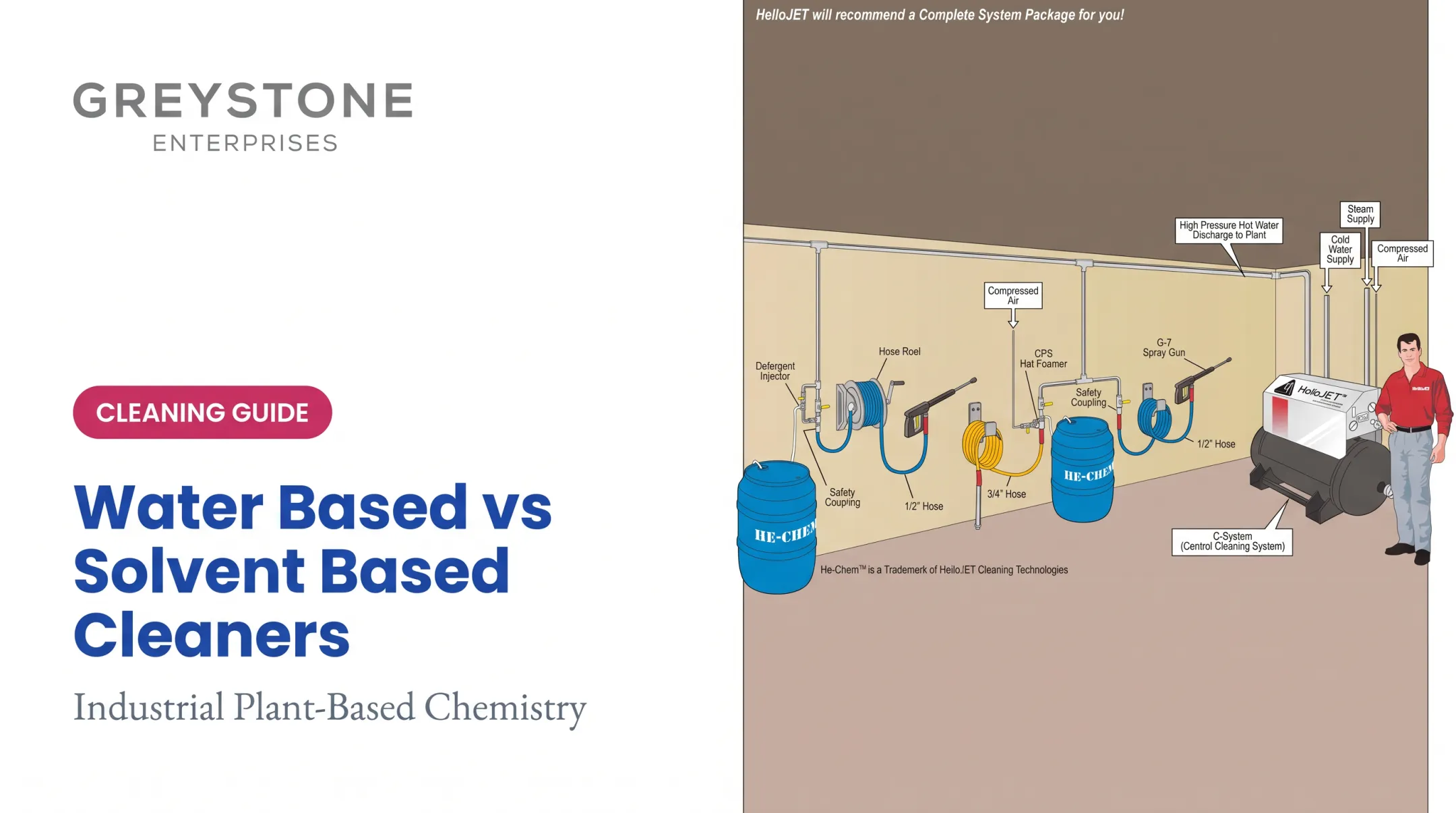
Greystone pairs Tri-Solve plant-based chemistry with HelioJET hot-water and steam equipment. In one documented paper-mill program, a 10% neutral degreaser was applied with the unit off, then rinsed. The cycle ran 22 minutes, with chemical use reportedly down 75%.
That result is a single case, not a universal outcome. Test any combination for chemical use, water, energy, cleaning time, substrate protection and operator safety.

Testing, Safety, Compliance and Quality Control
Build a test plan
| Property | Method or approach |
|---|---|
| Cleaning performance | ASTM G122 |
| Surface cleanliness | ASTM F22 water-break test |
| Foam | ASTM D1173 |
| Corrosion | ASTM G31 immersion |
| pH | ASTM E70 |
Also test:
- Hard-water stability
- Rinse residue
- Phase stability
- Packaging compatibility
- Bath life and repeat-use performance
Choose methods carefully. ASTM D892 (lubricant foam), D130 (copper strip for petroleum) and D1384 (engine coolants) were written for other products.
US worker, environmental and transport requirements
- HazCom: OSHA aligned its standard with GHS Revision 7, with extended compliance deadlines running to 2028. Labels need product identifier, signal word, hazard statements, pictograms, precautionary statements and supplier details.
- SDS: OSHA requires sections 1 to 11 and 16.
- PPE and flammables: Complete a hazard assessment under 29 CFR 1910.132, and follow 1910.106 when the product is a flammable liquid.
- VOCs: limits are set by state and local rules such as CARB and SCAQMD Rule 1171, not one federal industrial limit.
- TSCA: every substance must be on the inventory or go through premanufacture review.
- DOT: shipping rules apply only if the product meets hazmat criteria.
- Wastewater: POTWs prohibit pH below 5.0 and oil that causes interference. Check local limits.
- Spent baths: pH at or below 2 or at or above 12.5 meets the RCRA corrosivity characteristic. Flash points below 140°F meet the ignitability criterion.
Document quality and release
Before a formula moves from pilot to routine manufacturing, require:
- Raw-material specifications
- Batch records and in-process checks
- Final product specifications and certificates of analysis where applicable
- Traceability and retained samples
- Deviation handling
- Written approval
ISO 9001 documented-information guidance offers a useful framework, though it is not degreaser-specific.
Frequently Asked Questions
What is the strongest degreaser ever made?
No single product wins on every soil and substrate. Aggressive alkaline and solvent systems carry corrosion, coating damage, flammability, exposure and disposal risks. The best formula is the one validated for your whole cleaning process.
What ingredients are commonly used in an industrial degreaser formulation?
Carriers, alkaline builders, surfactants, solvents where appropriate, chelants, corrosion inhibitors, hydrotropes, defoamers, stabilizers and preservatives. Selection and loading depend on the application.
What is the difference between solvent-based and water-based industrial degreasers?
Solvents dissolve soil directly. Water-based systems emulsify, saponify and disperse it. They differ in VOCs, flammability, rinsing, substrate compatibility, wastewater and equipment needs.
How do I formulate a heavy-duty water-based degreaser?
Start with soil and substrate testing. Then balance alkalinity, surfactants, water conditioning, corrosion protection, foam control and stability for your application conditions. Validate in the lab and pilot rather than copying an unverified formula.
How do I choose a degreaser for aluminum and other sensitive metals?
Screen for compatibility on the actual alloy. Use controlled or near-neutral chemistry where appropriate, add corrosion inhibitors, limit dwell time, rinse thoroughly and validate drying.
How do you test an industrial degreaser before production?
Use representative soil coupons and compare cleaning, corrosion, foam, hard-water stability, rinsability, residue, storage stability and packaging compatibility. Confirm pilot-batch repeatability under actual plant conditions.