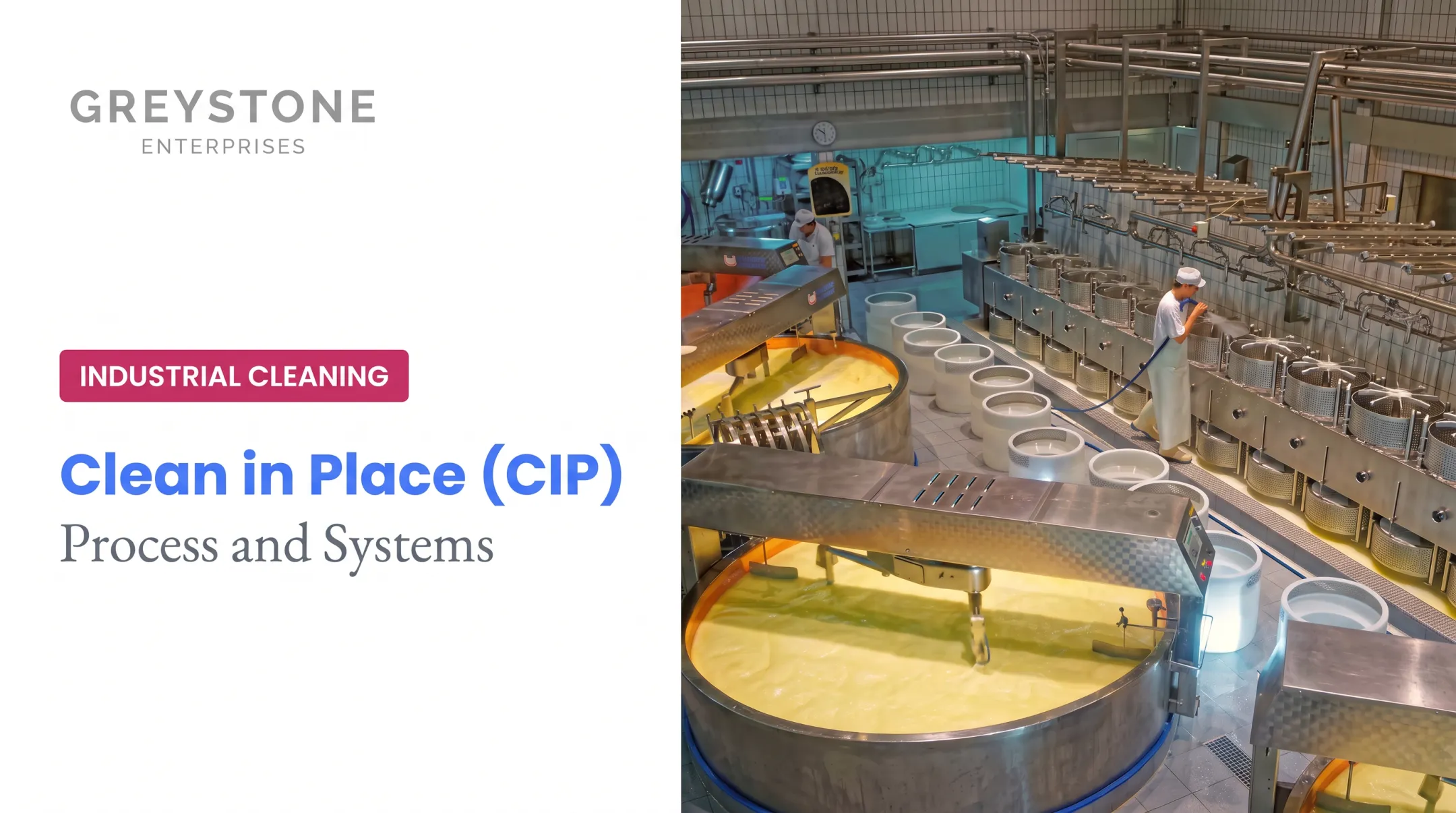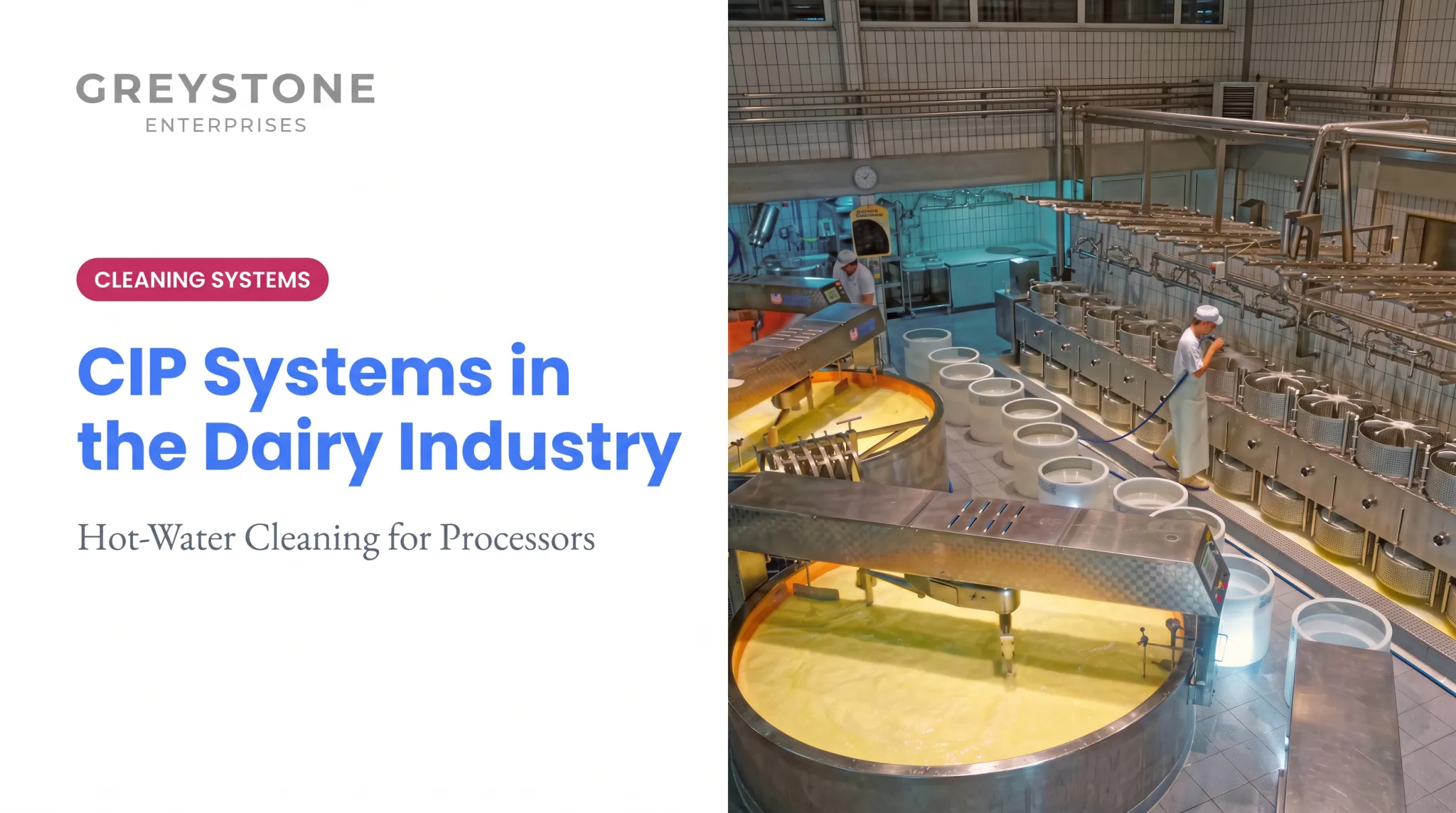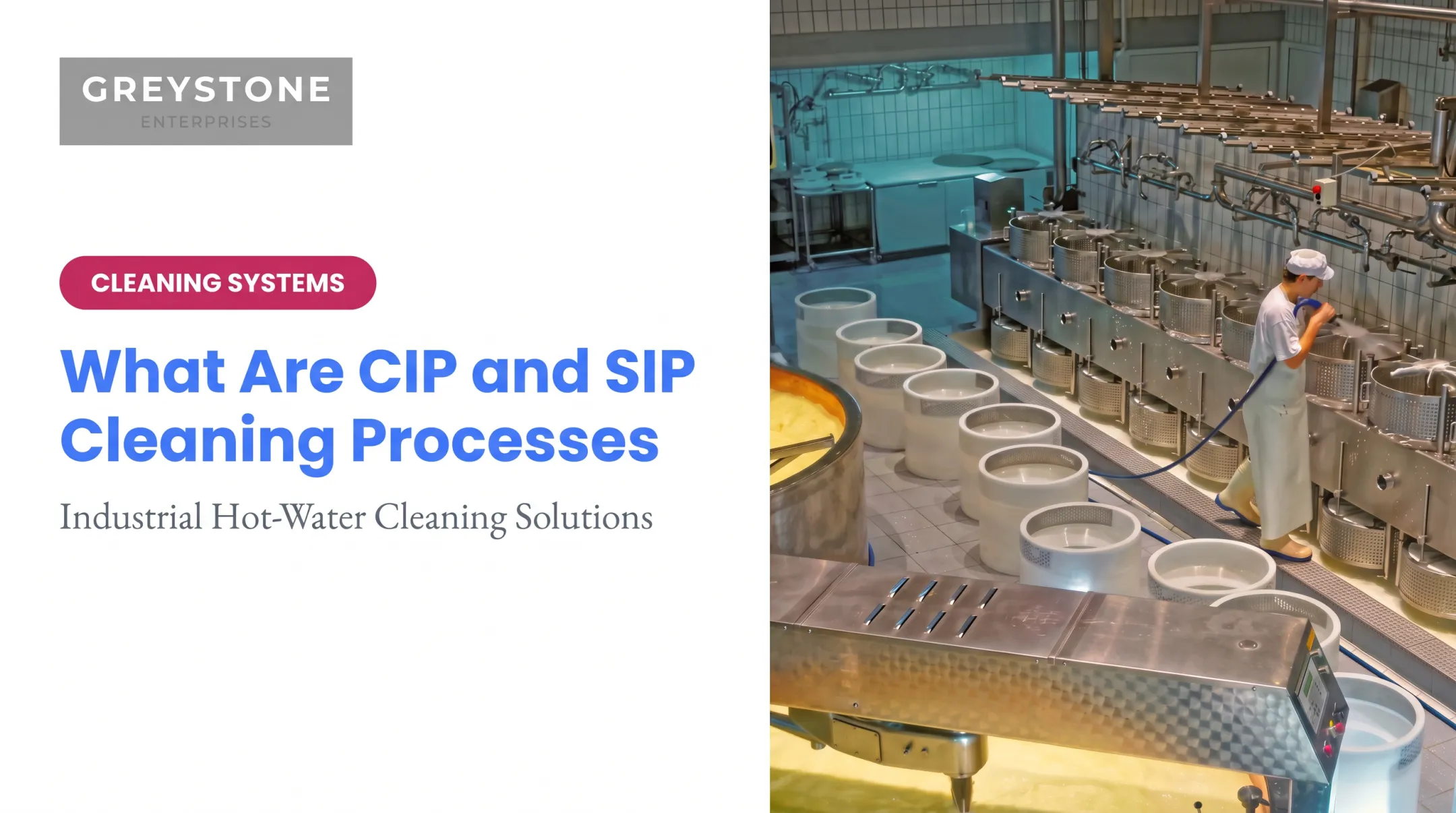

CIP touches product safety, hygiene, regulatory readiness, equipment reliability, and production continuity. Yet it's often misunderstood on the plant floor. A cycle that finishes on the HMI doesn't prove a surface is clean.
Below, we cover the cycle step by step, the variables that drive results, how to verify performance, where CIP falls short, and what to use instead.
Key Takeaways
- CIP cleans tanks, pipelines, and heat exchangers without routine disassembly.
- A typical cycle runs pre-rinse, alkaline wash, optional acid wash, final rinse, and sanitizing.
- Time, temperature, chemistry, and mechanical action must work together.
- Inspection, validation, records, COP, and manual cleaning still remain essential.
What Is CIP Cleaning?
CIP stands for "clean-in-place." 3-A Sanitary Standards defines it as removing soil from product-contact surfaces in process position by circulating, spraying, or flowing chemical solutions and water rinses.
The goal is simple: remove dairy residue and reduce microbiological risk so equipment can return to production safely.
CIP vs. COP vs. manual cleaning
- CIP: equipment stays assembled; solutions are pumped or sprayed through it.
- COP (clean-out-of-place): parts are removed and cleaned in a wash tank or cabinet with circulating detergent, heat, and agitation.
- Manual cleaning: disassembled parts are cleaned with brushes, nonmetallic pads, scrapers, and hoses.
Most dairy plants use all three. Parts not designed for CIP, such as removable gaskets and access-port components, go to COP or manual cleaning.
Why CIP Cleaning Is Used and Where It Is Applied in Dairy Plants
Why CIP is used
Food-contact surfaces must be cleaned as often as needed to prevent contamination under FDA's sanitation rules (21 CFR 117.35). The 2025 Grade A Pasteurized Milk Ordinance (PMO) adds that product-contact surfaces are cleaned and sanitized before each use, and equipment is cleaned at least once each day used.
Automated, repeatable cleaning brings practical gains when properly designed and validated:
- Consistent results from batch to batch
- Less operator exposure to concentrated chemicals
- Reduced equipment disassembly between runs
- More predictable changeovers
The cost of poor cleaning is real. A 2022 FDA warning letter to Swan Brothers Dairy cited protein film on equipment after cleaning, hard-to-clean seams, and Listeria monocytogenes in environmental samples.
FDA did not tie the positives to a single CIP cycle, but the pattern is familiar: residue, harborage, and risk.
Other consequences include:
- Mineral scale and microbial growth
- Cross-contamination and corrosion
- Unplanned downtime and incomplete sanitation records
CIP is an industry best practice for compatible equipment. It isn't an automatic regulatory guarantee. Plants still need documented procedures, verification, and validation.
Where CIP is applied
- Milk and product pipelines
- Storage tanks, silos, and vessels
- Mixers, pumps, and valves
- Plate heat exchangers and pasteurizers
- Filling equipment and other enclosed circuits designed for CIP
CIP typically runs after a production run, at product changeover, after an extended hold or shutdown, or when inspection or environmental monitoring flags a problem.
Don't read the PMO as a blanket 24-hour CIP rule. Storage tanks have their own rule: clean when emptied, and empty at least every 72 hours. Frequency should also reflect product soil, equipment design, risk, and your documented sanitation program.

How CIP Cleaning Works (Conceptual Flow)
A CIP supply-and-return circuit moves water and solutions along a defined path. It applies heat, chemistry, and mechanical action, removes residue, rinses away chemistry, and readies the circuit for the next run.
System components and controls
A typical CIP unit includes:
- Circulation tanks for water and solutions
- Supply pumps and return lines
- Heaters or heat exchangers
- Valves that sequence the circuit
- Spray devices for tanks and vessels
- Sensors for flow, temperature, level, and conductivity
- Automation with data recording
Hardware only helps if every surface is reached. Spray coverage, adequate flow, drainability, correct valve sequencing, and separation of product and cleaning circuits decide whether each surface gets the intended treatment.
Step 1: Product recovery and pre-rinse
Where the system supports it, product recovery pushes out bulk milk first. The pre-rinse then removes remaining residue, wets surfaces, and loosens water-soluble soil.
Send heavily soiled rinse water to the proper drain or recovery path. Recirculating it just redistributes soil. A clean, steady pre-rinse also confirms the flow path is open.
Step 2: Alkaline or caustic wash
An alkaline cleaner breaks down, emulsifies, and suspends fats and proteins. There's no universal temperature or concentration. Use your validated recipe, which depends on soil load and the cleaning-compound maker's guidance.
For illustration, the Tetra Pak Dairy Processing Handbook gives an example for a pasteurizer circuit: alkaline detergent at 0.5 to 2% and about 75°C for roughly 30 minutes. A cold pipe and tank example uses 0.5 to 1.5% at 75°C for about 10 minutes. These are examples, not legal limits.
Whatever the recipe, verify temperature, concentration, contact time, and flow throughout the circuit with instruments or chemical testing.
Step 3: Intermediate rinse and optional acid wash
The intermediate rinse clears alkaline cleaner and loosened soil. Conductivity, pH, appearance, or other approved indicators show when it's done.
An acid wash is conditional. It addresses mineral deposits, milkstone, and scale. Check acid chemistry, temperature, and contact time against stainless steel, gaskets, and valve seats before using it. The handbook's hot-circuit example includes an acid step; its cold pipe example does not.
Step 4: Final rinse
The final rinse removes remaining detergent or acid. Evaluate water quality, carryover, and drainage before production resumes.
Step 5: Sanitizing
Sanitizing is separate from cleaning. It controls microbes; it doesn't remove heavy soil.
Choose sanitizers permitted under 21 CFR 178.1010 and follow the label. Some labels require a post-sanitize rinse and some don't. For example, the EPA label for Oxonia Active states no post-sanitizer rinse is needed for its labeled dairy use. Check your product's own label.

Key Factors, Common Issues, and When CIP May Not Be Appropriate
Key factors that affect CIP cleaning in dairy plants
Cleaning performance is often described by the Sinner circle: time, action, chemistry, and temperature. Change one and the others shift. More mechanical action, for instance, can allow less of another input. No single variable fixes a poor cycle.
Other inputs matter too:
- Soil type, load, and age (dried milk films and heat-treated deposits are harder to remove)
- Water hardness, since calcium salts promote limescale
- Surface material and product temperature
- Flow velocity (1.5 to 3.0 m/s in pipes is a common target)
Design and control
Sanitary design sets the ceiling for results. The 2025 PMO calls for piping free of dead ends, and CIP pipelines that are rigid, self-draining, uniformly sloped, and accessible for inspection.
Confirm these design and control basics as well:
- CIP-compatible valves and gaskets
- No shadowed surfaces
- Proper spray-device coverage
- Reliable flow, temperature, and conductivity monitoring with documented cycle records
Riboflavin testing can show spray coverage, but coverage alone doesn't prove cleaning.
Scale also matters. Circuit length, branch lines, throughput, solution reuse, and recovery practices all need facility-specific validation.
Safety and compliance
CIP programs still have to cover plant safety and regulatory duties:
- Hazard communication: labels, SDS, and training
- PPE hazard assessment
- Lockout/tagout where unexpected startup or stored energy could injure someone
- Confined-space evaluation for tanks
- Sanitizers and procedures that meet U.S. dairy sanitation requirements
Hot-water technology and chemistry
Greystone pairs HelioJET high-pressure hot-water and steam technology with Tri-Solve plant-based chemistries to build customized cleaning strategies. Any dairy CIP application still has to fit the facility's validated process, equipment, chemistry, and sanitation requirements.
Common issues and misconceptions
Four myths cause the most trouble:
- CIP automatically cleans every component
- Stronger chemistry or higher heat always works better
- Sanitizing removes heavy soil
- A completed cycle proves hygienic readiness
Visual inspection alone can miss failures, according to Cornell research. Use ATP testing, microbiological swabs, and recorded parameters together, since each answers a different question.

When warning signs appear, trace them to causes:
- Recurring residue: check chemistry, soil age, and spray coverage
- Unstable conductivity: check dosing, rinse completeness, and sensors
- Temperature loss: check heaters, valves, and circuit length
- Poor flow: check pumps, blockages, and nozzles
- Foaming or corrosion: check chemistry selection and compatibility
- Positive micro results: review the circuit, equipment condition, controls, and records
Extending the cycle rarely solves the root problem.
When CIP may not be appropriate
CIP doesn't fit every part of a plant. USDA rules (7 CFR 58.146) allow it only for equipment and pipelines designed, engineered, and installed for it. Equipment outside that design is disassembled after each day's use.
Poor candidates include:
- Components not designed for in-place cleaning
- Removable gaskets and access-port parts
- External surfaces
- Damaged equipment
- Areas that can't achieve reliable solution contact or drainage
For these, use COP, manual cleaning, targeted maintenance, equipment redesign, or a revised circuit. Don't default to CIP when design, soil, risk, or verification results don't support it.
Conclusion
Dairy CIP is a controlled, repeatable process that uses chemistry, heat, time, and mechanical action to clean and sanitize compatible equipment without routine disassembly.
It works when the fundamentals are in place:
- Sanitary design and appropriate chemistry
- Validated parameters and reliable controls
- Trained operators, verification, and clear records
Choose CIP, COP, manual cleaning, or a combination based on the equipment, the soil, the risk, and evidence that the process delivers the result you need.
Frequently Asked Questions
What does CIP stand for in the dairy industry?
CIP means "clean-in-place." It cleans internal dairy processing surfaces without routine disassembly.
What is the CIP cleaning process?
It's a controlled sequence of rinsing, chemical cleaning, rinsing, and sanitizing solutions circulated through compatible tanks, piping, and equipment.
What are the main steps in a dairy CIP cycle?
Pre-rinse, alkaline wash, intermediate rinse, optional acid wash, final rinse, and sanitizing. The validated sequence varies by facility and circuit.
How is CIP different from COP cleaning?
CIP cleans equipment in its process position. COP requires removing components and cleaning them in a tank, cabinet, or other separate system.
What factors determine whether a CIP cycle is effective?
Time, temperature, chemistry and concentration, mechanical action, water quality, soil type, equipment design, flow, spray coverage, and verification.
Can every dairy processing component be cleaned in place?
No. Non-CIPable valves, gaskets, access-port parts, external surfaces, and poorly designed or damaged components may need COP, manual cleaning, or modification.