
Facilities use it on grease, oils, product residue, deposits, and dirt that manual scrubbing handles slowly or not at all. Done well, it supports safety, uptime, sanitation, and resource goals. Done badly, it wastes water, damages equipment, and pushes soil around.
This guide covers what the process is, how it works, where plants use it, how it compares with other methods, and what to check before buying.
Key Takeaways
- Results depend on pressure, flow, temperature, nozzle, distance, dwell time, and chemistry working together.
- Water jet washing, pressure washing, steam cleaning, and waterjet cutting are different processes.
- Check surface compatibility, operator safety, wastewater handling, and the specific contaminant before choosing equipment.
What Is High-Pressure Water Jet Washing?
High-pressure water jet washing uses a pump and a specialized nozzle to turn water into a controlled stream. That stream loosens, shears, flushes, and carries contaminants off a surface or component.
How the Cleaning Happens
Several mechanisms work at once:
- Impact from the jet breaks up soil
- Shear force across the surface lifts it
- Water flow carries detached material away
- Heat and chemistry, when used, help with oils and residues
Terminology and Thresholds
Labels vary by industry. The Water Jet Technology Association (WJTA) defines high pressure water cleaning as using a pump capable of 5,000 psi (340 bar) or greater. Below that, it classifies the work as pressure washing.
ASTM E1575-18 uses "high-pressure water jetting" for a much lower threshold, above 100.5 psig. The two standards are not interchangeable.
Terms like "jet washing," "power washing," and "hydroblasting" carry no fixed pressure class. Always ask for the actual pressure and flow.
Not the Same as Waterjet Cutting
Cleaning and cutting both use high-pressure water, but they do different jobs. Waterjet cutting, with or without abrasive, separates material. Cleaning removes unwanted matter from a surface that should stay intact.
The Variables That Decide Results
- Pressure and flow rate
- Water temperature
- Nozzle orifice and spray pattern
- Distance and angle from the surface
- Dwell time
- Cleaning chemistry
No single setting guarantees a result. A 2019 study on stand-off distance found cleaning response varied with soil type and cleaning time.
How Does High-Pressure Water Jet Washing Work?
The Typical Process
- Assess the job. Identify the soil, the surface, and the hazards.
- Isolate the equipment. Lock out energy sources where required.
- Set up the system. Match pressure, flow, nozzle, and chemistry to the soil.
- Wash in a controlled way. Work methodically so loosened soil does not get redistributed.
- Rinse and inspect. Confirm the surface is clean and chemical residue is gone.
- Capture and dispose of wastewater. Contain, treat, or reuse it as required.
Main Equipment Components
- Pump and drive, or a steam-and-water hot-water generator
- Water supply and optional heater
- High-pressure hose, lance or spray gun, and valves
- Nozzles or automated heads
- Chemical-injection equipment
- Filtration or recovery equipment
- Fixed piping and drops in central installations
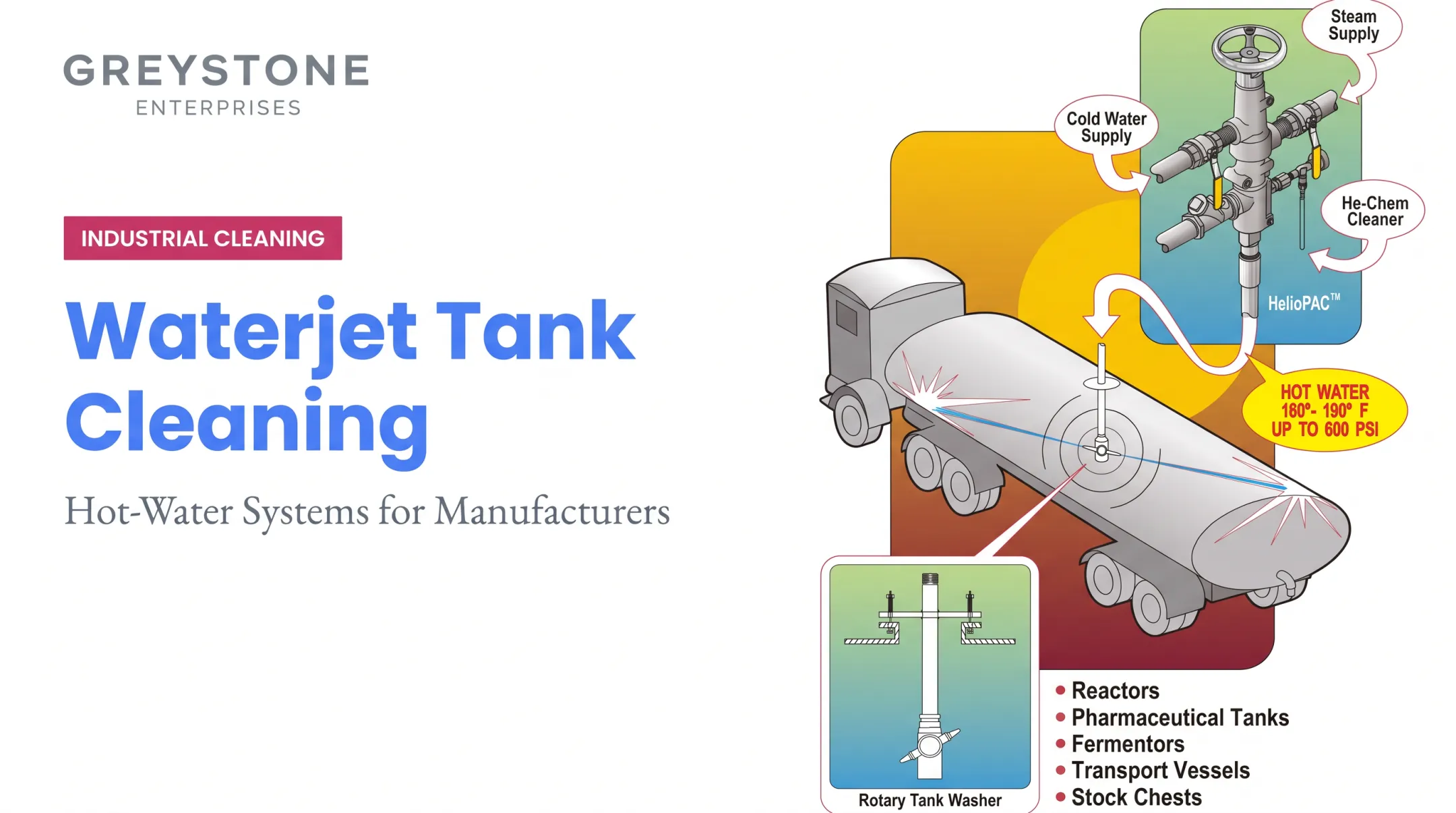
HelioJET systems from Greystone generate pressure without a conventional high-pressure pump. The patented HelioPAC combines existing plant steam and cold water with no moving parts. With 125 psi steam and 60 psi cold water, it can deliver 300 psi water at 185°F.
Balancing Pressure and Flow
Pressure helps break the bond between soil and surface. Flow moves the loosened material away. Hydraulic horsepower equals pressure (psi) times flow (gpm) divided by 1,714, so both inputs matter. A high-pressure, low-flow jet can loosen soil without clearing it.
Heat and Chemistry
Beyond pressure and flow, hot water helps with oils and grease, and compatible chemistry targets specific soils. More is not always better. Valmet's white paper on dryer fabrics notes that hot water reduces thermal shock to dryer cans. Poor chemical rinsing can leave concentrated residues that damage fabric.
Nozzle, Distance, and Movement
Nozzle choice and spray angle control coverage, intensity, and overspray. Closer distance and slower movement raise cleaning intensity and damage risk. As one example, HelioJET Fast Clean nozzles use a 60° pattern and are normally installed 6 to 8 inches from the surface. Never swap in arbitrary nozzle sizes: oversized ones drop pressure, and undersized ones cause overflow.

Where Is It Used in Industrial Facilities?
Water jet washing fits some jobs well. It is not a universal fix, so match the method to the contaminant, surface, hygiene requirement, and access challenge.
Plant-Wide Washdown and Sanitation
Multi-line plants can pipe a central hot-water system to several drops. Crews wash equipment and surfaces on demand instead of moving portable units around. A HelioJET Central Cleaning System, for instance, supplies hot water to multiple stations at once.
Tanks, Vessels, Totes, and Mixers
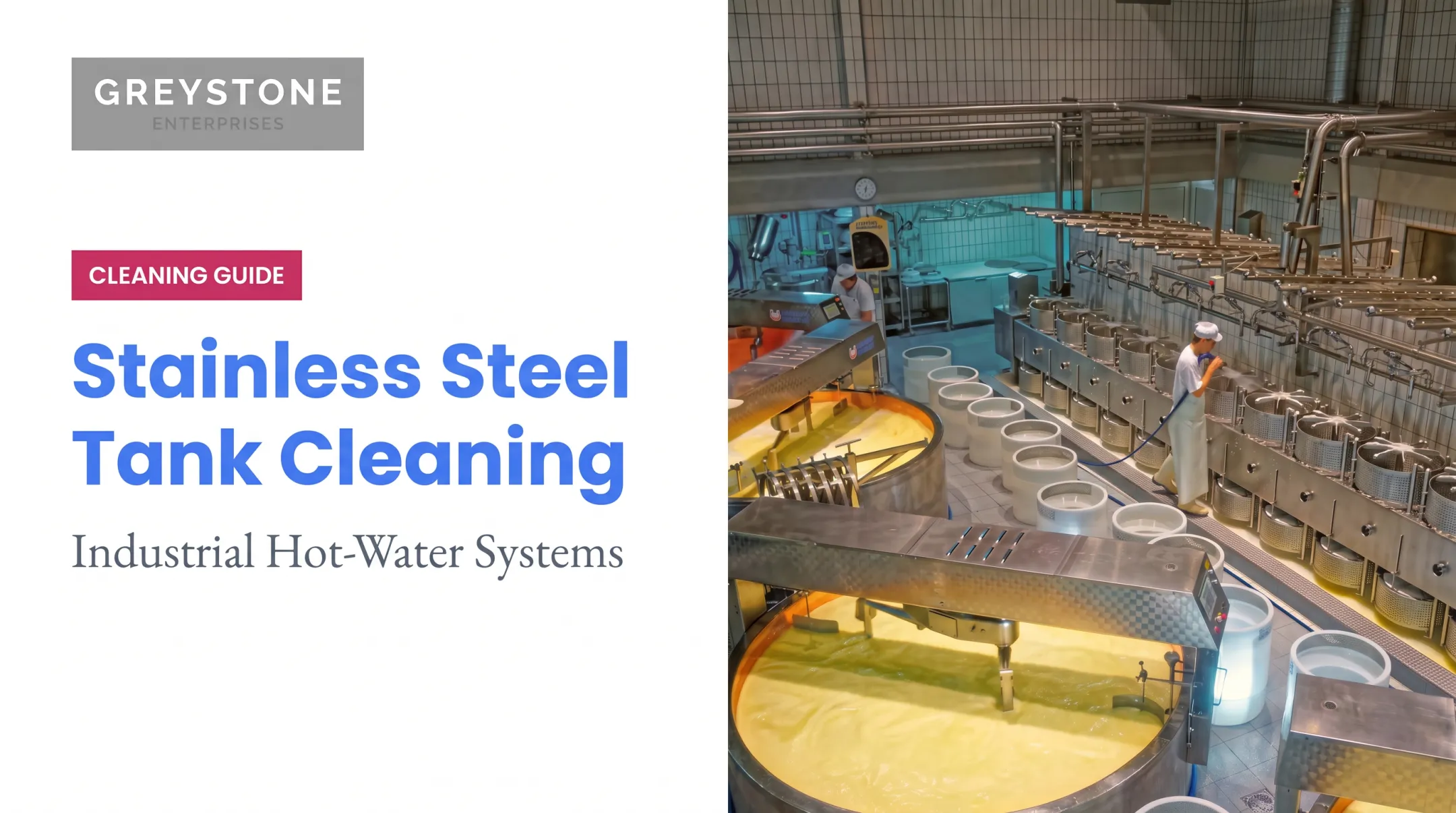
Food, chemical, coatings, adhesives, and liquid-product makers must clean interiors between batches. Interior geometry, residue type, and sanitation procedure drive the design. HelioJET's interior tank-washing system sprays 300 psi, 185°F water against tank walls for scouring action, paired with matched chemistries.
Fleet and Heavy-Equipment Wash Bays
Hot high-pressure water and compatible chemistry remove grease, road film, mud, and embedded soil from trucks, trailers, and shop equipment. EPA's vehicle washing guidance recommends containing, treating, or reusing the wash water.
Paper Mills and Continuous Processes
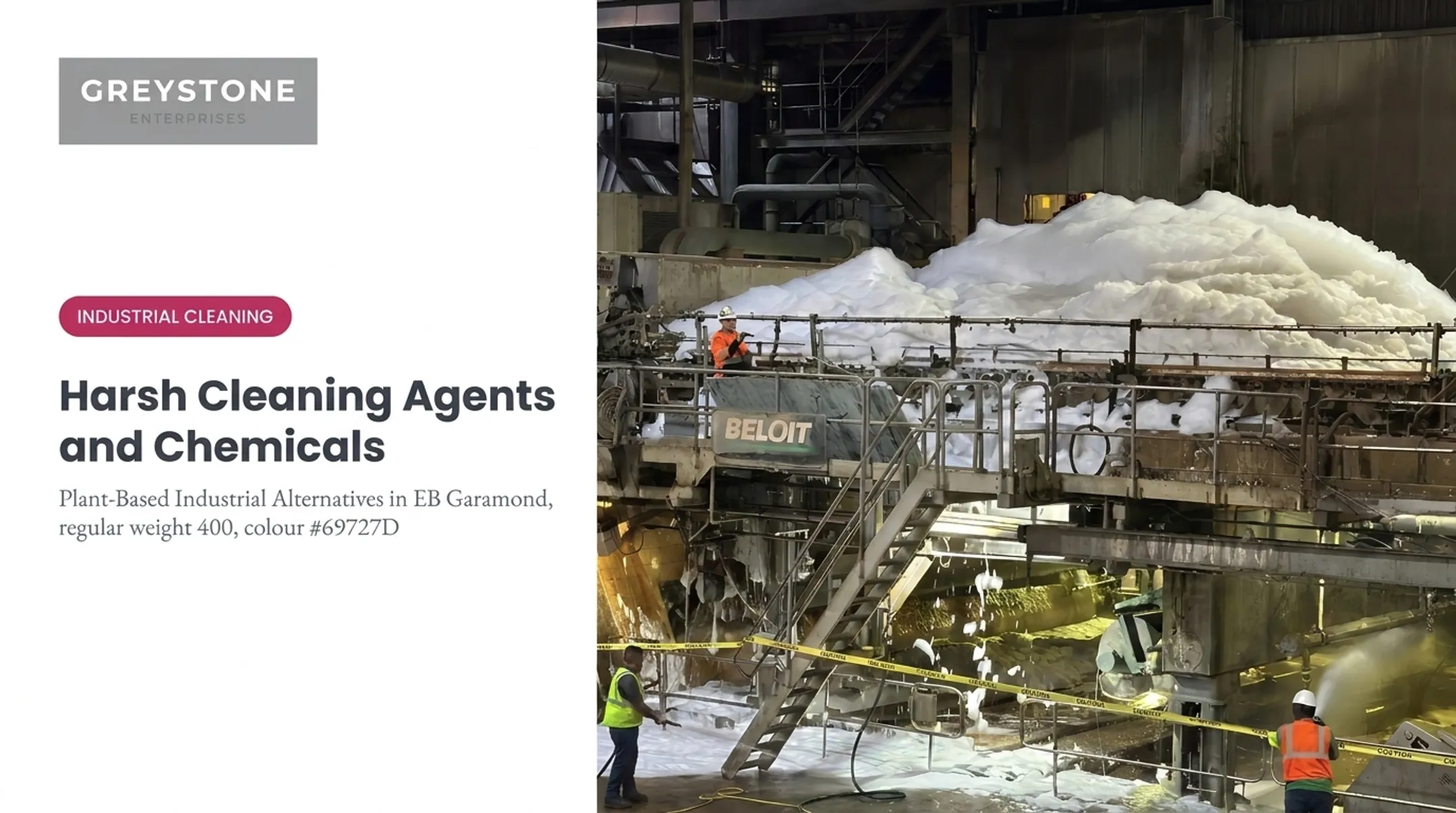
Mills clean wires, press felts, and dryer fabrics, often continuously. High-pressure showers do part of the job. Specialized chemistry and machine-specific deposit-control programs do the rest. Evaluate showers, chemistry, and deposit-control programs as separate pieces of the solution.
Other Settings
- Food and pharmaceutical plants: FDA rules require cleaned and sanitized equipment but do not mandate water jetting.
- Agriculture: USDA lists hot-water washing and pressurized steam as sanitation options for animal facilities.
- Energy and transportation: Site-specific fit depends on soils, access, and wash-water handling rules.
What Are the Benefits and Trade-Offs of High-Pressure Water Jet Washing?
Operational Benefits
When the system fits the job, benefits include:
- Less manual scrubbing
- Better access to difficult surfaces
- Repeatable cleaning procedures
- Fewer production interruptions
A HelioJET case study shows what fitted results can look like. A HelioPAC 1500 delivered 5 gpm at 165 psi and 175°F to remove baking residue from a conveyor belt. Cleaning time fell 41%, and water use dropped from 12 gpm to 5 gpm. That is one application, not a guarantee.
A 2024 dairy-tank study of adaptive jet cleaning reported 32% shorter cleaning time and four of five manual steps eliminated. The study did not report pressure class, so use it as supporting context rather than direct high-pressure proof.

Resource Benefits Depend on Management
Water, energy, and chemistry savings depend on how you run the system:
- Flow control
- Heating demand
- Recovery systems
- Maintenance quality
- Operator habits
EPA's WaterSense program notes commercial pressure washers typically flow 3.0 gpm or less at high pressure, while wash-down sprayers often run about 7 gpm. Those are benchmarks, not specifications for every industrial system.
The Trade-Offs
- Significant water consumption if flow is uncontrolled
- Contaminated wastewater that needs containment and treatment
- Aerosols and moisture, a concern in low-moisture food plants
- Energy demand for heating
- Surface or component damage from the wrong settings, nozzle, chemistry, or technique
How Does It Compare With Other Cleaning Methods?
Versus Conventional Pressure or Power Washing
"Pressure washing," "power washing," and industrial high-pressure water jet washing get used inconsistently. In practice, industrial systems differ in:
- Scale and duty cycle
- Pressure and flow control
- Temperature options
- System integration
- Process and sanitation requirements
Ask for the actual pressure, flow, and temperature rather than relying on the label.
Hot Water Versus Steam
Hot water cleans through volume and mechanical action. Steam works mainly through heat. USDA APHIS lists hot-water washing at 180°F or higher and pressurized live steam at 225°F or higher as separate sanitation options for animal facilities.

A facility may choose steam where water volume cannot be tolerated, such as when cleaning motors and castings. HelioJET's Steam Gun Station is built for that need. Choose by task: cleaning, sanitizing, deicing, or specialized residue removal.
Versus Other Methods
| Method | Best fit | Watch for |
|---|---|---|
| Manual cleaning | Small or delicate areas | Labor time, inconsistency |
| Chemical soaking | Parts that can be immersed | Chemical handling, rinse volume |
| Ultrasonic cleaning | Small, intricate parts | Part size limits |
| Abrasive blasting | Coating or rust removal | Surface removal, containment |
| Waterjet cutting | Cutting material | Not a cleaning method |
No reliable head-to-head benchmarks exist across these methods. Base the choice on:
- Part geometry and access
- Contaminant type
- Required cleanliness standard
- Part sensitivity
- Containment needs
What Should Facilities Consider Before Using It?
Safety
Hazards include:
- High-pressure injection injuries (small entry wound, extensive internal damage; treat as surgical emergencies)
- Hose recoil and flying debris
- Slips, falls, and noise
- Hot surfaces and chemical exposure
- Electrical risks and confined spaces
Follow manufacturer instructions, site procedures, and the relevant OSHA standards: PPE (29 CFR 1910.132), hearing conservation (85 dBA 8-hour action level), lockout/tagout (1910.147), and permit-required confined spaces (1910.146).
WJTA guidance adds trained operators, barricaded work areas, and attention to hose layout.
Environmental and Compliance Planning
Wash water carries soils, oils, and chemicals. Plan for containment, filtration, recovery, storage, and documentation.
Discharge to waters of the United States generally needs NPDES authorization. Sanitary-sewer discharge follows local pretreatment limits, so never assume the sewer will accept it. Check federal, state, and local rules.
Selection Checklist
- Contaminant and surface material
- Equipment geometry and access
- Required cleanliness level
- Water, steam, and power availability
- Heating needs
- Flow and pressure control
- Fixed versus portable installation
- Automation and operator ergonomics
- Maintenance and total lifecycle cost
One Integrated Example
Greystone pairs HelioJET high-pressure hot-water and steam technology with Tri-Solve plant-based chemistries for difficult industrial cleaning. Configurations include single-user wash stations, central systems, interior tank washing, and steam-gun stations. No single configuration suits every application, so the approach starts with the facility's soil, surfaces, and utilities.
Frequently Asked Questions
How expensive is a waterjet?
Cost depends on cleaning versus cutting use, plus pressure, flow, heating, automation, installation, wastewater controls, and maintenance. Request quotes matched to your specific requirements.
What is water jet cleaning?
It is the use of pressurized water, sometimes with heat or compatible chemistry, to loosen and remove contaminants from equipment, components, or surfaces.
Are wet jet pressure washers any good?
They can be very effective when pressure, flow, temperature, nozzle, and chemistry match the soil and surface. Suitability depends on the application, not the equipment label.
What is the difference between high-pressure water jet washing and pressure washing?
By WJTA's definition, high-pressure cleaning uses pumps capable of 5,000 psi or more, while pressure washing falls below that. In practice, "water jet" usually implies industrial, controlled systems and "pressure washing" a broader or residential context.
Is high-pressure water jet washing safe for industrial equipment?
It can be, once seals, electrical components, materials, pressure, temperature, nozzle, and chemistry are evaluated. Test first and follow manufacturer and site safety requirements.