
Introduction
Milk leaves a mess behind. Proteins denature on hot surfaces, fats cling to walls, sugars caramelize, and mineral salts build scale in tanks, pipelines, and heat exchangers. Left alone, those deposits shelter bacteria. A 2023 review notes that routine CIP is not always completely efficient against biofilms.
Clean-in-place (CIP) circulates water and cleaning solutions through installed equipment without routine disassembly. Cleaning removes soil. Sanitizing is a separate step that treats already-cleaned surfaces to reduce microorganisms.
This article covers how dairy CIP works, the typical cycle, equipment and design requirements, benefits, limits, and ways to optimize performance.
Key Takeaways
- CIP relies on flow, chemistry, temperature, and contact time working together.
- A common cycle runs pre-rinse, alkaline wash, rinse, acid wash if needed, final rinse, sanitize.
- No single recipe fits every plant; validate settings for your soils and equipment.
- Sanitary design, instrumentation, and verification matter as much as chemistry.
What Is a CIP System in the Dairy Industry and How Does It Work?
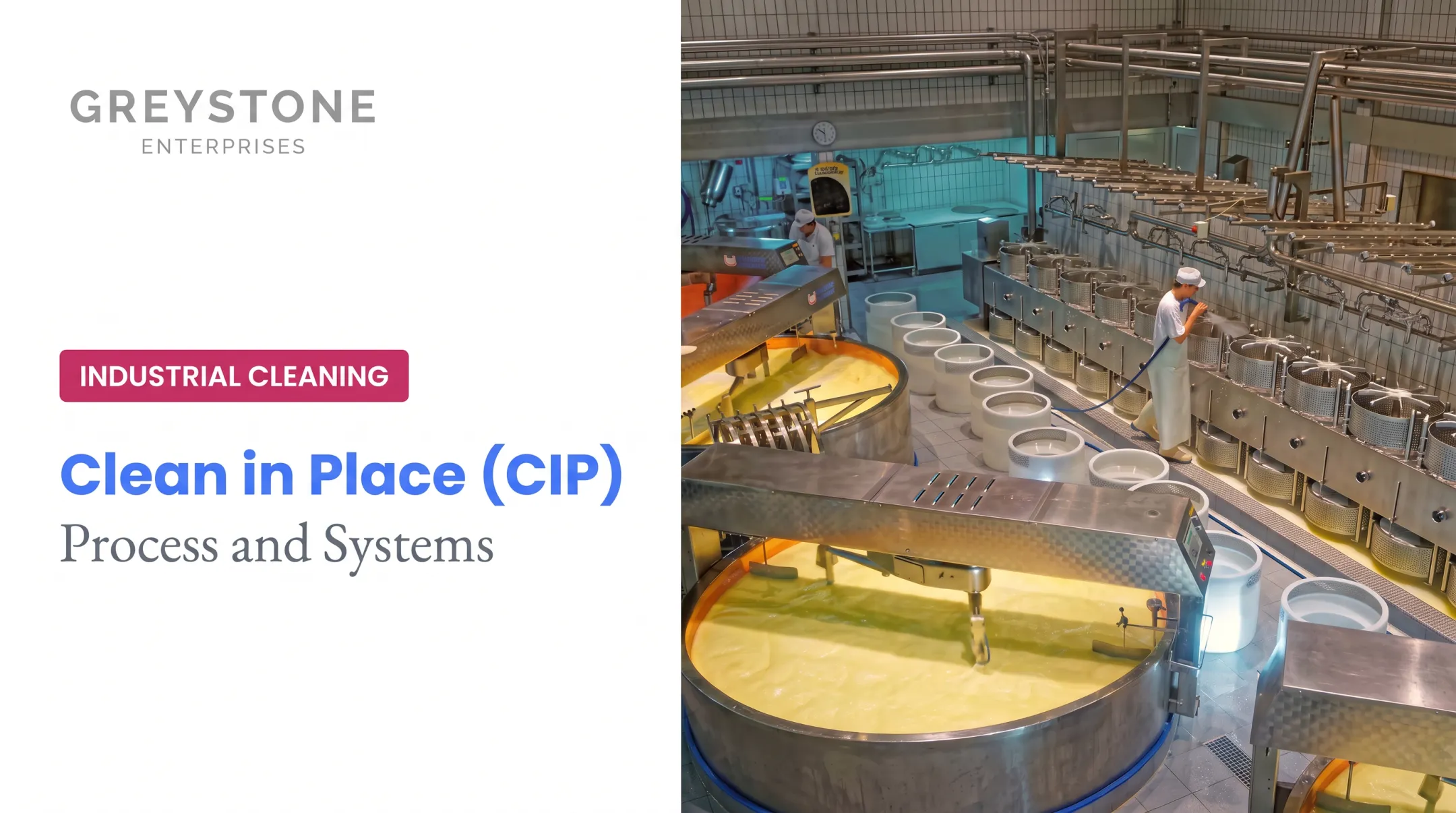
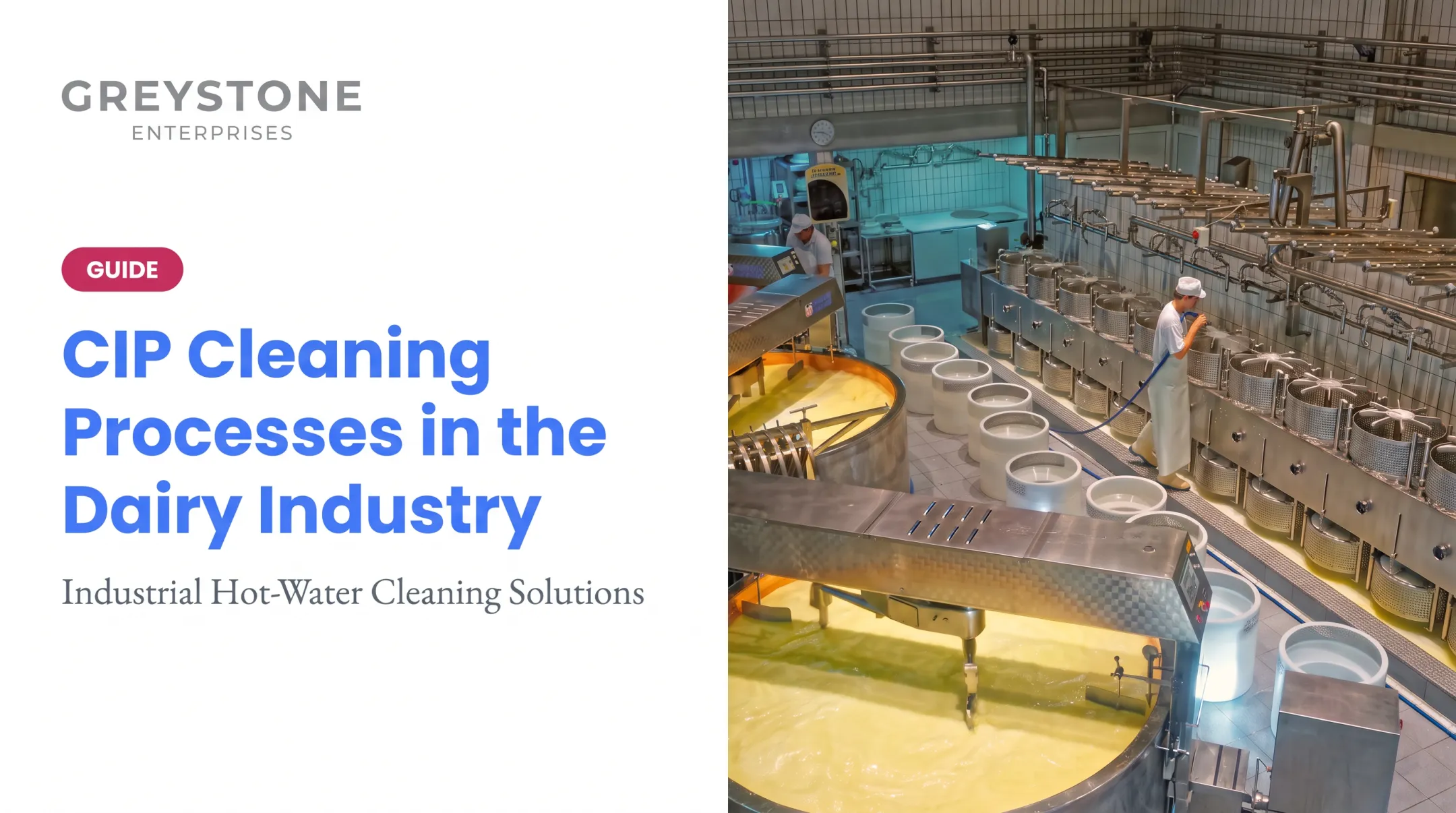
CIP cleans tanks, piping, vessels, heat exchangers, and fillers while they stay in their process position. Dairy plants avoid opening large circuits, get more repeatable results, and limit operator contact with hot water and chemicals.
The four cleaning factors
Effective CIP controls four variables:
- Chemical action
- Temperature
- Mechanical action
- Time
Mechanical action comes from turbulent flow in pipes, spray devices in tanks, and solution impingement. Tetra Pak cites 1.5-3.0 m/s (about 5-10 ft/s) as an example pipe velocity for scouring, though that is one source's guidance, not a universal minimum.
Raising one factor won't rescue a weak one. Extra caustic or time cannot fix a spray device that never wets part of the tank.
Supply, return, and controls
The system prepares or stores solution, heats it if needed, pumps it through a defined circuit, and returns it for monitoring, recovery, or drain. Sensors track temperature, flow, pressure, level, and conductivity. Conductivity, for example, can send return liquid to drain instead of back to the detergent tank.
Good control data flags a failed or incomplete step, such as low flow or a missed temperature, before the line goes back into production.
When CIP runs, and how it differs from COP
Typical triggers include:
- Scheduled sanitation
- Product changeovers
- Contamination concerns
- End of a production campaign
Frequency follows your validated procedures.
Clean-out-of-place (COP) means removing parts for cleaning elsewhere. Gaskets, valves, hoses, spray devices, and access ports often still need COP or manual brushing.
What Are the Steps in a Dairy CIP Process?
The sequence below is a framework, not a universal recipe. Heated circuits (pasteurizers, UHT) differ from cold circuits, and some stages are optional.
- Prepare the circuit. Stop production, isolate the circuit, recover or drain product, confirm valve alignment, and verify the flow path.
- Pre-rinse. Remove loose soil promptly so proteins and fats don't dry on. Rinse until return water runs clear; leftover soil raises detergent use. Decide whether rinse-water recovery fits your validated program.
- Alkaline wash. Caustic breaks down fats and proteins. Concentration, temperature, flow, contact time, and recirculation all matter.
- Intermediate rinse. Rinsing before an acid stage prevents neutralization and carryover.
- Acid wash, when needed. It dissolves mineral scale and heat-related deposits.
- Final rinse and sanitize. The rinse removes cleaning residues. A chemical or thermal sanitizing step follows.
- Drain, inspect, verify. Remove air or water as applicable and complete pre-operational checks before production resumes.
Source-specific examples
Tetra Pak's heated-circuit example uses a roughly 10-minute warm rinse, 0.5–2% alkaline detergent for about 30 minutes at 75°C (167°F), a short rinse, then 0.5–1.5% acid for about 20 minutes at 70°C (158°F). Its cold-component example ends with hot-water disinfection at 90–95°C (194–203°F) for 5 minutes. Treat these as illustrations only.

Sanitizer concentration, contact time, compatibility, and any post-sanitize rinse must follow your validated procedure and the manufacturer's label.
What Equipment and Design Features Does a Dairy CIP System Need?
A dairy CIP system needs the right station hardware, circuit design, instrumentation, and sanitary construction so process equipment can be cleaned in place without teardown.
Core components
A CIP station stores, monitors, and distributes cleaning fluids. Typical parts:
- Solution or recovery tanks
- Pumps, heat exchangers, and other heating equipment
- Supply and return piping and valves
- Spray balls or rotary spray devices
- Chemical dosing equipment
- Control hardware
Circuit and configuration choices
Those components only work if circuits are sized correctly. Dairy plants divide equipment into circuits cleaned at different times, so pumps, tanks, heating capacity, and return paths must match the equipment on each circuit. Some units serve many circuits; one manufacturer rates a unit for up to 32 connections, but that is a product spec, not a design rule.
Single-use systems discard solution after one pass, though it may serve as a later pre-rinse. Reuse systems recover detergent, top it up, and run it until too dirty. Reuse saves chemical and water but adds complexity, waste handling, and cross-contamination risk.
Instrumentation
Monitor these parameters with alarms and records:
- Temperature, flow, and pressure
- Conductivity and chemical concentration
- Tank level and rinse quality
Tie every reading to an acceptance limit and a corrective action. Otherwise it is just paperwork.
Sanitary design
- Fully drainable equipment with appropriate slopes
- Smooth, hygienic joints and connections
- Accessible surfaces and spray coverage
- No dead legs
- Materials and elastomers compatible with your chemicals (chlorine can attack stainless steel and damage elastomers)
Design choices should track recognized dairy standards. Relevant references include the 2025 Grade "A" Pasteurized Milk Ordinance and 3-A Accepted Practice 605-05 on installation and CIP of processing equipment and hygienic pipelines. A listing establishes a title, not that your system complies; that needs documentation.
Before installation, review process flow diagrams, valve matrices, circuit boundaries, and spray coverage, and flag parts that still need COP or manual cleaning.
What Are the Benefits and Limitations of CIP in Dairy Plants?
Benefits
- Repeatable cleaning
- Less manual disassembly
- Less operator exposure to heat and chemicals
- More predictable sanitation downtime
- Better support for product quality
CIP also shapes energy and water demand. A Berkeley Lab report attributes 9.5% of fluid-milk, 26% of butter, and 19% of cheese processing energy to CIP. It estimates conductivity-based solution separation could save up to 10% of water. Those are estimates, not guaranteed plant results.
Water reuse can extend those gains. A 2016 dairy study recovered 47.03% of water from whey through UF/RO and found no significant cleaning difference versus potable water under its test conditions.

Limitations
CIP cannot make up for:
- Poor sanitary design or bad drainage
- Blocked spray devices or inadequate flow
- Wrong chemistry
- Failed instruments
- Dirty components outside the circuit
Plants therefore combine CIP, COP, manual cleaning, inspection, and microbiological or rapid hygiene verification.
How Can Dairy Plants Optimize and Validate CIP Performance?
Build a cleaning matrix
Link each product, circuit, changeover, and contamination risk to an approved cycle and an escalation procedure.
Monitor, then verify
Trend these process parameters:
- Time, temperature, flow, and pressure
- Conductivity, concentration, and rinse endpoints
- Cycle duration, deviations, and recovery time
That is process monitoring. It does not prove the surface is clean.
Verification confirms cleanliness with:
- Visual inspection
- ATP tests
- Microbiological swabs
- Chemical checks
- Periodic validation
ATP gives fast feedback but isn't organism-specific.
Troubleshoot causes, not cycle length
| Symptom | Possible causes |
|---|---|
| Persistent protein residue | Weak caustic, low temperature, poor flow, late pre-rinse |
| Mineral scale | Skipped or weak acid stage, hard water |
| Chemical carryover | Short rinse, bad conductivity endpoint, valve leakage |
| Incomplete spray coverage | Blocked or worn devices, low pressure |
| Low return flow | Pump issues, restrictions, air in the line |
| Excess water use | Rinse endpoints set too conservatively, no solution separation |
| Repeated alarms | Sensor drift, unrealistic limits, equipment faults |
Extending the cycle often hides the cause and burns water, energy, and time.
Outside support
Greystone is an industrial cleaning partner for facilities evaluating customized sanitation strategies. It pairs HelioJET high-pressure hot-water and steam technology with Tri-Solve plant-based chemistries, tailored to each facility's equipment and goals.
The goal is resource-conscious cleaning without unnecessary production delays. Greystone doesn't supply complete CIP skids, and any savings should be confirmed with project data.

Whatever route you take, bring sanitation, engineering, quality, maintenance, production, and chemical-technology people into the review together.
Frequently Asked Questions
How does a CIP system work in the dairy industry?
It circulates water and cleaning solutions through tanks, pipes, and vessels while controlling flow, temperature, chemical strength, and contact time. Sensors and valves keep each step repeatable.
What are the steps of the CIP process in the dairy industry?
Common steps are product recovery, pre-rinse, alkaline wash, intermediate rinse, optional acid wash, final rinse, and sanitizing. Validated programs vary by plant and circuit.
What is CIP in the dairy industry?
Clean-in-place cleans internal product-contact surfaces without routine disassembly. Some parts still need COP or manual cleaning.
What chemicals are used in a dairy CIP system?
Alkaline cleaners such as caustic soda handle fats and proteins, and acids such as nitric acid handle mineral scale. Approved sanitizers control microbes. Selection depends on soil, materials, water quality, and your validated procedure.
What is the difference between CIP and COP in dairy processing?
CIP cleans equipment in its installed position. COP removes components for cleaning in a separate tank, cabinet, or manual area. Most dairy plants use both.